Multi-currency wallets
Live balances in multiple currencies, credited through a double-entry ledger with idempotent processing.
AI-Built Revolut Clone
An AI-first build of every neobank mechanic: transaction-risk scoring that flags anomalies in real time, fraud signals on every card and transfer movement, and personalization that lifts engagement per customer segment. Four synced panels ship white-label with 100% source code, on a double-entry ledger. The almost-ready AI build goes live in 6 working days; a custom build takes 3 to 4 weeks.
Launch-ready from
$15,999
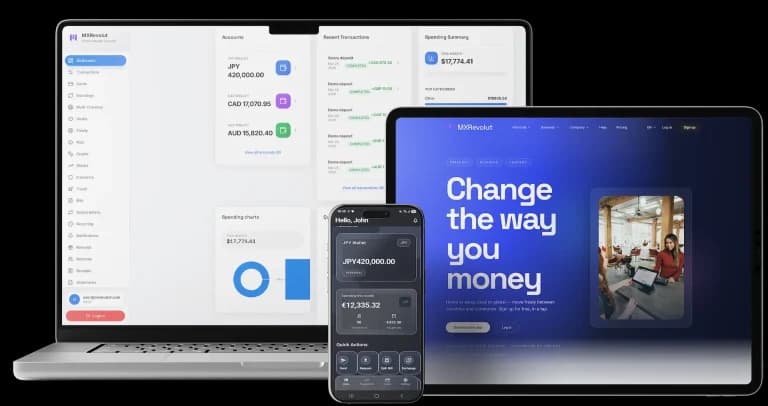
Synced panels
Almost-ready AI launch
Custom build
Source-code ownership
Trusted by the brands we build for



What a production-grade neobank clone buys you.
overview
A Revolut clone app is a neobanking platform: customers onboard through KYC, hold multi-currency wallet balances, spend with virtual and physical cards, and transfer P2P, all while your compliance team screens and monitors every movement. It ships as a customer app, a business account panel, a compliance console, and an admin panel over a double-entry ledger.
The purpose is launching a licensed or BaaS-partnered money business with your own brand, fee schedule, and interchange economics. Incumbent neobanks monetize their members' spending; an owned platform does the same for the population or segment you serve.
The engineering center of gravity is correctness and auditability: idempotent double-entry processing so balances never drift, tiered KYC gating features, and continuous sanctions and transaction screening with case management.
Neobanking continues to expand through BaaS partnerships in markets worldwide, and industry research repeatedly shows segment-focused banks outperforming general ones on engagement within their niche.
The summary layer above the panel detail below.
Live balances in multiple currencies, credited through a double-entry ledger with idempotent processing.
Document capture, selfie liveness checks, and sanctions and PEP screening through your KYC vendor.
Virtual cards activate instantly, physical cards ship, and customers set per-merchant limits and freezes.
Transfers, payment requests, bill splitting, and scheduled payments between wallets.
Goal-based vaults with spending analytics, without promises about returns.
Team cards, expense approvals, invoice links, and accounting exports under the same license.
Review queues, transaction monitoring rules, case management, and regulatory reporting exports.
Interchange assumptions, FX markups per pair, and plan pricing all set from your admin panel.
What these buyers share: a license or BaaS partnership, and a customer segment the incumbent banks treat as an afterthought.
Launch a branded neobank on the license you already hold, with risk scoring and compliance tooling engineered to your regulator's expectations.
Spin up a segment-focused digital bank without dragging core banking into the project. The ledger, cards, and wallets run on this platform.
Bring formal accounts, cards, and transfers to the customers you already serve, with tiered KYC matching your verification depth.
Add spend-side accounts to your transfer business so customers hold and spend balances, not just send them.
Enter markets where a focused neobank can out-serve a general incumbent, with the platform side delivered in weeks, not years.
$ moxace launch --nowIt means KYC gates every feature, every money movement writes an audit trail, and sanctions screening runs before, not after, onboarding. We architect for your regulators from the first schema.
Share your idea
a quick call, no deck required
See the live demo
every screen, admin to user
Launch with source
full code, your brand, your servers
Four surfaces, one ledger, no shortcuts on audit.
The everyday money app for your users.
For SME customers under the same license.
Where your compliance team lives.
Operations across customers, cards, and money.
Beyond customer administration: the operational systems that make the platform governable at scale.
Your banking partners are managed inventory, not hardcoded dependencies: provider health diagnostics, routing maps, per-provider commission settings, and demo/live/auto switching modes, so a partner outage is a routing change rather than a platform incident.
Account-issuance requests queue for review, approve into issuance, and track through lifecycle states. Every issued account reconciles against the provider's records, with identifiers you can trace end to end.
Sensitive actions record with reason categories and exportable history, and role-based access separates USER, BUSINESS, SUPPORT, ANALYTICS, INFRASTRUCTURE, and ADMIN scopes, so accountability survives personnel and vendor changes.
Transaction volumes, plan mix, FX line, and interchange line report into operational dashboards, so the unit economics your model depends on are visible daily, not reconstructed quarterly.
The customer journey a compliance-first money app runs for every user.
A customer registers by phone, and the account exists in a pending state until verification completes.
Document capture and a selfie liveness check run through your KYC vendor, with sanctions and PEP screening before approval.
The approved customer tops up the multi-currency wallet by bank or card, and each balance credits through the double-entry ledger.
A virtual card activates immediately and a physical card ships; the customer sets per-merchant limits and freeze controls.
Card spend clears through the issuing program, P2P transfers and payment requests move between wallets, and every movement writes its audit trail.
The customer moves funds into savings vaults, watches spending analytics, and your compliance console monitors the transaction stream for anomalies.
Five model-driven systems working the same money stream. Each ships pre-tuned for neobanking and sharpens as your data compounds.
Scores every card and transfer movement in real time so suspicious activity blocks before it settles, not after.
Merchant categories, velocity, device signals, amount patterns
Fraud caught at authorization instead of discovered in chargebacks
Learns normal behavior per customer segment and surfaces structuring and layering patterns into case management.
Transaction history, corridor patterns, peer-group behavior
Fewer false positives for your compliance team to clear
Builds affordability signals from wallet and spending history for the lending lines you may add later.
Inflow stability, balance curves, repayment markers
Lending products launch on evidence instead of guesswork
Ranks the insights, vault nudges, and plan upgrades each customer actually responds to.
Spending categories, feature usage, tenure
Higher card activity and plan upgrades per customer
Pre-screens KYC document quality so clean applications auto-approve and only genuine edge cases reach the human queue.
Document images, extraction confidence, submission patterns
Faster onboarding with a review queue your team can clear
The modules that turn a wallet app into a full banking product, each toggleable and configurable per market.
Crypto, stocks, and commodities views, portfolio tracking, recurring investments, and tax-reporting surfaces, wired to the brokerage and custody partners your license model permits.
Freeze and unfreeze at transaction level, dispute creation and confirmation workflows, and a dispute lifecycle that moves cleanly from the customer app through your admin and compliance teams.
A notification center with read states, activity alerts, support tickets, chat-style help, and an in-app knowledge base, so service quality does not depend on email.
JWT sessions with refresh-token flows, optional MFA and TOTP, protected routes, and device-session management, built to fintech-grade expectations rather than app-store minimums.
platform concepts
The ledger is the first concept and the non-negotiable one. Double-entry accounting with idempotent transaction processing means every balance is the sum of posted entries, so retries, timeouts, and partial failures never drift a balance. KYC tiers gate features on top: limits, cards, and transfers enable as verification depth increases.
Screening is continuous, not a one-time gate. Sanctions and PEP checks run at onboarding and again on transaction patterns, with the rules engine flagging velocity and anomalies into case management, every case carrying its audit trail. Issuing economics complete the picture: card spend routes through your issuing partner at the interchange terms of your program, FX conversion applies your configured markup per currency pair, and the admin panel reports both, so the unit economics your license model depends on stay visible and auditable.
insight
The spend side of the opportunity is measured in trillions. Industry trackers put global digital payment value around $37 trillion for 2026, with payments revenue near $2.5 trillion and still compounding toward $3 trillion. Digital wallets already carry roughly 30% of global point-of-sale volume, and instant-payment schemes now run in over 100 jurisdictions, so the rails a neobank orchestrates keep getting cheaper and faster to sit on.
The cost side is just as instructive. The World Bank pegs the global average cost of sending a remittance at about 6.36%, and incumbent banks still charge multiples of what interchange economics require. That spread is the opening a segment-focused neobank exploits: take a customer group the incumbents price lazily, run a lean ledger-led cost base, and monetize with the revenue lines quantified below.
revenue model
Interchange on card spend is the core line, with your fee share set per issuing program. Subscription tiers enable higher limits, premium cards, and priority support. FX margin on multi-currency conversion, outbound and inbound transfer fees, and interest-earning vault spreads complete the mix.
Every revenue parameter sits in the admin panel: per-plan interchange assumptions, FX markups by currency pair, transfer fee schedules, and plan pricing. Nothing is promised about returns; the platform reports what it earns, and your compliance console keeps the activity auditable.
Four monetization lines, quantified against regulator-published data. Every rate is configurable in your admin panel; the figures here are modelling inputs, not projections of your platform's earnings.
| Criteria | Revenue line | How it is charged | Typical range | What sets the ceiling |
|---|---|---|---|---|
| FX spread | A markup over the interbank mid-market rate, taken at the moment of conversion | 0.2% to 1.0% on major pairs, wider on thin-liquidity currencies | Competition, not regulation. The World Bank's 6.36% average remittance cost means the incumbent benchmark you price against is generous | |
| Card interchange | Paid to you as the issuer out of every card purchase, routed through your BIN sponsor | EEA and UK: 0.2% debit, 0.3% consumer credit. US: 1.2% to 1.5% signature debit for small-issuer sponsors, about 0.45% for covered issuers | Statute. The EEA and UK figures are hard caps; the US split is the Durbin small-issuer exemption, which makes sponsor-bank size a commercial decision, not only a compliance one | |
| Tiered subscriptions | A fixed monthly fee per user, independent of transaction volume | $3 to $20 per user per month across consumer tiers | Attach rate multiplied by price. The only line that does not move with volume, which is what makes it the stabilizer in ARPU | |
| BaaS margins | Reselling your sponsor bank or EMI wholesale pricing at a markup, per account, per card, per transaction | Contract-specific, set by your BaaS agreement and volume tier | Your sponsor agreement. No public benchmark exists, so model this line from your quoted rate card and re-model it at every volume tier |
Standard inclusions on every engagement, almost-ready or custom. Nine things you never have to ask for.
The complete unencrypted codebase transfers to you, with documentation and deployment scripts.
Your logo, colors, and store accounts across every panel, plus branded customer communications.
App store and Play Console submissions handled end to end, with production monitoring switched on.
Gateway and issuing-program integrations configured for card funding, wallet top-ups, and payouts.
Transaction risk scoring, AML pattern detection, and engagement models arrive configured for neobanking, not as raw APIs.
Languages, currencies, and tax display configured for your markets during the launch window.
Containerized services on AWS or Azure with autoscaling and queue-backed intake for peak traffic.
Operational dashboards, finance reconciliation views, and CSV exports so your team starts informed on day one.
Included support window plus product updates covering bug fixes, OS compatibility, and version upgrades.
Ledger correctness and partner reliability above all.
Double-entry PostgreSQL ledger with idempotent transaction processing, so balances survive retries, timeouts, and partial failures without drift.
Integrations with card issuing platforms and KYC vendors (document and biometric verification, sanctions and PEP screening), architected so partners are swappable per market.
React Native apps, Next.js web, Node.js and Go services behind Kafka event streams, with hardware-key-protected access to every production surface.
PCI-DSS-scoped payment flows, encrypted data at rest and in transit, role-based access with full audit trails, and secrets management reviewed in every release.
Issuing platforms, KYC vendors, accounting exports, notification providers, and analytics platforms ship as configured integrations, so the platform plugs into the partners your program already runs on.
Role-based access, append-only audit logs, encrypted traffic and secrets, and rate-limited endpoints come standard, so regulator and partner-bank due diligence has answers before it is asked.
The almost-ready AI build, day by day. Store review times can add a short buffer outside our control.
Licensing posture, issuing program, and target segments locked with a written scope, and your identity applied across all four panels.
KYC vendor, issuing platform, payment rails, and fee structures configured and tested against your live partner accounts.
KYC, wallet, card, and transfer flows piloted end to end, including monitoring rules and a full compliance-desk walkthrough.
App store submissions with review buffers accounted for, production monitoring on, and full launch with post-launch support and product updates included.
Both tracks ship the same ledger core. The difference is time, price structure, and how much you want to change.
| Criteria | Almost-Ready AI Launch | Custom Build |
|---|---|---|
| Time to live | 6 working days from branding handoff | 3 to 4 weeks, scoped before work starts |
| Pricing | Fixed written quote after a short scoping call, no hourly meter | Estimated per module after the discovery call |
| Source code and IP | 100% ownership on delivery | 100% ownership on delivery |
| AI layer | Dispatch, forecasting, and personalization pre-tuned for the vertical | AI services designed around your workflows and data |
| Partner architecture | Proven issuing and KYC partner adapters configured in the build window | Custom partner integrations and product surfaces built to your program |
| Best for | Operators who want to launch this quarter | Teams with bespoke workflows or a unique model |
| After launch | Post-launch support and product updates included | Post-launch support and product updates included |
$ moxace launch --nowBook a walkthrough and we will demo KYC, the card flows, and the compliance console on a live build, then send the written scope.
Share your idea
a quick call, no deck required
See the live demo
every screen, admin to user
Launch with source
full code, your brand, your servers
No two launches price the same. These are the factors that shape the written quote you receive after scoping.
The almost-ready AI build covers the proven feature set. Bespoke product surfaces, lending modules, or unique program rules add scoped estimate work.
Currencies, languages, and jurisdiction rules are configured per market. Adding markets means more configuration, never a rebuild.
Issuing platforms, KYC vendors, and banking partners are wired during the build, and each integration is estimated individually.
Out of the box, risk scoring, AML pattern detection, and engagement models are pre-tuned for neobanking. Training models on your historical transaction data is an optional, separately scoped workstream.
The core build is complete on its own. These modules add differentiation, stricter-market readiness, or new revenue lines, from day one or as you scale.
Credit lines, installment products, and BNPL flows built on the credit-readiness signals the platform already computes, gated by your lending license or partner.
International payout flows, corridor-specific routing, and cross-currency transfers, connecting this platform to the remittance side of the practice.
Premium and single-use virtual cards, tighter controls, and custom card experiences for higher tiers and spend-management products.
Growth incentives, referral mechanics, and cashback logic configured against your interchange economics rather than as a loss-leader.
Stronger identity verification, deeper sanctions screening, and market-specific compliance workflows for regulated deployments.
Additional Banking-as-a-Service providers integrated per geography, licensing model, and routing strategy, beyond the adapters that ship in the build.
Jurisdiction-specific workflows, compliance steps, provider mappings, and feature availability, so one codebase serves multiple regulatory regimes.
Several branded fintech apps on one shared core, with separate branding, domains, and tenant isolation for agencies and multi-brand operators.
Ready-made speed with custom-build engineering discipline.
Double-entry accounting and idempotent processing are core product logic, not an afterthought bolted onto a wallet app.
A ready-made launch costs a fraction of a ground-up build, with a fixed written quote before work starts.
One hundred percent of the source code transfers to you. No per-user royalties, no black-box dependencies.
For cross-border corridors, see our Wise-style build, and our wider fintech app development practice.
Canonical deployments from our own portfolio. Metrics are reported from live platforms, not projections.
A high-concurrency platform our engineering system ships and operates at 99.9% uptime, the same reliability bar every money platform is held to.
A consumer transaction platform from the same engineering system, proving payment and matching cores hold under city-wide, real-time load.
A high-traffic consumer platform our team ships and operates, the standard every engagement is measured against.
A clone is software, not a financial license. Here is the boundary, stated plainly.
Multi-currency accounts and ledgers, transaction processing, card lifecycle screens, FX flows, KYC and AML workflows, screening hooks, audit logs, and role-based admin. Delivered as source code you own.
Holding client funds, issuing IBANs and card BINs, settling fiat, and reporting to a regulator. Those sit with your BaaS partner, EMI, or sponsor bank, or a licence your own entity holds. We build to that partner's APIs; we do not act as one.
The platform stores payment tokens, not primary account numbers, so cardholder data lives inside your processor's certified environment and your own assessment scope stays as narrow as the integration allows.
Encryption in transit and at rest, segregated admin roles, immutable audit logging, and environment separation are built in, so your certification audit starts from a compliant codebase. The certificate is issued to your operating entity, not to us.
EMI authorization and PSD2 in the UK and EU, state-by-state money transmitter licensing in the US, PA and PPI rules in India. Confirm your route with a licensed partner or financial-services counsel; we do not provide legal advice.
the process
Discovery maps your licensing model, issuing partner, and target corridors, and the quote is fixed in writing. Once you approve, you hand over your brand assets and we configure the platform: your identity across all four panels, your partners, fee structures, and jurisdiction rules. The almost-ready AI build goes live in 6 working days; a custom build takes 3 to 4 weeks, planned with you up front.
Post-launch you hold 60 days of included support and 12 months of updates, with trained operations staff. The first 90 days are operational proving: reconciling issuer and processor reports daily, calibrating transaction-monitoring thresholds against real false-positive rates, and walking your first KYC edge cases through the review queue. Money businesses earn trust through that discipline, and the platform is built to make it visible.
Open the web app, sign in with the printed demo credentials, or install the Android build — no signup, no sales call. What you see is what you launch.
$ moxace launch --nowBook a free consultation and get a written scope and quote.
Share your idea
a quick call, no deck required
See the live demo
every screen, admin to user
Launch with source
full code, your brand, your servers
Moxace is an independent software development company. We are not affiliated with, sponsored by, or endorsed by Revolut.
The phrase “Revolut clone” is used descriptively. It is how the software industry refers to building a platform with similar functionality, and how buyers search for one.
The design and codebase are built entirely by our in-house team. Nothing is taken from the Revolut website, applications, or brand assets.
Revolut and all third-party names and marks remain the property of their respective owners, referenced here only to describe the category of software we build.
Read the full legal notice on our disclaimer page.