Shared city dispatch
One assignment engine serves every brand in a city, enabling shared rider pools, the cost advantage group operators are built on.
AI-Built Delivery Hero Clone
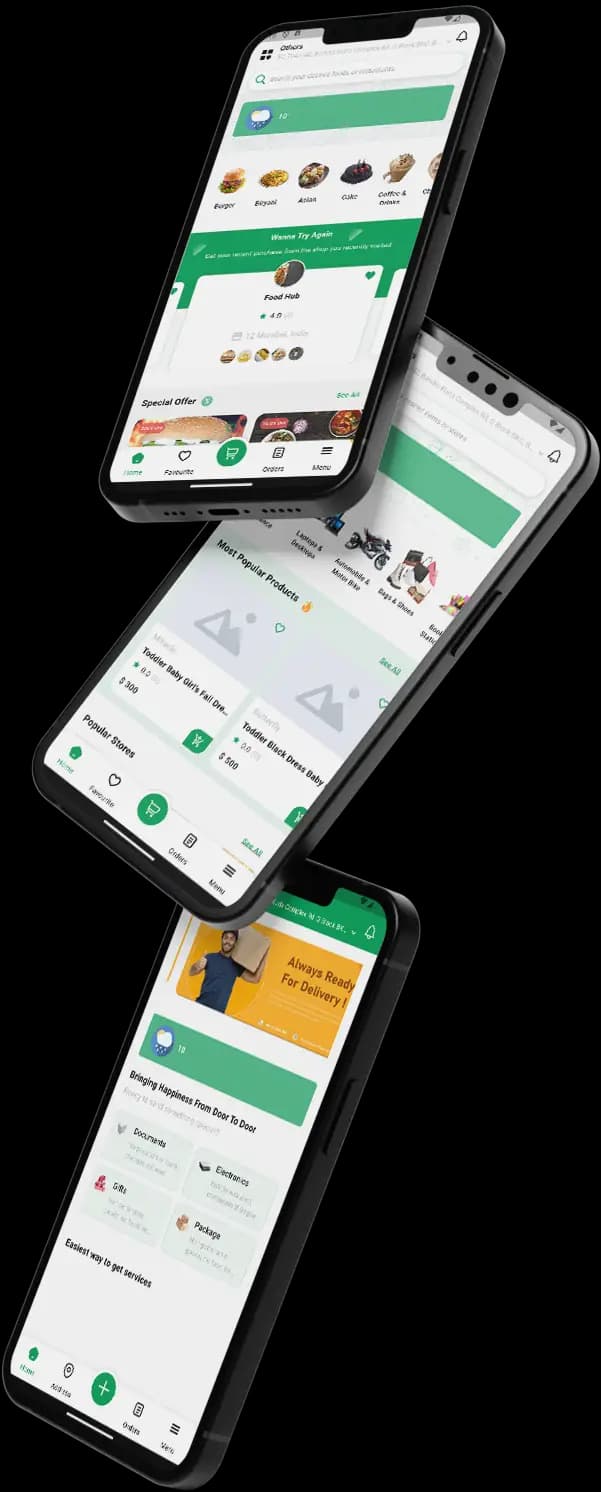
An AI-first build of the multi-market pattern: one shared dispatch engine serving every brand in a city, per-country forecasting, and expansion that is configuration rather than a rebuild. Four synced panels ship white-label with 100% source code. The almost-ready AI build goes live in 6 working days; a custom build takes 3 to 4 weeks.
Launch-ready from
$3,399
Synced panels
Almost-ready AI launch
Custom build
Source-code ownership
Trusted by the brands we build for



Facts behind every Moxace delivery build.
overview
A multi-market delivery platform is one operating system that runs delivery brands across countries and product lines: separate storefronts and catalogs per market, shared dispatch, settlement, and administration underneath. Ours is built AI-first, with shared dispatch, per-market forecasting, and cross-brand personalization running as model-driven services in the platform core. It is the structure international delivery groups use, made available as a launchable product.
Operators build one when a single-city, single-vertical app would box them in. Launching with multi-market architecture means each new country or brand is a configuration exercise, a new storefront, catalog, fee schedule, and payment set, rather than a rebuild. Franchisors, investment groups, and agencies serving several markets all share that requirement.
The platform includes per-market customer apps and vendor panels under distinct brands, a shared driver fleet layer where operations allow, and a master admin console that manages markets, commissions, catalogs, and promotions centrally with local delegation.
Published industry research shows the largest delivery companies consolidating multiple regional brands under shared technology. That same multi-market pattern is increasingly what regional operators and investors specify from the start, because expansion is the plan rather than the exception.
AI-native operations plus the headline capabilities beyond the role panels.
One assignment engine serves every brand in a city, enabling shared rider pools, the cost advantage group operators are built on.
Projects order volume per country, city, and daypart so each market staffs and positions riders against its own demand rhythms.
Discovery learns per customer within each brand, and the organization can share signals across brands where policy allows.
Country, brand, and city modeled as first-class entities with inherited settings and per-level overrides.
Each brand ships its own themed apps and store listings on the same shared engine underneath.
Currency, language, RTL, and payment methods are per-country data rendered from one codebase with no market-specific forks.
Per-market settlement at local commission rules, rolled into consolidated reporting and reconciliation in one console.
Cross-market fraud scoring on orders, refunds, and driver behavior, with review queues per market.
The fit test is simple: if you expect to run more than one brand, city, or country within two years, multi-market architecture saves you a migration later.
Building a delivery operating company across several countries, with one engineering asset instead of one per market.
Giving each franchisee a branded storefront on shared infrastructure, with group-level control of commissions and policy.
Deploying separate client brands on one deployment, sharing infrastructure costs while each client gets a standalone brand.
Extending into adjacent verticals and neighboring markets without forking the engineering or rebuilding operations.
Launching category-specific brands without a second engineering team, on the same dispatch and settlement core.
One codebase, many brands and countries.
White-label per brand, shared engine underneath.
Fleet tooling that works in every market.
Restaurants and dark stores across markets.
Country, brand, and city management in one console.
Four consoles, one view of the group's brands, fleets, and revenue position.
The multi-country organization tree with per-level overrides, brand-level theming, franchise controls, and per-branch vendor modes, so group policy is enforced and local reality is respected in the same structure.
Commission structures per market and tier, delivery-fee rules per city, loyalty and membership pricing, and advertising rates, all editable without a code release and all reporting into consolidated finance.
Shared fleet orchestration across brands per city, zone and fee configuration, cash-collection tracking, and payout administration, so shared pools stay the group's structural cost advantage.
Forecasting dashboards per market, per-market analytics alongside consolidated reporting, cross-market fraud screening queues, and refund and dispute consoles, so each market's honesty is visible group-wide.
One customer journey, replicated per brand and market.
Each brand ships its own themed app and store listing, but every brand lands on the same shared engine underneath.
The catalog, language, and currency come from the country configuration, so the same product serves different markets without forks.
Checkout offers the payment methods configured for that country, cards, wallets, or cash, all settled on the same order pipeline.
Multi-branch vendors manage intake, prep timers, and stock flags per location from one portal.
A rider from the shared city pool accepts the run, brand-aware in their app, which is how group operators cut fleet cost per order.
The order settles at that market's commission and fee rules, and consolidated finance reporting rolls every brand and country into one console.
Five model-driven systems working the same order stream. Each ships pre-tuned for multi-market delivery and sharpens as your data compounds.
Scores riders across every brand in a city on proximity, load, and rating, so one fleet serves the whole group profitably.
Rider locations, active loads, ratings, order urgency, brand mix
Lower fleet cost per order across all brands
Projects order volume per country, city, and daypart, so each market staffs riders and advises vendors on its own rhythms.
Order history per market, local calendars, weekday patterns
Rider supply matched to demand country by country
Ranks each brand's home feed per customer from behavior within that brand, with optional shared signals where policy allows.
Order history, browsing, brand boundaries, language preference
Higher feed conversion in every brand app
Scores orders, refunds, and driver behavior across markets, surfacing coordinated abuse that single-brand systems miss.
Order patterns, refund rates, device and payment signals
Lower fraud losses group-wide
Ranks search results per market using local language and cuisine signals, so discovery works from day one in every country.
Query text, local catalog tags, market-specific ratings
Search that converts in market two as well as market one
Four groups, each mapped to the part of the multi-market operation it protects or accelerates.
Country, brand, and city as first-class entities with inherited settings and per-level overrides, per-country currency, language, and RTL, and per-branch vendor modes for franchises, so one codebase carries many brands honestly.
One assignment engine serving every brand in a city with brand-aware rider tooling, shared pools, batched deliveries, and cash collection tracking, so fleet cost per order falls as the group grows.
Restaurant and shop catalogs with personalized per-brand feeds, local payment methods and gateways, loyalty priced per market, and multilingual RTL support, so each market gets a native experience rather than a translation.
Group-level commission policy with city overrides, cross-market fraud screening, refund and dispute consoles, and consolidated finance reporting with per-market analytics, so the group runs as one operation with honest local numbers.
platform concepts
The organization tree is the structural concept: country, brand, and city are first-class entities with inherited settings and per-level overrides, so a commission rate set at country level can be overridden for one city without touching another market.
Shared dispatch is the economic concept. One assignment engine serves every brand in a city, which is what makes shared rider pools possible, and shared pools are where group operators win on fleet cost per order.
Configuration discipline is the operational concept. Currency, language, RTL, and payment rails are per-country data rather than per-country codebases, so market two is a configuration sprint, and configuration debt never forks the platform.
insight
Delivery groups scale because a proven platform, run in several markets, carries fixed engineering cost across growing revenue. Industry analysis of the major multi-brand delivery groups consistently shows the same pattern: market entry succeeds when catalog density and rider supply arrive fast, and the groups that compound are the ones whose second market costs configuration effort rather than a rebuild.
The multi-market structure also compounds on the operations side. Shared rider pools in each city lower fleet cost per order across every brand, cross-market fraud screening catches abuse that single-brand systems miss, and group-level analytics price each market honestly. The revenue table below quantifies the lines a multi-market platform earns.
Per-order commissions, set per market and vendor tier, because unit economics differ by country.
Delivery fees with zone, distance, and peak components, configured per city.
Vendor advertising sold per market: sponsored ranking, banners, and campaign packages.
Loyalty and membership programs, priced per market where willingness to pay differs.
The multi-market structure is the point: you launch country two without a rebuild, and every rate is tunable from one admin console.
Six monetization lines across the platform, quantified against published industry benchmarks. Every rate is configurable per market in your admin panel; the figures here are modelling inputs, not projections of your platform's earnings.
| Criteria | Revenue line | How it is charged | Typical range | What sets the ceiling |
|---|---|---|---|---|
| Per-market commissions | A percentage per order, set per market and vendor tier because unit economics differ by country | Delivery platforms commonly take 15% to 30% of order value, varying by market | Market-level economics. Honest per-market pricing is what makes each country's P&L legible | |
| Delivery fees | Zone, distance, and peak components, configured per city | Commonly $1 to $5 per order by market and distance | Shared-fleet density. Shared rider pools lower cost per order across every brand in a city | |
| Vendor advertising | Sponsored ranking, banners, and campaign packages, sold per market | Contract-specific per campaign | Local marketing budgets, which differ by market and reward proof from your analytics | |
| Loyalty and membership | Programs priced per market where willingness to pay differs | Subscription tiers commonly priced monthly per user | Local price sensitivity. Willingness to pay for frequency is a per-market fact the structure respects | |
| Service and cancellation charges | Service fees per order and cancellation charges, configured per market | Contract-specific per market | Unit economics per market, protected without surprising local customers | |
| White-label and platform services | Deployment and platform services for sub-brands and franchisees on the same core | Contract-specific per deployment | Group scale. Every brand added to the organization tree spreads the engineering cost thinner |
Standard inclusions on every engagement, almost-ready or custom. Nine things you never have to ask for.
The complete unencrypted codebase transfers to you, with documentation and deployment scripts.
Each brand in your group gets its own identity on the shared engine, with branded customer communications.
App store and Play Console submissions handled end to end per brand, with production monitoring switched on.
Stripe, PayPal, and regional gateways configured per country, with automated split payouts and consolidated reconciliation.
Shared dispatch, per-market forecasting, and personalization arrive configured for multi-brand delivery, not as raw APIs.
Currency, language, and RTL are per-country configuration rendered from one codebase, ready for market two.
Containerized, multi-region deployment on AWS or Azure with autoscaling and queue-backed order intake.
Consolidated finance reporting, per-market analytics, and CSV exports so your operations team starts informed on day one.
Included support window plus product updates covering bug fixes, OS compatibility, and version upgrades.
Multi-market operations fail on configuration debt. This is how we prevent it.
Country, brand, and city modeled as first-class entities with inherited settings and per-level overrides, so market rules stay explicit.
One dispatch engine serves all brands per city, enabling shared rider pools, which is how group operators win on fleet cost.
Currency, language, RTL, and payment methods per country, rendered from one codebase with no market-specific forks.
Containerized, multi-region deployment with autoscaling. For single-city focus, our Smooth-style build is a tighter fit.
Per-country payment rails, POS systems, accounting and BI exports, SMS and push providers, and analytics ship as configured integrations.
Role-based access, append-only audit logs, encrypted traffic and secrets, per-market data residency options, and rate-limited endpoints come standard.
The almost-ready AI build, day by day. Store review can add a short buffer outside our control.
Brand structure, first country, commissions, and zones locked with a written scope, and brand themes applied across the panels.
Country settings, payment rails, languages, and fee schedules configured and tested against your live accounts.
First-city catalogs imported with bilingual menus and hours, then test orders run across brands, payment types, and both languages.
App store submissions with review buffers accounted for, production monitoring on, and full launch with post-launch support and product updates included.
Both tracks ship the same multi-market core. The difference is time, price structure, and how much you want to change.
| Criteria | Almost-Ready AI Launch | Custom Build |
|---|---|---|
| Time to live | 6 working days from branding handoff | 3 to 4 weeks, scoped before work starts |
| Pricing | Fixed written quote after a short scoping call, no hourly meter | Estimated per module after the discovery call |
| Source code and IP | 100% ownership on delivery | 100% ownership on delivery |
| AI layer | Shared dispatch, per-market forecasting, and personalization pre-tuned for multi-brand delivery | AI services designed around your workflows and data |
| Country expansion | New markets added as configuration out of the box | Custom org structures and settlement flows to your spec |
| Best for | Operators who want to launch this quarter | Teams with bespoke workflows or a unique model |
| After launch | Post-launch support and product updates included | Post-launch support and product updates included |
$ moxace launch --nowBook a walkthrough and we will demo shared dispatch, the organization tree, and per-market reporting on a live build, then send the written scope.
Share your idea
a quick call, no deck required
See the live demo
every screen, admin to user
Launch with source
full code, your brand, your servers
No two group launches price the same. These are the factors that shape the written quote you receive after scoping.
The single-brand platform ships standard. Multi-brand theming, shared admin across countries, or group-level analytics add scoped estimate work.
Per-brand city coverage, per-country languages, currencies, and tax compliance are configured market by market.
POS, payments, and fleet partners differ per country, and each market's integration set is estimated individually.
Dispatch and forecasting models are pre-tuned. Tuning them per market and brand on your own order data is a separately scoped workstream.
Each ships as an optional module on the same multi-market core, scoped separately.
Separate store listings per brand with themed builds, so each market and brand gets its own presence while the engine stays shared.
Franchisee onboarding, per-branch menus and reporting, and head-office policy controls, sold as an enterprise tier of the same platform.
Grocery, pharmacy, and retail categories activated per market on the same vendor and payout architecture, each with its own commission structure.
Contactless handoff with photo proof, configured per market where the expectation is standard.
Cross-brand and cross-market analytics with consolidated dashboards sold to group leadership, monetizing the data the shared core already produces.
Built for the org chart you will have in three years.
Per-brand theming and app listings on one shared engine, so group brands share dispatch and infrastructure costs.
Rider pools work across brands in a city, the operational advantage group delivery companies are built on.
Country two is currency, language, and vendor configuration, not a second project. Proven across 3,900+ delivered apps.
Consolidated finance and per-market analytics in one console. For pure on-demand depth, see on-demand app development.
Canonical deployments from our own portfolio. Metrics are reported from live platforms, not projections.
A food delivery platform operating across a dense multi-cuisine market, with AI-assisted dispatch and live order tracking at consumer scale.
An on-demand mobility platform from the same engineering system, proving the dispatch core holds under city-wide, real-time load.
A high-traffic consumer platform our team ships and operates at national-carrier scale, the same bar every build is held to.
A multi-market group holds many brands' money and reputations on one core. The controls are built in, and stated plainly.
The organization tree enforces group-level policy while city-level overrides are explicit and logged, so local flexibility never becomes invisible drift.
Cross-market screening scores orders, refunds, and driver behavior group-wide, so abuse patterns learned in one brand protect every other immediately.
Split settlement and payout runs respect each market's payment rails and reconciliation views, so every brand's books close on its own terms.
Multi-region deployment and per-market residency options live in the infrastructure layer with role-based access and audit logging enforced centrally.
Cross-brand personalization only shares signals where policy allows, with brand boundaries enforced in the data model, so one brand's customer file never leaks into another's.
the process
We begin with a discovery call covering your target markets, brands, and expansion sequence, then provide a written scope and fixed quote. After brand handoff we configure per-market storefronts, catalogs, payments, and fee schedules, with the almost-ready deployment live in 6 working days and market-by-market additions handled as configuration.
After launch you have 60 days of support and 12 months of updates. The first 90 days typically focus on proving the lead market before expansion: reaching vendor and rider density in the first city, validating unit economics per order, and documenting the launch playbook your second market will reuse.
Open the web app, sign in with the printed demo credentials, or install the Android build — no signup, no sales call. What you see is what you launch.
$ moxace launch --nowBook a free consultation with our platform architects.
Share your idea
a quick call, no deck required
See the live demo
every screen, admin to user
Launch with source
full code, your brand, your servers
Moxace is an independent software development company. We are not affiliated with, sponsored by, or endorsed by Delivery Hero.
The phrase “Delivery Hero clone” is used descriptively. It is how the software industry refers to building a platform with similar functionality, and how buyers search for one.
The design and codebase are built entirely by our in-house team. Nothing is taken from the Delivery Hero website, applications, or brand assets.
Delivery Hero and all third-party names and marks remain the property of their respective owners, referenced here only to describe the category of software we build.
Read the full legal notice on our disclaimer page.