Cross-vertical demand forecasting
Projects order volume per catalog and daypart so you position drivers and stock dark stores before the rush arrives.
AI-Built DoorDash Clone
An AI-first build of the DoorDash pattern: demand forecasting that spans restaurant and convenience catalogs, batch dispatch tuned for shop-and-deliver runs, and membership-driven frequency. Four synced panels ship white-label with 100% source code. The almost-ready AI build goes live in 6 working days; a custom build takes 3 to 4 weeks.
Launch-ready from
$3,399
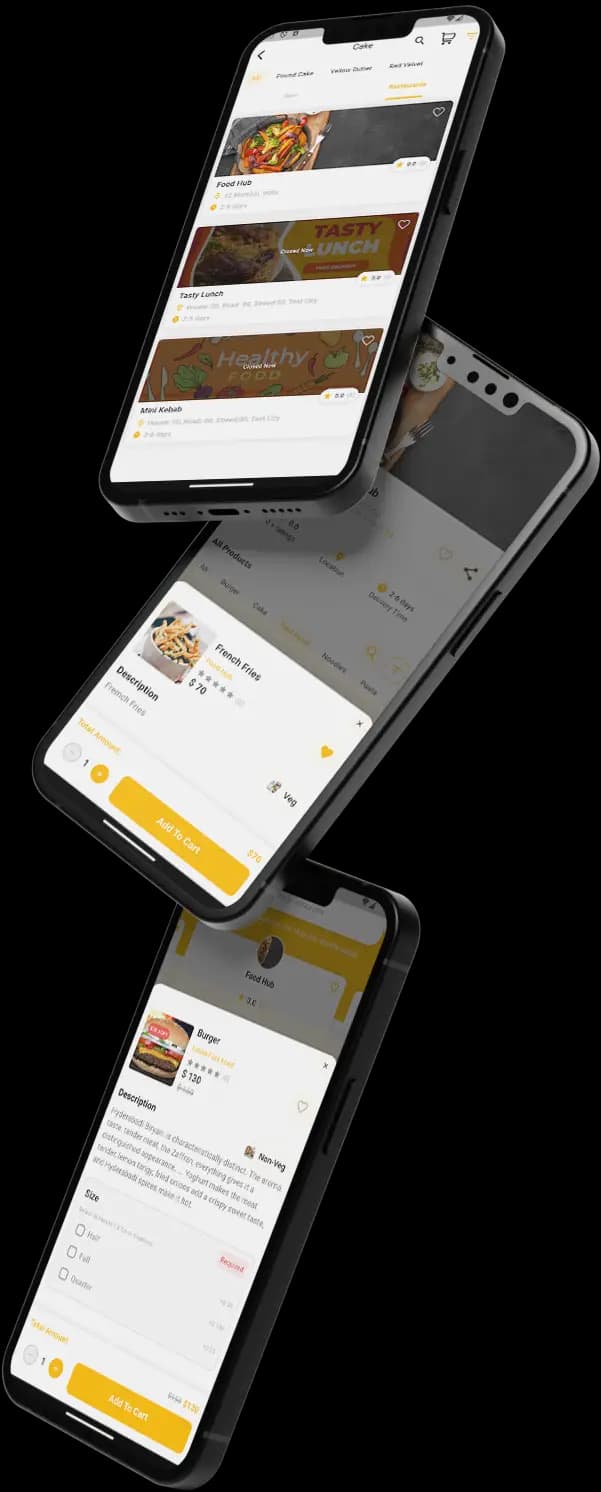
Synced panels
Almost-ready AI launch
Custom build
Source-code ownership
Trusted by the brands we build for



Canonical facts behind every build.
overview
A DoorDash-style marketplace is a multi-vertical delivery platform where customers order from restaurants and local stores in one app, a fleet of independent drivers fulfills the runs, and the operator earns commission on every basket. Ours is built AI-first: demand forecasting, batch dispatch, and personalized discovery run as model-driven services in the platform core, not bolt-on plugins. You get the complete stack under your own brand, not a reseller arrangement.
The purpose is commercial control. Operators launch one to own the customer relationship, set their own commissions and fees, and keep the membership, advertising, and data revenue that aggregators keep for themselves. Because the marketplace spans food, convenience, and shop-and-deliver, basket sizes and order frequency climb together, and every order feeds the forecasting models that make the next one cheaper to fulfill.
The platform bundles four products that operate as one system: a customer app spanning multiple catalog types, a driver app with offer-based dispatch, a merchant panel for restaurants and stores, and an admin console that governs verticals, fees, and promotions on shared infrastructure.
Multi-vertical delivery keeps expanding in published market research, with convenience and grocery categories growing alongside restaurant ordering. Operators who can run both food and retail catalogs on one platform are positioned for that mix without building a second system.
AI-native operations plus the headline capabilities beyond the role panels.
Projects order volume per catalog and daypart so you position drivers and stock dark stores before the rush arrives.
Drivers see pay, distance, and stop count before accepting, and the model learns acceptance patterns to keep declines low.
Home ranking tuned per customer from basket history across food and retail, which raises repeat-order frequency.
Free-delivery subscriptions with per-market pricing and eligibility rules, the single strongest frequency driver in this category.
Drivers scan items against the digital basket so retail counts match before checkout, with substitution approvals in the app.
Draw zones on a map and attach distance bands, surge multipliers, and minimum orders per vertical from the admin panel.
Multiple participants add to one cart and split payment at checkout, a proven order-value driver for offices.
Commission, merchant share, and driver earnings settle through the gateway automatically, with a reconciliation view for finance.
The common thread is supply-side access: if you can sign merchants, the platform turns those relationships into a transaction business.
Entering markets where incumbent aggregators have thin store coverage. The AI layer runs forecasting and dispatch while you sign the merchants only you can reach.
Offer delivery from your own locations under your own brand, keeping the margin and the customer data instead of renting a marketplace storefront.
Add delivery verticals to fill idle capacity, with dispatch that understands both your fleet density and your merchants' prep times.
A capital-efficient entry into on-demand commerce: launch on the almost-ready build in 6 working days and scope custom work from a position of live data.
Deploy the platform repeatedly for clients across cities and verticals. White-label configuration and full source code make every deployment standalone.
Four products in one platform. Every panel ships in every build.
More than restaurant ordering: one cart for the neighborhood.
Built around earnings transparency, which is how you keep drivers.
Vendor self-service for restaurants and stores.
The control room for a multi-vertical operation.
Four consoles, one view of the marketplace's supply, fleet, and revenue position.
Vendor onboarding across restaurants and retail, vertical and category management, catalog quality standards, and commission rules per vendor and vertical, so supply-side quality is administered as deliberately as demand.
Zone drawing, distance and peak fee components, category-level zoning, membership pricing, and promotion-engine rules, all editable without a code release and all explainable to both sides of the marketplace.
Driver fleet monitoring, offer and incentive configuration, dispatch-policy tuning, and payout administration, so the last mile across every vertical runs as an engineered system.
Demand-forecasting dashboards by vertical, refund and dispute consoles, and finance reconciliation across every revenue line, so the numbers your board and your finance team ask for are already generated.
One journey spanning restaurants, convenience, and shop-and-deliver.
The customer moves between restaurant menus and convenience SKUs in one session, with membership free delivery applied at checkout where eligible.
Checkout classifies the order type, restaurant, convenience, or shop-and-deliver, and the corresponding fulfillment path starts.
The restaurant fires the order to the kitchen or the store begins assembly, each against its own prep and pack timers.
For retail orders the driver picks items from the aisle, scanning each against the digital basket so counts match before checkout.
When an item is unavailable, the customer approves or declines the suggested replacement from the app, and the order total adjusts automatically.
Dispatch combines compatible stops, live tracking runs to the door, and the completed order settles across platform, merchant, and driver.
Five model-driven systems working the same order stream. Each ships pre-tuned for multi-vertical delivery and sharpens as your data compounds.
Projects order volume by catalog, zone, and daypart so you staff drivers and stock shelves ahead of the rush.
Order history, catalog mix, zone activity, weekday patterns
Driver supply and shelf stock matched to real demand
Scores nearby drivers on proximity, load, and pay fit for every offer, chaining compatible stops into one profitable run.
Driver positions, active loads, route geometry, order urgency
More deliveries per hour without longer customer waits
Ranks the home feed per customer from basket history across food and retail, so regulars see their usual, new users see proven favorites.
Order history, browsing, cart patterns, daypart behavior
Higher feed conversion and larger average baskets
When a retail item is out of stock, the model proposes replacements from the same category that fit price and past preferences.
Catalog data, stock flags, purchase history, price bands
Fewer cancelled shop-and-deliver orders and happier customers
Quotes fulfillment times from merchant history and live load, and throttles intake when a kitchen or store falls behind.
Prep settings, pack times, merchant load, pickup history
Quoted times customers can trust and fewer refunds
Four groups, each mapped to the part of the multi-vertical loop it protects or accelerates.
Restaurant, convenience, and retail catalogs in one personalized home ranking, with group ordering and split pay, so the neighborhood's full shopping list fits one cart.
Shop-and-deliver in the same dispatch loop as restaurant runs, item pick verification with substitution approvals, batch and multi-stop modes, and proof of delivery, so every order type ships on one engine.
Menu, price, and stock control with order throttling, prep and pack timers, availability flags, promo participation, and payout statements, so restaurants and stores run their own storefronts.
Membership free-delivery tiers, promo wallets, tips, ratings loops, and reorder tooling, so the platform compounds frequency across every vertical instead of renting demand one discount at a time.
platform concepts
A multi-vertical catalog is the first concept to understand. Restaurant menus carry modifiers and cooking states while retail carries stock counts and expiry-sensitive SKUs, and the platform keeps them as one order pipeline so a mixed basket never forks into a second system.
The order state machine carries an extra branch for substitutions: a pick-verification event can trigger a customer approval step before checkout, and every acceptance or decline is logged with its price delta for reconciliation.
Membership economics tie the flow together. Free delivery above a threshold is funded by the subscription, so the checkout prices each order against the membership state, and the admin panel configures that rule per market rather than in code.
insight
Multi-vertical delivery is the model that turned food ordering into neighborhood commerce: the same membership, the same fleet, and the same customer app carry restaurant dinners, convenience runs, and shop-and-deliver baskets. Industry analyses consistently show basket size and order frequency rising when retail sits beside food in one cart, because the weekly top-up keeps the app on the home screen between dinners.
The operator consequence is that membership economics improve with every vertical added. A subscription funded by free delivery pays back faster when it covers grocery orders too, and the fleet a food launch recruits monetizes across more dayparts. The revenue table below quantifies the lines a multi-vertical marketplace earns.
Per-order commissions by vendor tier, plus separate marketplace fees for convenience and retail catalogs.
Delivery fees with distance, peak, and service components, all configurable per zone.
Membership subscriptions: a free-delivery tier is the strongest frequency driver in this category.
Vendor advertising: sponsored placement in search and category pages, sold per campaign.
Every rate lives in the admin panel, so you can tune pricing and pilot new revenue lines without a code release.
Six monetization lines across the marketplace, quantified against published industry benchmarks. Every rate is configurable in your admin panel; the figures here are modelling inputs, not projections of your platform's earnings.
| Criteria | Revenue line | How it is charged | Typical range | What sets the ceiling |
|---|---|---|---|---|
| Vendor commissions | A percentage of each basket, set per vendor tier and vertical | Food marketplaces commonly take 15% to 30% of order value | Merchant economics. Commissions merchants sustain at volume keep supply and catalog breadth on the platform | |
| Delivery and service fees | Distance, peak, and service components per order, configurable per zone | Commonly $1 to $6 per order by distance and service level | Fleet density. Dense driver supply makes low fees sustainable at scale | |
| Membership subscriptions | Recurring plans funding free delivery above a basket threshold | Subscription tiers commonly priced monthly or annually per user | Order frequency. Multi-vertical coverage makes the membership pay back faster | |
| Vendor advertising | Sponsored search placement, category banners, and campaign packages | Contract-specific per campaign; priced against category traffic | Discovery attention. Placement sells where hungry customers actually browse | |
| Convenience and cancellation charges | Convenience fees per order and cancellation charges on late cancellations | Contract-specific per market and vertical | Unit economics. These lines decide whether thin-margin orders cost or earn | |
| Third-party API and white-label licensing | API access and white-label deployments licensed to downstream operators | Contract-specific per licensee | Platform maturity. A proven multi-vertical core becomes a revenue line of its own |
Standard inclusions on every engagement, almost-ready or custom. Nine things you never have to ask for.
The complete unencrypted codebase transfers to you, with documentation and deployment scripts.
Your logo, colors, and store accounts across all four panels, plus branded customer communications.
App store and Play Console submissions handled end to end, with production monitoring switched on.
Stripe, PayPal, and regional gateways configured with automated split payouts across platform, merchant, and driver.
Forecasting, batch dispatch, and personalized discovery arrive configured for multi-vertical delivery, not as raw APIs.
Languages, currencies, and tax display configured for your markets during the launch window.
Containerized services on AWS or Azure with autoscaling and queue-backed order intake for peak-hour traffic.
Sales dashboards, finance reconciliation views, and CSV exports so your operations team starts informed on day one.
Included support window plus product updates covering bug fixes, OS compatibility, and version upgrades.
Where generic scripts fail and we spend our effort.
One catalog service handles restaurant menus, convenience SKUs, and barcode-based items without three competing data models.
Shop-and-deliver order types handled in the same assignment loop as restaurant runs, weighted by pay, distance, and driver tier.
Tokenized card and wallet payments with automatic split settlement across platform, vendor, and driver.
Containerized services on AWS or Azure with autoscaling and queue-backed intake. For deeper logistics tooling, see our delivery management software.
POS systems, accounting exports, SMS and push providers, mapping, and analytics ship as configured integrations, so the platform plugs into the tools your operations already run on.
Role-based access, append-only audit logs, encrypted traffic and secrets, and rate-limited endpoints come standard, so compliance questions have answers before they are asked.
The almost-ready AI build, day by day. Store review can add a short buffer outside our control.
Verticals, commission structure, and zones locked with a written scope, and your identity applied across all four panels.
Payment gateways, membership tiers, fees, SMS, and currencies configured and tested against your live accounts.
Restaurant and convenience catalogs imported with hours, modifiers, and stock flags, then end-to-end test orders run, including a shop-and-deliver flow and a refund.
App store submissions with review buffers accounted for, production monitoring on, and full launch with post-launch support and product updates included.
Both tracks ship the same multi-vertical core. The difference is time, price structure, and how much you want to change.
| Criteria | Almost-Ready AI Launch | Custom Build |
|---|---|---|
| Time to live | 6 working days from branding handoff | 3 to 4 weeks, scoped before work starts |
| Pricing | Fixed written quote after a short scoping call, no hourly meter | Estimated per module after the discovery call |
| Source code and IP | 100% ownership on delivery | 100% ownership on delivery |
| AI layer | Forecasting, dispatch, and personalization pre-tuned for multi-vertical delivery | AI services designed around your workflows and data |
| Catalogs | Restaurant, convenience, and shop-and-deliver configured out of the box | Any vertical mix, with custom catalog logic to your spec |
| Best for | Operators who want to launch this quarter | Teams with bespoke workflows or a unique model |
| After launch | Post-launch support and product updates included | Post-launch support and product updates included |
$ moxace launch --nowBook a demo and we will show forecasting, dispatch, and the admin console on a live build, then follow with the written scope.
Share your idea
a quick call, no deck required
See the live demo
every screen, admin to user
Launch with source
full code, your brand, your servers
No two multi-vertical marketplaces price the same. These are the factors that shape the written quote you receive after scoping.
The almost-ready build covers the core multi-vertical order pipeline. Adding categories beyond restaurants and convenience, a custom ads system, or a first-party fleet module expands scoped estimate work.
Service areas, category-level zoning, and regional tax treatment are configured per market. Each additional city or category layer is quoted from configuration effort.
POS terminals at merchant counters, regional payment gateways, and third-party fleet APIs are wired during the build, each estimated individually.
Forecasting, dispatch, and merchandising models arrive pre-tuned for on-demand delivery. Retraining them on your own order history is a separately scoped workstream.
Each ships as an optional module on the same multi-vertical core, scoped separately.
Cloud-kitchen and virtual-brand tooling so one physical kitchen operates several delivery-only storefronts, each with its own menu and commission profile.
Contactless handoff flows with photo proof, meeting the delivery expectations that became standard in this category.
Voice search and reorder entry for the repeat-order case, lowering friction on the weekly top-up that drives membership value.
Stored value, referral rewards, and loyalty programs beyond the membership tier, deepening retention economics across verticals.
Merchant-level performance analytics and forecasting exports sold as a premium tier, monetizing the data the platform already produces.
Ready-made speed with custom-build engineering discipline.
Restaurant, convenience, and shop-and-deliver run on one order pipeline, not three plugins fighting each other.
A ready-made launch costs a fraction of a ground-up build, with a fixed written quote before work starts.
One hundred percent of the source code transfers to you. No per-order royalties, no black-box dependencies.
Multi-vertical delivery is a proven on-demand model. For a fully custom platform, see our food delivery app development track.
Canonical deployments from our own portfolio. Metrics are reported from live platforms, not projections.
A food delivery platform operating across a dense multi-cuisine market, with AI-assisted dispatch and live order tracking at consumer scale.
An on-demand mobility platform from the same engineering system, proving the dispatch core holds under city-wide, real-time load.
A high-traffic consumer platform our team ships and operates at national-carrier scale, the same bar every build is held to.
A multi-vertical marketplace moves money, food, and retail goods every minute. The controls are built in, and stated plainly.
Card and wallet payments authorize at checkout and settle through automated splits only when the order completes, so refunds and cancellations reverse cleanly.
Cancellation, prep, pickup, and delivery each carry their own refund rules in the order engine, so disputes resolve by policy rather than by negotiation.
Shop-and-deliver orders scan each item against the digital basket, with substitution approvals logged, so missing-item disputes start from a verified record.
Pay per offer, incentives, and batching feed an auditable earnings breakdown with weekly payout views, which is what keeps drivers on the platform.
Restaurant and driver verification workflows gate every storefront and courier account, with role-based admin access and audit logs behind the controls.
the process
The engagement opens with a discovery call covering your verticals, merchants, and pricing model, followed by a written scope and fixed quote. After approval you provide brand assets and we apply them across every panel while configuring payments, membership tiers, fees, and delivery zones. The almost-ready AI build goes live in 6 working days; a custom build takes 3 to 4 weeks, planned with you up front.
Post-launch you carry 60 days of included support and 12 months of updates. The first 90 days are about density, not code: signing merchants per zone, recruiting drivers, and watching the early order data to tune fees and promotions. Most marketplaces that fail, fail on supply-side execution, which is why we keep the platform simple to configure while you focus on the ground game.
Open the web app, sign in with the printed demo credentials, or install the Android build — no signup, no sales call. What you see is what you launch.
Login: Restaurant: [email protected] | Store_321. Delivery: +919876543211 | Driver_321
Access: Handed over in a guided call
$ moxace launch --nowBook a free consultation with our delivery platform team.
Share your idea
a quick call, no deck required
See the live demo
every screen, admin to user
Launch with source
full code, your brand, your servers
Moxace is an independent software development company. We are not affiliated with, sponsored by, or endorsed by DoorDash.
The phrase “DoorDash clone” is used descriptively. It is how the software industry refers to building a platform with similar functionality, and how buyers search for one.
The design and codebase are built entirely by our in-house team. Nothing is taken from the DoorDash website, applications, or brand assets.
DoorDash and all third-party names and marks remain the property of their respective owners, referenced here only to describe the category of software we build.
Read the full legal notice on our disclaimer page.