Prep-time prediction
Collection slots quoted from each vendor's own fulfilled history, so the promise is one the kitchen has actually hit before.
AI-Built Just Eat Clone
An AI-first build of the Just Eat pattern: hybrid order-only and platform-delivery modes on one marketplace, collection slots predicted from each kitchen's real history, and reconciliation-grade cash handling. Four synced panels ship white-label with 100% source code. The almost-ready AI build goes live in 6 working days; a custom build takes 3 to 4 weeks.
Launch-ready from
$3,399
Synced panels
Almost-ready AI launch
Custom build
Source-code ownership
Trusted by the brands we build for



Facts we can stand behind on every call.
overview
A Just Eat-style platform is a hybrid takeaway marketplace: order-only restaurants receive digital orders while paying simple commission, and full-service vendors with platform riders run delivery under the same roof. Ours is built AI-first, with prep-time prediction, hybrid dispatch, and search ranking running as model-driven services in the platform core. Customers choose collection slots or tracked delivery at checkout, and the operator earns across both modes.
The model's purpose is market coverage. In many countries, most local kitchens have no riders and will not join a delivery-only marketplace, but they will join one that lets them take orders digitally at a lower commission rate. That flexibility lets an operator sign nearly every kitchen in a territory, then add delivery-enabled vendors where demand justifies it.
The stack includes the customer app with hybrid delivery and collection, a driver app for vendors using platform riders with cash-handling support, a takeaway panel with sound alerts and own-rider mode, and an admin console that reconciles commissions and cash settlement per vendor and per mode.
Cash on delivery remains a significant share of restaurant transactions in many published market reports across Europe, the Middle East, and Asia, which is why reconciliation-grade cash handling is a core requirement for this model rather than an optional extra.
AI-native operations plus the headline capabilities beyond the role panels.
Collection slots quoted from each vendor's own fulfilled history, so the promise is one the kitchen has actually hit before.
Order-only and platform-delivered orders share one marketplace, with commission rates priced differently per mode.
Cash trips write ledger entries at collection and at handover, so a missing note traces to a driver, a trip, and a timestamp.
Takeaway results ranked by proximity, rating, and cuisine, with sponsored slots vendors can buy.
Per-vendor stamps and rewards that raise order frequency inside the marketplace.
The driver app shows cash-collection amounts before accepting a run and reconciles at shift handover.
Delivery fees with distance and peak components, configured per zone from the admin panel.
Commission, vendor share, and rider earnings settle through the gateway automatically, with cash reconciled separately.
The hybrid structure is the selling point in every case: supply comes easy because vendors can join without changing how they operate.
Where cash on delivery is normal, the reconciliation tooling is what makes the model viable at scale rather than a bookkeeping nightmare.
Building a lower-commission ordering channel they control, open to every kitchen whether or not it runs riders.
Using the order-only tier to build supply fast before recruiting riders, then switching vendors to delivery mode as fleet density grows.
Launching across a national footprint with per-branch vendor modes, commissions, and collection slots.
White-labeling the platform for hospitality clients in multiple countries, with white-label configuration and full source code.
Four panels, one platform, all in every build.
Takeaway ordering done properly.
For the vendors who use platform delivery.
Vendor control for kitchens running their own riders.
Marketplace operations without spreadsheets.
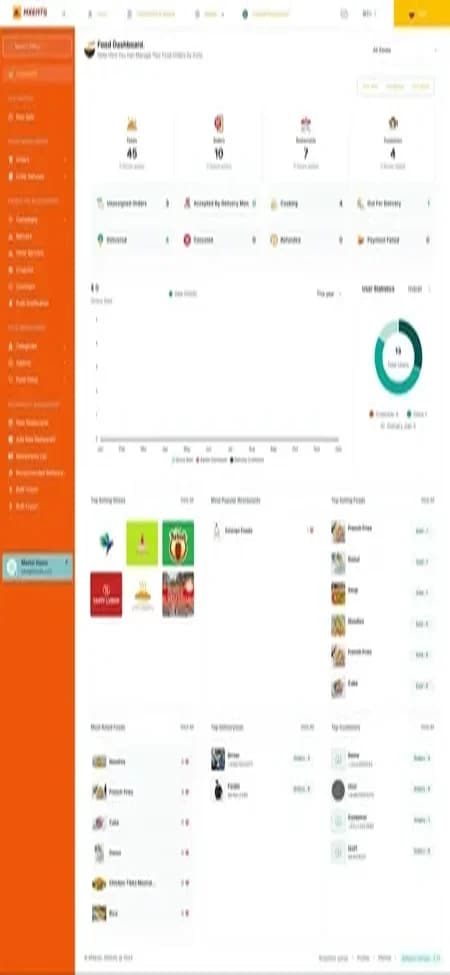
Four consoles, one view of the marketplace's supply, fleet, and revenue position.
Vendor onboarding with order-only versus delivery mode per vendor, commission setup per mode and tier, and busy-period policy, so every kitchen can join in the mode it operates and upgrade as your fleet grows.
Commission rates per mode, delivery fees with distance and peak components, featured-listing rates, loyalty-program funding, and cash-on-delivery ceilings, all editable without a code release and all reporting into finance.
Driver fleet monitoring, batch rules for dense areas, cash reconciliation matching at handover, and dispute resolution with evidence, so the two ledger entries every cash trip writes always meet.
Demand-forecasting dashboards by zone and daypart, vendor and mode performance reports, refund and dispute analytics, and finance reporting across every revenue line, generated on schedule.
Collection, delivery, and cash settlement in one hybrid flow.
At checkout the diner picks collection with a time slot, or platform delivery with a rider ETA, priced differently from the same basket.
Order-only vendors receive intake with sound alerts in the takeaway panel, while delivery-mode vendors see the same queue plus rider assignment.
For pickup, the quoted time is learned from the vendor's own prep history, so the promise is one the kitchen has actually hit before.
Platform-delivered orders enter the dispatch loop, and the driver app shows cash-collection amounts before accepting the run.
Cash on delivery is tracked per driver per trip, and the app records the amount collected against the order total.
At shift handover the driver's cash is reconciled against platform commission dues, with the matching audit trail in the admin panel.
Five model-driven systems working the same order stream. Each ships pre-tuned for hybrid takeaway operations and sharpens as your data compounds.
Quotes collection slots from each vendor's own fulfilled history and live kitchen load, not fixed settings.
Prep history, kitchen load, order mix, collection patterns
Collection promises that hold and better vendor reviews
Scores nearby riders on proximity, load, and rating for delivery-mode orders, batching compatible runs in dense areas.
Rider positions, active loads, ratings, route geometry
Faster assignments and fewer late deliveries
Ranks takeaways per diner from proximity, rating, cuisine, and order history, so the decision takes seconds.
Location, ratings, cuisine tags, order history, time of day
Higher search conversion and more repeat orders
Projects order volume by zone and daypart so you advise vendors on staffing and position riders before the weekend peak.
Order history, zone activity, weekday and seasonal patterns
Vendor intake and rider supply matched to real demand
Classifies review text into themes and surfaces which vendors or processes are slipping before ratings show it.
Review text, tags, ratings, order outcomes
Earlier intervention on vendors drifting below standard
Four groups, each mapped to the part of the hybrid model it protects or accelerates.
Order-only and platform-delivered orders in one state machine, self-rider mode per vendor, collection time slots, and batched nearby runs, so every kitchen can join in the mode it actually operates.
Cash amounts shown on offers, cash collection tracking, per-driver ceilings, and reconciliation at handover matched in the admin panel, so cash-on-delivery is an accounting system rather than a leap of faith.
Menu and price control, order intake with sound alerts, collection-time management, busy and closed flags, and payout statements, so kitchens run the channel from a panel built for counters, not call centers.
Loyalty stamps, promo codes, ratings, reorder favorites, and live tracking when delivery is used, so the local takeaway habit moves onto your platform and stays there.
platform concepts
The hybrid order flow is the defining concept: order-only and platform-delivered orders share one state machine but diverge at settlement, because an order-only vendor owes commission on intake while a delivery order also funds the rider and delivery fee margin.
Cash handling is an accounting problem the platform must own. Every cash trip writes a ledger entry at collection and a second at handover reconciliation, and the admin panel matches the two so a missing note is traceable to a driver, a trip, and a timestamp.
Prep-time prediction protects the collection promise. Quoted slots come from the vendor's own fulfilled history rather than a fixed setting, which is what keeps the review score of a busy kitchen from collapsing at peak.
insight
The hybrid model exists because supply is the bottleneck in most delivery markets, not demand. Order-only vendors join without changing how they operate, which lets a new platform sign every takeaway in town on day one and add delivery coverage as its fleet grows, the pattern that built the category's largest European players from takeaway listings first.
Cash-on-delivery markets are where this model becomes decisive: order-only listings capture demand that card-first aggregators cannot serve, and the platform's edge is the reconciliation discipline that makes cash workable at scale rather than a bookkeeping nightmare. The revenue table below quantifies the lines a hybrid venue earns.
Per-order commissions, with lower rates for order-only vendors who handle their own delivery.
Delivery fees on platform-delivered orders, with distance and peak components.
Featured listings and sponsored ranking sold to vendors as advertising.
Loyalty program economics that raise order frequency and lifetime value.
The hybrid model is the point: you can sign every kitchen in town, whether or not they have riders, and price each mode independently from the admin panel.
Six monetization lines across the platform, quantified against published industry benchmarks. Every rate is configurable in your admin panel; the figures here are modelling inputs, not projections of your platform's earnings.
| Criteria | Revenue line | How it is charged | Typical range | What sets the ceiling |
|---|---|---|---|---|
| Order commissions | A percentage per order, with lower rates for order-only vendors handling their own delivery | Food marketplaces commonly take 10% to 25% on order-only tiers, 15% to 30% on full-service | Supply breadth. Signing every kitchen, rider or not, is what builds the catalog that draws demand | |
| Delivery fees | Distance and peak components on platform-delivered orders only | Commonly $1 to $5 per order by distance | Fleet growth. The fee line scales as order-only vendors convert to delivery mode | |
| Featured listings and sponsored ranking | Placement in search and category results, sold per period | Contract-specific per campaign | Vendor competition for discovery, which denser catalogs intensify | |
| Loyalty economics | Program-funded retention: stamps, rewards, and promo participation | Program-specific per market | Order frequency in takeaway-heavy neighborhoods, where loyalty changes weekly habits | |
| Cash-handling services | Fees on cash-on-delivery processing and reconciliation tooling where the market carries them | Contract-specific per market | Cash-market demand. In COD-heavy regions the reconciliation tooling is the differentiator vendors pay for | |
| Collection-slot economics | Commission rates on pre-ordered collection slots with prep-time prediction | Contract-specific per vendor tier | Peak precision. Accurate slots let kitchens accept more pre-orders without missing promises |
Standard inclusions on every engagement, almost-ready or custom. Nine things you never have to ask for.
The complete unencrypted codebase transfers to you, with documentation and deployment scripts.
Your logo, colors, and store accounts across all four panels, plus branded customer communications.
App store and Play Console submissions handled end to end, with production monitoring switched on.
Stripe, PayPal, and regional gateways covering cards, wallets, and cash, with automated split payouts and cash reconciliation.
Prep-time prediction, hybrid dispatch, and search ranking arrive configured for takeaway operations, not as raw APIs.
Languages, currencies, and tax display configured for your markets during the launch window.
Containerized services on AWS or Azure with autoscaling and queue-backed order intake for peak-hour traffic.
Sales dashboards, cash and finance reconciliation views, and CSV exports so your operations team starts informed on day one.
Included support window plus product updates covering bug fixes, OS compatibility, and version upgrades.
Order-only marketplaces fail on reconciliation. We engineer for it.
Order-only and platform-delivery orders share one state machine with different settlement paths, so commission accounting stays clean.
Cash-on-delivery trips are tracked per driver with handover reconciliation and a matching audit trail in the admin panel.
Cards, wallets, and cash through Stripe, PayPal, and regional gateways, with tokenized storage and automated split payouts.
Containerized services with autoscaling and queue-backed intake. For bespoke vendor tooling, see restaurant app development.
EPOS systems, accounting exports, SMS and push providers, mapping, and analytics ship as configured integrations, so the platform plugs into the tools your vendors already run.
Role-based access, append-only audit logs, encrypted traffic and secrets, and rate-limited endpoints come standard, so compliance questions have answers before they are asked.
The almost-ready AI build, day by day. Store review can add a short buffer outside our control.
Markets, vendor modes, and commission tiers locked with a written scope, and your identity applied across all four panels.
Payment gateways, cash-handling rules, collection slots, and fee structures configured and tested against your live accounts.
Takeaway menus, hours, and delivery modes imported for every vendor, then test orders run across collection, delivery, and cash payment paths.
App store submissions with review buffers accounted for, production monitoring on, and full launch with post-launch support and product updates included.
Both tracks ship the same hybrid core. The difference is time, price structure, and how much you want to change.
| Criteria | Almost-Ready AI Launch | Custom Build |
|---|---|---|
| Time to live | 6 working days from branding handoff | 3 to 4 weeks, scoped before work starts |
| Pricing | Fixed written quote after a short scoping call, no hourly meter | Estimated per module after the discovery call |
| Source code and IP | 100% ownership on delivery | 100% ownership on delivery |
| AI layer | Prep-time prediction, dispatch, and ranking pre-tuned for takeaway operations | AI services designed around your workflows and data |
| Cash handling | Collection-to-handover reconciliation out of the box | Custom settlement and EPOS flows to your spec |
| Best for | Operators who want to launch this quarter | Teams with bespoke workflows or a unique model |
| After launch | Post-launch support and product updates included | Post-launch support and product updates included |
$ moxace launch --nowBook a walkthrough and we will demo order-only intake, dispatch, and cash reconciliation on a live build, then send the written scope.
Share your idea
a quick call, no deck required
See the live demo
every screen, admin to user
Launch with source
full code, your brand, your servers
No two hybrid marketplaces price the same. These are the factors that shape the written quote you receive after scoping.
The hybrid marketplace module set ships standard. Self-onboarding vendor tooling, hybrid ordering flows, or custom commission schemes add scoped estimate work.
Coverage areas, takeaway versus delivery rules, and multi-country language and currency packs are configured per market.
Vendor-owned POS and ordering tablets, regional payment methods, and local maps providers connect during the build, each estimated individually.
Recommendation and dispatch models are pre-tuned for food marketplaces. Adapting them to your vendor mix and order data is quoted separately.
Each ships as an optional module on the same order core, scoped separately.
Full fleet tooling for operators who run riders across multiple vendors: rosters, shifts, and performance, extending the delivery-mode arm as density grows.
Booking and waitlist seating for takeaways that also serve dine-in, turning the same vendor panel into a front-of-house tool.
Tiered stamps, cross-vendor rewards, and campaign tooling on top of the loyalty engine, deepening the weekly takeaway habit.
Direct links to counter systems so platform orders print alongside walk-in tickets without double entry, the integration vendors ask for first.
Language packs, currencies, and regional payment rails configured per market as the venue crosses borders, expansion by configuration rather than rebuild.
Ready-made speed with custom-build engineering discipline.
Order-only and delivery modes, cash reconciliation, and own-rider tooling are core product logic, not plugins fighting each other.
A ready-made launch costs a fraction of a ground-up build, with a fixed written quote before work starts.
One hundred percent of the source code transfers to you. No per-order royalties, no black-box dependencies.
Scale into rider-led delivery when ready. Our Deliveroo-style build covers cloud-kitchen and membership mechanics.
Canonical deployments from our own portfolio. Metrics are reported from live platforms, not projections.
A food delivery platform operating across a dense multi-cuisine market, with AI-assisted dispatch and live order tracking at consumer scale.
An on-demand mobility platform from the same engineering system, proving the dispatch core holds under city-wide, real-time load.
A high-traffic consumer platform our team ships and operates at national-carrier scale, the same bar every build is held to.
A hybrid venue handles cash, commissions, and promises made on behalf of other people's kitchens. The controls are built in, and stated plainly.
Collection and handover reconciliation write separate ledger entries that the admin panel matches, with per-driver ceilings capping exposure before problems compound.
Order-only vendors settle on intake commission while delivery orders also fund riders and fees, and the state machine keeps the two accounting paths from bleeding into each other.
Busy and closed flags plus prep-time prediction stop a saturated kitchen from accepting orders it cannot fulfill, protecting the review scores the vendor's business runs on.
Card and wallet payments authorize at checkout and settle through automated splits when the order completes, so cancellations and refunds reverse cleanly.
Mode switches, commission edits, and cash matches write to append-only audit logs, so the venue's books are checkable rather than reconstructable.
the process
The process starts with a discovery call about your market, vendor types, and payment mix, then a written scope and fixed quote. After you hand over brand assets we configure the panels, payment gateways, cash-handling rules, and collection slots. The almost-ready AI build goes live in 6 working days; a custom build takes 3 to 4 weeks, planned with you up front.
Launch brings 60 days of included support and 12 months of updates. In the first 90 days your work is supply acquisition and cash-process discipline: signing order-only vendors at a low-friction rate, training their staff on the takeaway panel, and setting driver handover routines so the reconciliation reports stay clean from week one.
Open the web app, sign in with the printed demo credentials, or install the Android build — no signup, no sales call. What you see is what you launch.
Login: Delivery: +919876543211 | Driver_321. Restaurant: [email protected] | Store_321
Access: Given on request
$ moxace launch --nowBook a free consultation with our team.
Share your idea
a quick call, no deck required
See the live demo
every screen, admin to user
Launch with source
full code, your brand, your servers
Moxace is an independent software development company. We are not affiliated with, sponsored by, or endorsed by Just Eat.
The phrase “Just Eat clone” is used descriptively. It is how the software industry refers to building a platform with similar functionality, and how buyers search for one.
The design and codebase are built entirely by our in-house team. Nothing is taken from the Just Eat website, applications, or brand assets.
Just Eat and all third-party names and marks remain the property of their respective owners, referenced here only to describe the category of software we build.
Read the full legal notice on our disclaimer page.