Lazy minting
Creators list for free with item data stored off-chain and the contract minting on-chain only at purchase, so gas is paid at settlement rather than at creation.
AI-Built Rarible Clone
An AI-first build of every Rarible mechanic: lazy minting with deferred gas, contract-enforced royalties, and curation intelligence that keeps the catalog worth browsing. Four synced panels ship white-label with 100% source code, owned by you from day one. The almost-ready AI build goes live in 6 working days; a custom build takes 3 to 4 weeks.
Launch-ready from
$4,299
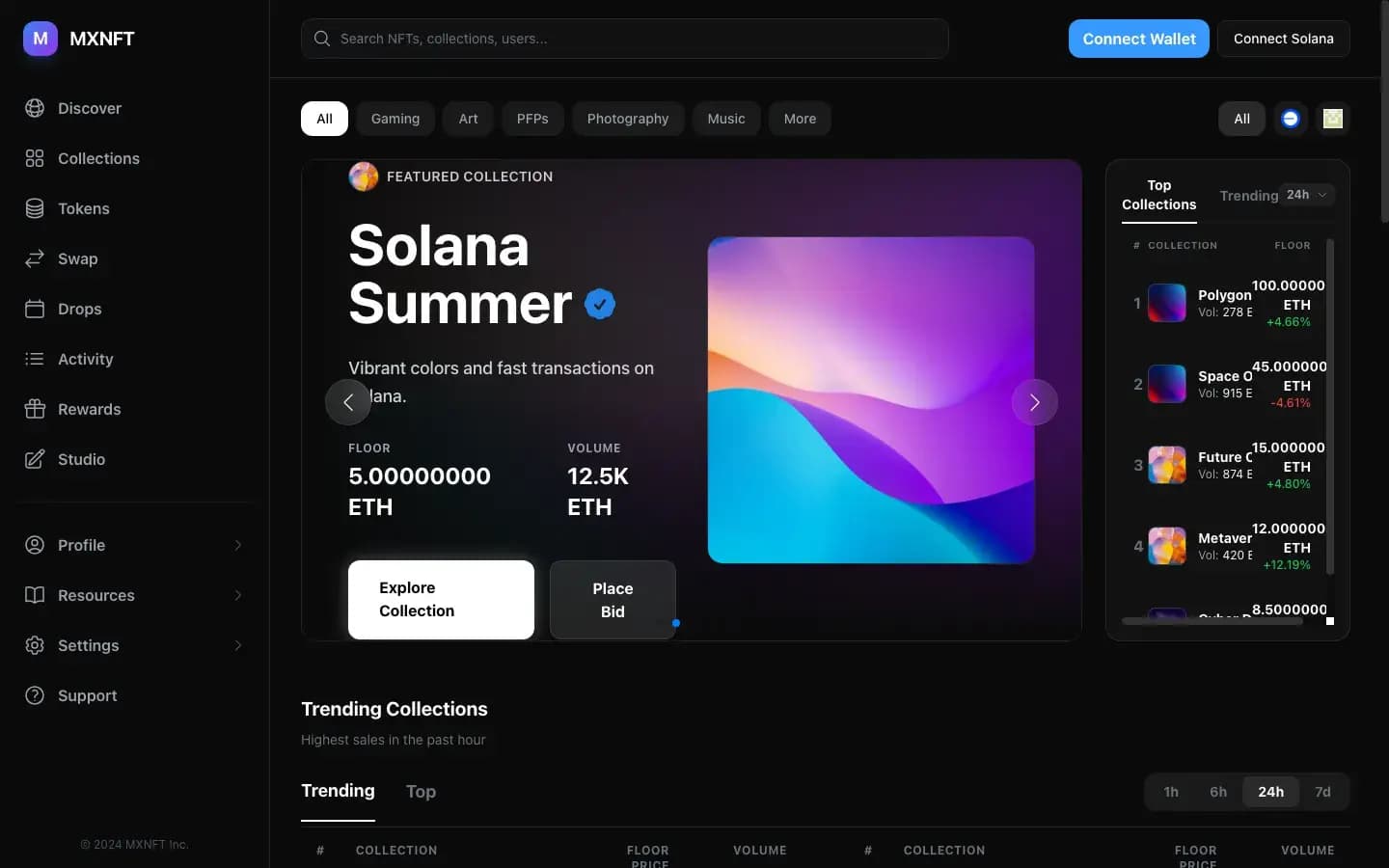
Synced panels
Almost-ready AI launch
Custom build
Source-code ownership
Trusted by the brands we build for

What a production-grade marketplace buys you.
overview
A Rarible-style NFT marketplace is a platform where creators mint digital collectibles, list them for sale in fixed-price, auction, or open-bid formats, and collectors discover, trade, and resell them, with royalties enforced by contract logic at every settlement.
Its purpose is to give a community ownership of its creative economy. Operators launch NFT marketplaces to serve a specific vertical, art, gaming assets, music, memberships, tickets, because general-purpose platforms moderate and rank vertically poorly, and because the marketplace earns fees on primary and secondary sales alike without holding inventory or pricing anyone's art.
The platform includes a collector app with discovery, bids, and wallet connection, a creator studio for minting and storefronts, community features such as follows and leaderboards, and an admin panel over moderation, royalty policy, fees, and chain management, with minting and settlement contracts underneath.
Market context, hedged: NFT activity has moved through boom and consolidation cycles, and commentary across the industry has noted that durable volume now concentrates around communities and utility rather than speculation alone. We avoid unsourced figures, frame every build around creator economics rather than price promises, and enforce royalties through contracts where chain norms permit.
The headline capabilities, at product level.
Creators list for free with item data stored off-chain and the contract minting on-chain only at purchase, so gas is paid at settlement rather than at creation.
Royalty percentages and payout splits settle atomically on every sale, primary and resale, with policy strictness configurable per collection.
Fixed price, timed auctions, and open offers out of the box, with bundle listings for multi-item drops.
Themed pages with collections, drop scheduling, and allowlist campaigns, so recurring creators build a home rather than a listing.
Event-driven indexing over contracts powers trait filters, rarity rankings, and price-floor tracking that serious collectors expect.
Major EVM chains supported with per-chain fee handling, and existing collections importable so established creators list on day one.
Collection moderation, verified-creator checks, and content flagging keep impersonators out of the catalog.
IPFS pinning with content addressing and gateway redundancy, so item links survive long after mint day.
What these buyers share: a creative community they already hold and the need for infrastructure second. If you bring the creators, the platform side is the part we handle.
You already hold supply and audience. The curation and royalty core runs the marketplace mechanics while you keep the editorial standard that makes the venue worth visiting.
Run an in-game asset marketplace under your own brand and economics, with trait indexing and drop tooling built for live games.
Tokenized collectibles as a direct fan-revenue channel, with drop scheduling and allowlist campaigns built in.
Deploy the white-label build for brand and entertainment clients, every deployment standalone on 100% source code.
Launch a venue where general platforms neither curate nor enforce your norms, with moderation and verification tooling that protects the catalog.
Every panel below ships in every build.
Discovery and trading that feels native to the category.
Minting and storefronts without code.
Tools that make collectors return.
Marketplace operations from one console.
Beyond marketplace administration: the operational systems that keep a creator economy governable at scale.
Per-collection royalty configurations, policy strictness tiers, and split-payout verification, so the creator economy's core promise is enforced by system rather than by negotiation.
Impersonation flagging, verified-creator checks, content moderation queues with audit trails, and IPFS integrity monitoring, because the catalog's trustworthiness is the venue's inventory value.
Per-chain fee handling, contract management, and collection import verification, so multi-chain operations stay consistent and every deployment is documented.
Fee revenue by tier, royalty flows, drop performance, and creator retention report together, so the marketplace's health reads as a creator business, not just a sales ledger.
The creator and collector journey from mint to resale.
A creator uploads the work, sets traits, supply, and royalty percentage, and mints through the studio. Lazy minting keeps it off-chain, free to list, until a buyer arrives.
The item goes live as a fixed price, timed auction, or open bid listing, with gas-aware checkout totals shown to buyers before they commit.
Trait search, rarity rankings, and activity feeds surface the collection, and bids, offers, or bundle purchases arrive with escrow-style locking of the asset or bid.
On acceptance, the contract executes in one transaction: buyer funds move, the NFT transfers, and the creator's royalty plus the platform fee split out automatically.
When the collector resells, marketplace contract logic applies the collection's royalty policy on the secondary price, so creators keep earning from appreciation.
Sales history, verified badges, and follower activity accrue to creator storefronts, which is what turns a one-off drop into a recurring collector base.
Five model-driven systems working the same collection event stream. Each ships pre-tuned for NFT marketplaces and sharpens as your data compounds.
Ranks the discovery feed per collector from browsing, bids, and follows, so every home page reads like it was curated for that collector.
Browse history, bids, follows, collection activity
Higher home-feed conversion and faster first purchases
Computes trait distributions and rarity rankings from indexed contract events, keeping rankings honest as supply changes.
Trait data, mint events, listing history
Trait search collectors trust for valuation decisions
Tracks collection price floors and listing pressure so creators price drops and collectors time bids with evidence.
Listing prices, sale history, floor movement
Better-priced drops and fewer stale listings
Flags copied artwork, fake collections, and suspicious creator patterns before they reach the moderation queue.
Image similarity, metadata patterns, account history
Impersonators kept out of the catalog proactively
Prioritizes the moderation queue by risk so reviewers handle counterfeit and policy risks before routine checks.
Flags, content signals, reporter history
A cleaner catalog with a smaller review team
The modules that turn a listing platform into a community economy, each toggleable and configurable per collection.
High-value pieces fractionize so collectors invest at accessible sizes, expanding the buyer base for premium assets while the vault holds the underlying token.
Holders stake their NFTs for rewards, fostering engagement and giving collections a reason to be held rather than flipped.
Immersive 3D gallery spaces where collectors explore and display collections, extending the venue from a list into a place.
Multi-chain NFT movement and swap mechanics, so collections and liquidity are not prisoners of one network.
Community participation in marketplace decisions through DAO-based mechanisms, the engagement layer that turns users into stakeholders.
Support for evolving, interactive tokens and dynamic pricing models, serving the gaming-asset and utility collections driving durable volume.
platform concepts
The core concept is the sale state machine: every item is minted or lazily listed, then moves through listed, bid, accepted, and settled states, with the contract executing funds, transfer, and royalty splits in one atomic transaction. Because each transition is on-chain, a resale settles identically to a primary sale, and the royalty policy applies without anyone remembering to apply it.
The second is marketplace economics. Fees attach per collection tier, royalties are policy enforced by contract with configurable strictness, and featured placements sell per campaign window, so the venue earns on settlement service rather than on anyone's art. Creator subscriptions and mint fees are admin-configurable, which is what lets you run a fee holiday for a launch drop and keep the accounting clean.
The third is the collection catalog. Collections carry metadata, traits, royalty configurations, and storefront themes, with existing contracts importable so established creators list on day one. That structure is what lets you onboard a gaming collection with different royalty terms, verify an artist collective before badges appear, and keep moderation decisions on an audit trail.
insight
NFT activity has moved through boom and consolidation cycles, and the durable volume now concentrates around communities and utility rather than speculation alone, a pattern industry commentary has noted consistently. That is precisely the opening for a vertical marketplace: general platforms moderate and rank every category poorly, while a venue built for one community enforces its norms and curates its catalog.
The economics reward that focus. Marketplace fees attach to both primary sales and the resale chain, royalties enforced by contract keep creators earning from appreciation, and creator subscriptions monetize the storefronts that keep them listing. Depth modules, fractional ownership for high-value pieces, staking that rewards holding, and governance that hands the community real say, extend the economy beyond the sale itself. The revenue lines below quantify each path.
Marketplace fees on every primary and secondary sale, set per collection tier in the admin panel.
Minting fees on on-chain mints, with lazy-minting costs settled at purchase instead of at creation.
Featured-placement advertising for drops and collections, sold per campaign window.
Creator subscriptions for storefront theming, analytics, and allowlist tooling.
Every rate is admin-configurable, so you can run promotional fee holidays or premium tiers without a code release.
Six monetization lines across the marketplace, quantified against published industry benchmarks. Every rate is configurable in your admin panel; the figures here are modelling inputs, not projections of your platform's earnings.
| Criteria | Revenue line | How it is charged | Typical range | What sets the ceiling |
|---|---|---|---|---|
| Marketplace fees | A percentage of every primary and secondary sale, set per collection tier | NFT marketplaces commonly charge 1.5% to 5% per sale, with secondary sales the durable half | Resale chain depth. Contract-enforced royalties and active communities are what keep secondary volume alive | |
| Royalty share economics | Creator royalties enforced by contract at settlement; the platform may share in enforced-royalty policy where terms permit | Royalties commonly 5% to 10% of resale price, split creator and platform by policy | Creator loyalty. The line grows only where creators keep listing, so storefronts and drop tooling are the lever | |
| Minting fees | Charged on on-chain mints, with lazy-minting costs settled at purchase instead of at creation | Commonly $5 to $50 per mint depending on chain and network conditions | Drop calendar. Volume follows the drop schedule, so creator pipelines drive the line | |
| Featured placements | Sponsored listings and promotional slots for drops and collections, sold per campaign window | Contract-specific per campaign; priced against discovery-page traffic | Catalog curation. Placement sells only where the catalog is worth browsing, which curation quality protects | |
| Creator subscriptions | Recurring fees for storefront theming, analytics, and allowlist tooling | Commonly $10 to $100 per month across creator tiers | Recurring-creator depth. Subscriptions monetize the creators who treat the venue as a storefront, not a listing | |
| Tokenization and fractional services | Service fees for tokenizing assets for businesses and fractional-ownership mechanics on high-value pieces | Contract-specific per engagement and per vault | Institutional adoption. These services extend the venue beyond consumer collectibles into asset tokenization |
Standard inclusions on every engagement, almost-ready or custom. Nine things you never have to ask for.
The complete contracts and application code transfer to you, with documentation and deployment scripts.
Your logo, colors, and domains across the collector app, creator studio, and admin panel.
App store and web launch handled end to end, with contracts deployed and IPFS infrastructure switched on.
Wallet connection options and fiat on-ramp gateways configured, with split payouts for royalties and fees.
Curation, rarity analytics, and impersonation detection arrive configured for NFT marketplaces, not as raw APIs.
Languages and EVM chain targets configured for your markets during the launch window.
Indexing and IPFS pinning with autoscaling, so trait search stays fast at drop traffic.
Revenue dashboards, collection analytics, and CSV exports so your operations start informed on day one.
Included support window plus product updates covering bug fixes, chain compatibility, and version upgrades.
Minting, metadata, and royalties are engineering problems.
Lazy minting keeps items off-chain until purchase, so creators list for free and the buyer covers gas at settlement. On-chain minting is a one-toggle upgrade per collection.
Royalty percentages enforced through marketplace contract logic with configurable policies per collection, and split payouts settling creator, platform, and collaborator shares atomically.
IPFS-pinned metadata with content addressing and gateway redundancy, so links survive long after mint day.
Event-driven indexing over contracts feeds trait search, activity feeds, and price history. For protocol depth, see our NFT marketplace development company practice.
Wallet SDKs, IPFS pinning services, fiat on-ramps, analytics, and notification channels ship as configured integrations, so the marketplace plugs into the stack your creators expect.
Contract verification, role-based access, audit logs, and content moderation workflows come standard, so the catalog's integrity has engineering behind it, not just policy.
The almost-ready AI build, day by day. Store review times can add a short buffer outside our control.
Chains, fee tiers, royalty policy, and moderation rules locked with a written scope, and your identity applied across all panels.
Contracts deployed, IPFS and wallets configured, fees and royalty policies set, and store accounts connected.
Seed collections imported with metadata and storefront themes, and test mints, bids, sales, royalty splits, and withdrawals run end to end.
App store submissions with review buffers accounted for, production monitoring on, and full launch with post-launch support and product updates included.
Both tracks ship the same contract core. The difference is time, price structure, and how much you want to change.
| Criteria | Almost-Ready AI Launch | Custom Build |
|---|---|---|
| Time to live | 6 working days from branding handoff | 3 to 4 weeks, scoped before work starts |
| Pricing | Fixed written quote after a short scoping call, no hourly meter | Estimated per module after the discovery call |
| Source code and IP | 100% ownership on delivery | 100% ownership on delivery |
| AI layer | Curation, rarity analytics, and impersonation detection pre-tuned | AI services designed around your community and data |
| Royalty policy | Contract-enforced royalties with configurable strictness | Royalty logic designed around your creators' terms |
| Chains | Major EVM chains pre-wired | Any target chain, scoped per network |
| Best for | Operators who want to launch this quarter | Teams with bespoke mechanics or a unique model |
$ moxace launch --nowBook a walkthrough of the creator studio, trait search, and moderation console on a live build, then receive the written scope.
Share your idea
a quick call, no deck required
See the live demo
every screen, admin to user
Launch with source
full code, your brand, your servers
No two launches price the same. These are the factors that shape the written quote you receive after scoping.
The almost-ready AI build covers the proven feature set. Custom royalty logic or novel sale modes add scoped estimate work.
Chain deployments and collection imports are configured per network. Adding chains means more configuration, never a rebuild.
Wallet SDKs, IPFS pinning, fiat on-ramps, and analytics are wired during the build, and each integration is estimated individually.
Out of the box, curation, rarity analytics, and impersonation detection are pre-tuned for NFT marketplaces. Training models on your collection history is an optional, separately scoped workstream.
The extensions NFT marketplace operators most often add once the creator roster is active, each scoped as its own workstream.
Managed services creating and managing tokens for businesses and artists, extending the venue into B2B asset tokenization.
Collection quests, badges, and reward mechanics that deepen collector engagement between drops.
Sustainable blockchain deployments for communities where environmental posture is part of the brand.
Several branded marketplaces on one shared contract and indexing core, with separate branding, collections, and fee tiers per tenant.
Creator economics with engineering discipline.
Royalty policy is enforced by contract logic with per-collection strictness, not by a paragraph in the terms of service.
Lazy minting, storefronts, and drop scheduling are core product logic, because the creator roster is the marketplace's real inventory.
Contracts and app code transfer to you completely. No per-sale royalties, no black-box dependencies.
Compare the aggregator-style depth of our OpenSea-style build if your model leans breadth over curation.
Canonical deployments from our own portfolio. Metrics are reported from live platforms, not projections.
A high-volume consumer experience our team ships at global-release scale, the same bar every build is held to.
A consumer engagement platform from the same engineering system, proving the stack holds attention at campaign scale.
A high-traffic consumer platform our team ships and operates at national-carrier scale, the same discipline applied to every launch.
A marketplace's inventory is creative work and collector money. The controls are built in, and stated plainly.
Buyer funds, NFT transfer, and royalty splits execute in one contract transaction, so no party can take value without delivering theirs, primary sale or resale alike.
Royalty terms live in marketplace contract logic with per-collection strictness, so creator earnings do not depend on a marketplace's good mood.
Image-similarity detection, fake-collection flags, and verified-creator checks keep copied work out of the catalog before buyers ever see it.
IPFS pinning with content addressing and gateway redundancy keeps item links alive, because a dead link is a dead collectible.
Users can export or delete their data, with privacy-aware retention policies, because a platform holding wallets, follows, and purchase histories holds real personal data.
the process
You start with a discovery call covering chains, fee tiers, and royalty policy, then receive a written scope and quote. The almost-ready AI path launches in 6 working days: branding applied, contracts deployed, IPFS and node infrastructure set, and seed collections imported with metadata and storefront themes before a full pilot of mints, bids, sales, and royalty splits. Custom royalty logic or extra chains are estimated per module in writing.
Post-launch you have post-launch support and product updates included, covering bug fixes and chain compatibility. The first 90 days are a creator-recruitment phase: onboarding your first collections personally, verifying them so buyers see credible badges, running a launch drop to establish the fee and royalty rhythm, and building the moderation habit that keeps the catalog clean. Marketplaces in this category live or die on their creator roster, and that roster is earned one relationship at a time.
Open the web app, sign in with the printed demo credentials, or install the Android build — no signup, no sales call. What you see is what you launch.
$ moxace launch --nowBook a free consultation and get your launch plan.
Share your idea
a quick call, no deck required
See the live demo
every screen, admin to user
Launch with source
full code, your brand, your servers
Moxace is an independent software development company. We are not affiliated with, sponsored by, or endorsed by Rarible.
The phrase “Rarible clone” is used descriptively. It is how the software industry refers to building a platform with similar functionality, and how buyers search for one.
The design and codebase are built entirely by our in-house team. Nothing is taken from the Rarible website, applications, or brand assets.
Rarible and all third-party names and marks remain the property of their respective owners, referenced here only to describe the category of software we build.
Read the full legal notice on our disclaimer page.