Atomic contract settlement
Sales execute in the marketplace contract so assets and payment never move separately, with royalties in the same settlement.
AI-Built OpenSea Clone
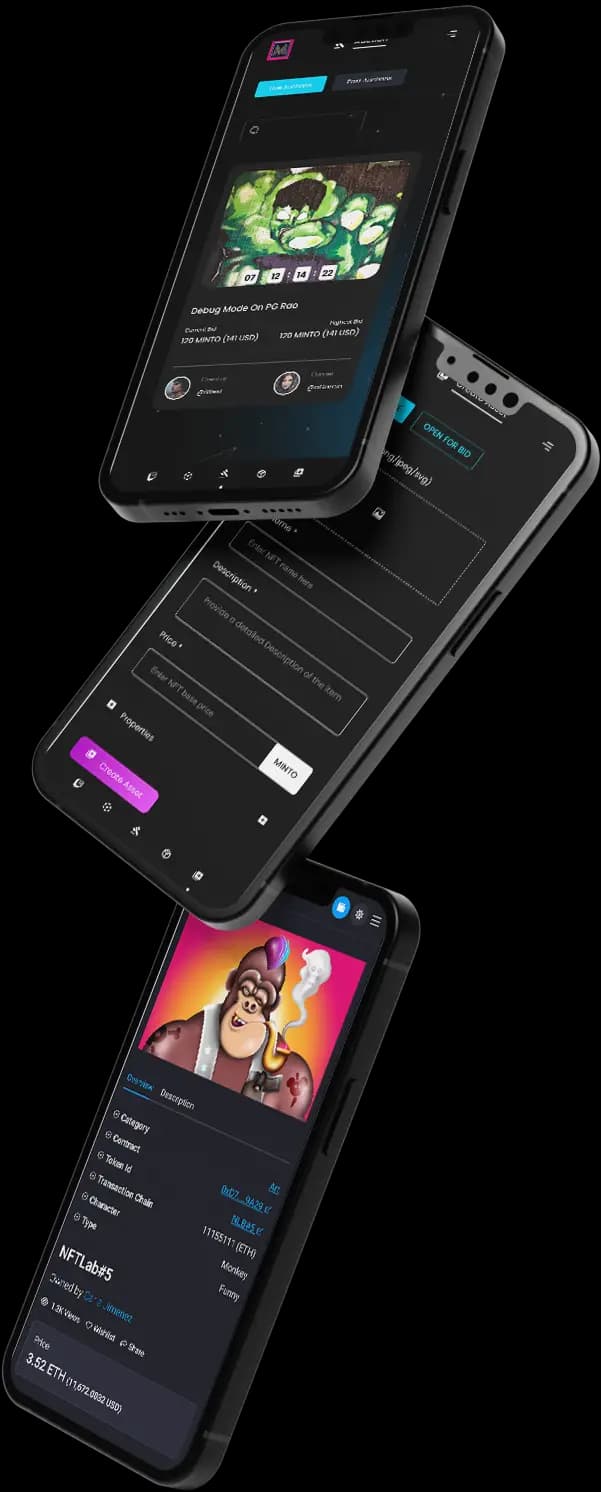
An AI-first build of every marketplace mechanic: pricing intelligence that reads collection demand, fraud screening on listings and offers, and rarity and metadata integrity checks at scale. Three synced panels ship white-label with 100% source code, contract-audited. The almost-ready AI build goes live in 6 working days; a custom build takes 3 to 4 weeks.
Launch-ready from
$4,299
Synced panels
Almost-ready AI launch
Custom build
Source-code ownership
Trusted by the brands we build for

What a production-grade NFT marketplace buys you.
overview
An OpenSea clone app is an NFT marketplace platform: creators mint collections with royalties configured, collectors browse, bid, and purchase through fixed price, auction, and bundle mechanics, and smart contracts settle every sale atomically. It ships as a collector app, a creator studio, and an admin console for verification and governance.
The purpose is operating the venue for a collectibles, gaming, or membership economy you understand better than general marketplaces do. Marketplace fees on primary sales and secondary trades, plus launchpad and verification services, are the operator's revenue lines.
The engineering bar is contract correctness and indexing: audited marketplace contracts with royalty distribution at settlement, event-driven indexers with reorg-safe confirmations, and lazy minting that removes upfront gas from creators' risk.
NFT activity concentrates around gaming assets, memberships, and brand collectibles in current market coverage, and vertical marketplaces with verified communities continue to attract volume that general platforms scatter.
The summary layer above the panel detail below.
Sales execute in the marketplace contract so assets and payment never move separately, with royalties in the same settlement.
Fixed price, Dutch and English auctions, and bundles, all contract patterns enforced off-chain via EIP-712 orders.
Creator signatures authorize items off-chain and NFTs mint on first purchase, removing upfront gas risk.
MetaMask, WalletConnect, and mobile adapters with gas-aware transaction previews.
Event-driven indexers per chain keep listings and ownership truthful under chain reorganizations.
Collection-level royalty configuration with your optional-royalty marketplace policy applied consistently.
A verification queue with metadata integrity checks that keeps impersonation out.
Allowlists, drop windows, and reveal mechanics for generative launches.
What these buyers share: an ecosystem or IP worth collecting, and the intent to run the venue rather than rent shelf space on one.
Run the marketplace for your in-game asset economy, with pricing intelligence that keeps the economy healthy as supply grows.
Tokenize memberships and collectibles for fans, with verified collections and drop mechanics that protect the brand.
Add on-chain ownership to communities that already publish, and earn the marketplace fee on the secondary market you create.
Build the marketplace layer for a chain or L2 ecosystem, with governance and royalty policy in your control.
Move access credentials on-chain with transfer rules enforced by contract, and collect fees on every legitimate resale.
$ moxace launch --nowContract-level royalty enforcement, verified collection flows, and an indexing layer that stays correct when the chain reorganizes. Those three, done properly, are the build.
Share your idea
a quick call, no deck required
See the live demo
every screen, admin to user
Launch with source
full code, your brand, your servers
Collectors, creators, and your operations team each get a surface.
Discover, bid, and collect.
Mint and manage collections properly.
Marketplace governance and safety.
Beyond collection administration: the operational systems that keep a marketplace governable at scale.
Review queues for listings and collections, guideline enforcement, and takedown workflows that keep impersonation and stolen assets out of the venue.
Collection verification with metadata integrity checks and revocation paths, so the checkmark stays meaningful instead of decaying into decoration.
Per-chain and per-collection fee configuration, royalty policy administration, and automated creator payouts, with every parameter reporting into analytics.
Smart contract management across standards and chains, gas optimization settings, and indexer health monitoring with reorg alerts before users notice.
Wash-trading pattern flags, bot offer detection, suspicious transaction reviews, and dispute resolution, protecting the price signals your fees price against.
Real-time sales, user behavior, and trending-collection dashboards, so drop scheduling and featured placements run on evidence.
The collector and creator journey across contracts, bids, and settlement.
A collector connects MetaMask or WalletConnect, and gas-aware previews show every transaction cost before confirmation.
A creator defines metadata and traits, configures royalties, and mints directly or uses lazy minting so items materialize on purchase.
Items list at fixed price, in Dutch or English auctions, or as bundles, with signatures enforced by EIP-712 typed orders off-chain.
Collectors bid, receive outbid alerts, and send counteroffers; the indexer keeps listings and ownership truthful with reorg-safe confirmations.
On acceptance or auction close, the contract settles atomically: funds move to the seller, the NFT to the buyer, no partial states.
Creator royalties distribute at settlement per the collection's configuration, and the sale lands in analytics for both sides.
Five model-driven systems working the same order stream. Each ships pre-tuned for NFT marketplaces and sharpens as your data compounds.
Reads floor prices, trait demand, and volume trends per collection so price suggestions and featured placements use evidence.
Floor histories, trait-level sales, volume trends
Listings priced where trades actually happen
Flags stolen-asset listings, bot offer walls, and wash-trading patterns before they distort the market.
Listing provenance, offer patterns, account graphs
A marketplace collectors trust with real money
Verifies that collection metadata and media match what was promised at mint, catching rug-style edits.
Metadata hashes, IPFS state, edit history
Verified collections stay verified
Projects drop demand from allowlist engagement and collection history so drop windows and pricing are set deliberately.
Allowlist signups, social signals, past drop curves
Drops that sell through instead of stalling
Ranks the explore feed per collector from collecting history and trait affinity.
Purchase history, browsing, watchlists
Higher conversion from the same supply
The modules that turn a listing site into a full collectibles economy, each toggleable and configurable per chain.
Fractionalize high-value assets so collectors buy shares instead of whole pieces, with the contract handling share accounting and redemption governance.
Comments, likes, follows, and shareable collection pages, because collectibles communities are social objects and the feed is where volume forms.
NFTs with embedded interactive elements and metadata that evolves with game state or campaign milestones, indexed and rendered faithfully.
Algorithmic rarity scoring from trait distributions, helping collectors evaluate assets and giving your featured placements a defensible ranking.
Badges, achievements, and loyalty programs for active collectors and traders, driving repeat visits without unpriced giveaways.
DAO-style community input on platform policies, fees, and upgrades where your operator model wants it, engineered against the same contracts.
platform concepts
Contract-level settlement is the first concept: sales execute atomically in the marketplace contract, so an NFT and its payment never move separately, and royalty distribution happens in the same settlement rather than as a favor. Auction mechanics, fixed price, Dutch, English, and bundles, are all contract patterns, not UI states.
Indexing is the second. Event-driven indexers per chain watch the contracts and rebuild marketplace state, with reorg-safe confirmations so a chain reorganization cannot leave your listings lying. Lazy minting is the third: creator signatures authorize items off-chain, and the NFT mints on first purchase, which removes upfront gas from the creator's risk. Verification and royalty policy sit in the admin panel as governance, applied consistently across collections, with pattern flags watching the volume your fee schedule prices.
insight
The NFT market has moved past its speculation phase into utility phases: gaming assets, memberships, ticketing, and brand collectibles now carry the volume that pure art speculation used to. Industry trackers put global digital payment value around $37 trillion for 2026 overall, and NFT-specific activity concentrates in verticals where the token is the product rather than the bet.
The strategic shift is from trading venues to economy venues. A marketplace that anchors a game's asset economy, a brand's membership program, or an event's ticketing lifecycle earns fees on every legitimate transaction in that economy, including resales it did not originate. That recurring capture, not one-time mint volume, is what makes an owned venue worth operating.
revenue model
Marketplace fees on primary sales and secondary trades are the core line, configurable per chain and per collection tier. Collection verification fees, featured-drop placements, and launchpad services for generative projects add direct revenue.
Royalty infrastructure is a product in itself: enforcing creator royalties at the contract level, with your policy on optional royalty markets set deliberately in the admin panel. Every fee line reports into per-collection analytics, so you can see which collections earn their placement.
Seven monetization lines on one contract core. The figures here are modelling inputs drawn from observed market pricing, not projections of your marketplace's earnings.
| Criteria | Revenue line | How it is charged | Typical range | What sets the ceiling |
|---|---|---|---|---|
| Marketplace transaction fees | A percentage of every primary and secondary sale, settled in-contract | 1.5% to 5% per sale by collection tier | Volume times fee, minus the fee pressure from rival venues courting your creators | |
| Listing and minting fees | Charged to creators on listings or mint events | Flat per listing or tiered by collection size | Creator economics; price it where launching on your venue beats self-serve alternatives | |
| Auction premiums | A higher take on auction-settled sales | 1 to 2 points above the base transaction fee | Bid competition per collection; premiums hold only where demand is real | |
| Verification and launchpad | Fees for collection verification and generative drop services | $500 to $10k+ equivalent per service by depth | The credibility of your verification; a queue that approves carelessly forfeits the line | |
| Featured placements | Sponsored slots and homepage placements for drops | Fixed campaign pricing by duration and surface | Trust. Placement priced on engagement data sells; placement priced on desperation repels | |
| Premium subscriptions | A monthly tier for creators and collectors with analytics, lower fees, and early access | $10 to $50+ per account per month | Attach rate among active accounts, and the only line that does not move with volume | |
| Tokenization services | Custom token and real-world-asset creation projects | Project-scoped engagements priced individually | Your contract engineering capacity and the compliance posture of each asset class |
Standard inclusions on every engagement, almost-ready or custom. Nine things you never have to ask for.
The complete unencrypted codebase transfers to you, with documentation and deployment scripts.
Your logo, colors, and store accounts across every panel, plus branded customer communications.
App store and Play Console submissions handled end to end, with production monitoring switched on.
Wallet and gateway integrations configured for crypto-native checkout and gas-aware transactions.
Pricing intelligence, fraud screening, and metadata integrity checks arrive configured for NFT marketplaces, not as raw APIs.
Languages, currencies, and tax display configured for your markets during the launch window.
Containerized services on AWS or Azure with autoscaling and queue-backed intake for peak traffic.
Operational dashboards, finance reconciliation views, and CSV exports so your team starts informed on day one.
Included support window plus product updates covering bug fixes, OS compatibility, and version upgrades.
Contract correctness and indexer reliability set the bar.
Audited marketplace contracts supporting fixed price, Dutch and English auctions, and bundle sales, with royalty distribution enforced at settlement.
Event-driven indexers per chain with reorg-safe confirmations, so listings, bids, and ownership stay truthful even under chain reorganizations.
MetaMask, WalletConnect, and mobile wallet adapters with gas estimation, EIP-712 typed signing for orders, and transaction previews before confirmation.
React Native apps, Next.js web, Node.js services, decentralized metadata on IPFS with pinning redundancy, and PostgreSQL for marketplace state.
Chain nodes and data providers, IPFS pinning services, fiat on-ramp gateways, and notification platforms ship as configured integrations, so the platform plugs into the ecosystem your venue already runs on.
Contract audits before launch, role-based access, append-only audit logs, and encrypted traffic and secrets come standard, so collection and custodian due diligence has answers before it is asked.
The almost-ready AI build, day by day. Store review times can add a short buffer outside our control.
Chains, royalty policy, and launch collections locked with a written scope, and your identity applied across all three panels.
Wallet infrastructure, chain nodes, fee schedules, and verification rules configured and tested against live contracts.
Founding collections verified and listed, then pilot trades run end to end: mint, list, bid, settle, royalty payout.
App store submissions with review buffers accounted for, contract audit complete, production monitoring on, and full launch with post-launch support and product updates included.
Both tracks ship the same contract core. The difference is time, price structure, and how much you want to change.
| Criteria | Almost-Ready AI Launch | Custom Build |
|---|---|---|
| Time to live | 6 working days from branding handoff | 3 to 4 weeks, scoped before work starts |
| Pricing | Fixed written quote after a short scoping call, no hourly meter | Estimated per module after the discovery call |
| Source code and IP | 100% ownership on delivery | 100% ownership on delivery |
| AI layer | Dispatch, forecasting, and personalization pre-tuned for the vertical | AI services designed around your workflows and data |
| Ecosystem coverage | Your launch chains configured on the audited contract core | Custom chains, launchpads, and game integrations built to your ecosystem |
| Best for | Operators who want to launch this quarter | Teams with bespoke workflows or a unique model |
| After launch | Post-launch support and product updates included | Post-launch support and product updates included |
$ moxace launch --nowBook a walkthrough and we will demo minting, auctions, and the verification queue on a live build, then send the written scope.
Share your idea
a quick call, no deck required
See the live demo
every screen, admin to user
Launch with source
full code, your brand, your servers
No two launches price the same. These are the factors that shape the written quote you receive after scoping.
The almost-ready AI build covers the proven feature set. Launchpads, multi-chain expansion, or game integrations add scoped estimate work.
Chain adapters, fee tiers, and collection taxonomies are configured per network. Adding chains means more configuration, never a rebuild.
Chain data providers, IPFS pinning, and on-ramp gateways are wired during the build, and each integration is estimated individually.
Out of the box, pricing intelligence, fraud screening, and metadata checks are pre-tuned for NFT marketplaces. Training models on your historical volume is an optional, separately scoped workstream.
The core build is a complete NFT venue. These modules add scale, sophistication, or adjacent economies, from day one or as you grow.
Optimistic rollup and zkRollup integration to cut transaction costs and confirmation times, which is often the difference between retail collectors transacting or bouncing.
Rewards for staking collectibles, tying holdings to your game or membership economy and giving collectors a reason to hold rather than flip.
Asset exchanges between supported chains inside one venue, opening trading across ecosystems without leaving your marketplace.
Immersive 3D showcase spaces for collections and drops, turning display into an event surface for your community.
Deeper rarity evaluation and fraud models trained on your marketplace's own history, beyond the pre-tuned core.
Extend the contract core to real estate, music rights, and luxury goods tokenization where your compliance posture permits.
Card and bank purchasing for collectors who do not hold crypto yet, wired through your gateway partners with AML screening.
Several branded marketplaces on one shared contract and indexing core, with separate branding and governance per tenant.
Ready-made speed with custom-build engineering discipline.
Atomic settlement, royalty enforcement, and reorg-safe indexing are core product logic, not plugins fighting each other.
A ready-made launch costs a fraction of a ground-up build, with a fixed written quote before work starts.
One hundred percent of the source code transfers to you, covering contracts, indexers, apps, and panels.
For the payment rails behind fiat ramps, see our fintech app development practice and our NFT marketplace development company work.
Canonical deployments from our own portfolio. Metrics are reported from live platforms, not projections.
A high-concurrency digital platform our engineering system ships and operates at 99.9% uptime, the same reliability bar every marketplace is held to.
A high-traffic digital platform our engineering system ships at franchise scale, the same brand-protection bar every collectibles build is held to.
A consumer marketplace platform from the same engineering system, proving transaction and trust cores hold under real-time load.
An NFT marketplace is contracts plus a legal posture. Here is the boundary, stated plainly.
Audited marketplace contracts, royalty enforcement, lazy minting, indexers, wallet integrations, verification workflows, and admin governance. Delivered as source code you own, with the audit completed before launch.
Legal clarity on what your tokens represent, consumer-protection compliance in your market, and any licenses your asset classes require. We build to your jurisdiction's expectations; we do not provide legal advice.
The contracts enforce whatever royalty policy you configure, including how optional-royalty markets are treated. That policy is a business and creator-relations decision, applied from your admin panel.
Decentralized storage with pinning redundancy and integrity checks that catch post-mint edits protect collectors from rug-style changes, which is what keeps verified collections worth trusting.
Wash-trading flags, bot detection, and dispute workflows keep your price signals real. A marketplace whose volume is fabricated cannot price anything, including its own fees.
the process
Discovery maps your chains, collections, and contract requirements, and the fixed written quote follows before work begins. Once you approve, you hand over your brand assets and we configure the platform: your identity across all three panels, your chains, royalty policy, and fee schedules. The almost-ready AI build goes live in 6 working days; a custom build takes 3 to 4 weeks, with a contract audit before launch on every build.
After launch you hold 60 days of included support and 12 months of updates, with a trained operations console. The first 90 days are collection-side work: verifying founding collections, watching indexer health through real market conditions, and tuning royalty policy and fee tiers from live volume. Marketplaces earn creator loyalty in that window, and verified supply is what pulls collectors after it.
Open the web app, sign in with the printed demo credentials, or install the Android build — no signup, no sales call. What you see is what you launch.
Access: Shared on a guided call
Access: API routes, contracts, admin Settings
$ moxace launch --nowBook a free consultation and get a written scope and quote.
Share your idea
a quick call, no deck required
See the live demo
every screen, admin to user
Launch with source
full code, your brand, your servers
Moxace is an independent software development company. We are not affiliated with, sponsored by, or endorsed by OpenSea.
The phrase “OpenSea clone” is used descriptively. It is how the software industry refers to building a platform with similar functionality, and how buyers search for one.
The design and codebase are built entirely by our in-house team. Nothing is taken from the OpenSea website, applications, or brand assets.
OpenSea and all third-party names and marks remain the property of their respective owners, referenced here only to describe the category of software we build.
Read the full legal notice on our disclaimer page.