Standardized service catalogs
Every category is defined as packaged services with fixed inclusions, durations, and prices, so customers know exactly what they are buying.
AI-Built UrbanClap Clone
An AI-first build of every home-services marketplace mechanic: pro matching that ranks on skill and reliability, transparent pricing that wins the customer's trust before the booking, and job lifecycle tooling from quote to completion. Every panel ships white-label with 100% source code, owned by you from day one. The almost-ready AI build goes live in 6 working days; a custom build takes 3 to 4 weeks.
Launch-ready from
$2,799
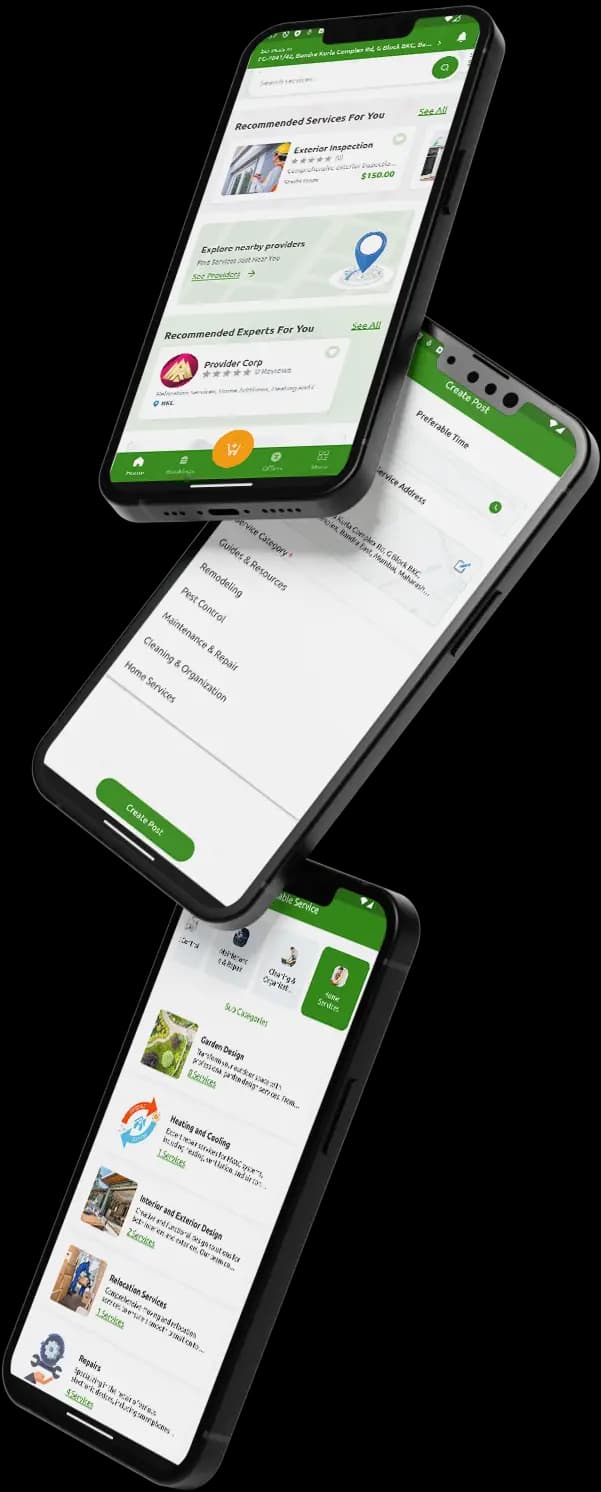
Synced panels
Almost-ready AI launch
Custom build
Source-code ownership
Trusted by the brands we build for



Canonical facts, not promises.
overview
An UrbanClap (Urban Company)-style marketplace is a home-services platform where customers book verified professionals for cleaning, repairs, beauty, tutoring, and dozens of other categories, with standardized packages and transparent prices set by the platform rather than negotiated door to door.
Its purpose is trust at scale in a fragmented supply market. Home services have historically been informal, inconsistent, and cash-based; the platform wins by standardizing what the service includes, what it costs, and who shows up, then earning a commission on every completed booking.
At a high level the platform includes a customer app with category browsing and booking, a pro partner app for jobs, schedules, and earnings, and an admin panel over categories, pro verification, pricing, and quality control.
Market context, hedged: organized home services have grown strongly in dense urban markets where informal supply is the status quo, and commentary frequently notes that quality consistency, not price, is the binding constraint. We make no claims about any specific market's size; the build is designed so quality controls and unit economics are visible from day one.
The headline capabilities, at product level.
Every category is defined as packaged services with fixed inclusions, durations, and prices, so customers know exactly what they are buying.
Matches bookings to pros by skill, rating, location, and availability, optimizing schedules so pros spend hours working, not traveling.
Document checks, skill assessments, and background screening gates that keep the supply side credible from the first booking.
Platform-set package prices with visit-fee and add-on rules per category, configured per city from the admin panel.
Booking, arrival tracking, job completion, before-and-after evidence, and payment collection governed by one state machine.
Two-sided ratings with audit follow-ups, re-visit guarantees, and quality flags that decide who keeps getting work.
Subscription packages for repeat services like cleaning, the retention engine of the category.
Per-job earnings, incentives, and scheduled payouts with statements, so supply loyalty compounds.
What these buyers share: a city they know well and the desire to organize its fragmented service supply.
Building the default services app for one metro, where supply quality and density, not features, decide the winner.
Salons, cleaning companies, and repair firms productizing their operations into a platform with third-party supply.
Running the marketplace across cities with per-city pricing, supply, and quality controls in one deployment.
Owning one category deeply, from beauty to tutoring, where standardized packages beat generic listings.
Deploying the white-label build for clients under separate brands, every deployment a standalone business on 100% source code.
Three products operating as one system. Every panel ships in every build.
Booking home services without the phone tag.
The supply side's daily driver.
Run the marketplace from one console.
Four consoles, one view of pros, jobs, and money.
The pro verification queue with credential checks, category and package configuration, and city-level pricing rules governing what each market sees.
AI matching and scheduling controls, the job state machine with re-visit handling, and live operations dashboards across active bookings.
Quality audit workflows with checklist evidence, the dispute resolution queue with the evidence trail, and two-sided rating oversight.
Revenue reporting across commissions and plans, pro payout reconciliation per job, and CSV exports for finance.
The journey both sides repeat, engineered end to end.
The customer browses standardized packages with fixed inclusions and prices, adds any options, and sees the total before booking.
They choose a time window; the matching engine reserves a verified pro with the right skills and shows the profile up front.
The pro accepts, the customer tracks arrival in the app, and the job's checklist loads on the pro's device.
The pro works through the checklist, captures before-and-after evidence, and marks completion; the customer confirms in app.
Payment collects in app with tipping, ratings flow both ways, and any issue triggers the re-visit or refund workflow.
Pro earnings post to their ledger, quality signals feed matching, and the best pros see more work automatically.
Five model-driven systems working the same booking stream. Each ships pre-tuned for home services and sharpens as your data compounds.
Matches bookings to pros by skill, rating, location, and availability, and optimizes daily schedules to cut travel time.
Pro profiles, job history, locations, availability
More jobs per pro-day and higher fulfillment rates
Projects bookings by category, zone, and season so pro supply and incentives land before the weekend rush.
Booking history, seasonality, weather, events
Supply matched to demand instead of guesswork
Flags pros whose job patterns predict complaints before ratings collapse, triggering audits and retraining.
Ratings, re-visits, completion evidence, dispute history
Quality problems caught while they are still small
Recommends package prices and surge settings per city and category against conversion and margin data.
Conversion curves, fulfillment rates, cost signals
Prices that win bookings without eroding margin
Classifies complaints, recommends remedies from policy, and routes the hard cases to humans with context attached.
Chat, job records, photos, policy documents
Faster resolutions and fewer escalations
platform concepts
The first concept is standardization as product. The marketplace's core offer is a promise: this package, these inclusions, this price, this quality bar. Everything in the build, from catalogs to checklists to audits, exists to keep that promise at scale, because trust is the only thing customers are really buying.
The second is supply-side economics. Pro earnings, incentives, and platform commissions reconcile per job, and package prices configure per city. That visibility is what lets you run a launch city with aggressive incentives and a mature city with healthy margins on the same deployment.
The third is the job state machine. Every booking moves through booked, confirmed, in-progress, completed, and settled states, with re-visits and disputes as governed transitions. When something goes wrong, the state machine and the evidence trail decide, not memory.
Commission on every completed booking, configurable per category and city.
Membership and recurring-service plans that turn one-off customers into subscribers.
Featured placement and category sponsorships sold to top-rated pros.
Every rate is admin-configurable, so you can tune the economics per city without a code release.
Four groups, each mapped to the part of the services promise it protects.
A core offer of this package, these inclusions, this price, this quality bar, with everything from catalogs to checklists to audits keeping that promise at scale, because trust is the only thing customers are really buying.
Bookings moving through booked, confirmed, in-progress, completed, and settled states with re-visits and disputes as governed transitions, so when something goes wrong the state machine and evidence trail decide, not memory.
Pro earnings, incentives, and platform commissions reconciling per job with package prices per city, so a launch city runs aggressive incentives while a mature city runs healthy margins on the same deployment.
AI matching and scheduling controls, pro verification with credential checks, quality audit workflows, and two-sided ratings that keep the promise honest as volume grows.
insight
On-demand home services keep compounding past the five-billion-dollar mark in platform GMV globally by 2030 on widely published forecasts, with organized marketplaces replacing informal word-of-mouth where standardized quality beats the neighborhood handymen. The category's economics reward operators who own the quality bar.
The engineering wedge is the job state machine and supply economics: bookings that resolve from governed states and evidence, and pro earnings that reconcile per job, are what keep customers and pros both. The revenue table below quantifies the lines.
Six monetization lines across the platform, quantified against published industry benchmarks. Every rate is admin-configurable; the figures here are modelling inputs, not projections of your platform's earnings.
| Criteria | Revenue line | How it is charged | Typical range | What sets the ceiling |
|---|---|---|---|---|
| Booking commissions | Per completed job by category and city | Commissions commonly 15% to 25% of booking value | Job quality. Commissions hold while jobs stay promise-keeping | |
| Membership plans | Recurring service plans for households | Subs commonly $10 to $100+ per month | Habit depth. Subs earn while service stays reliable | |
| Featured placement | Sponsored pros in category search | Ads commonly 2% to 5% of GMV | Ranking honesty. Placement earns while ratings stay real | |
| Materials and parts | Markup on supplies procured through jobs | Margins commonly 10% to 30% of materials value | Transparency. Markup earns while pricing stays honest | |
| B2B contracts | Facilities and property contracts | Contracts commonly $500 to $50,000+ per month | Service SLAs. Contracts hold while audits stay clean | |
| White-label deployments | Branded platforms for regional operators | Deployments commonly $10,000 to $100,000+ | Market demand. Deals close while per-city config stays cheap |
Standard inclusions on every engagement, almost-ready or custom. Nine things you never have to ask for.
The complete unencrypted codebase transfers to you, with documentation and deployment scripts.
Your logo, colors, and store accounts across all three panels, plus branded customer and pro communications.
App store and Play Console submissions handled end to end, with maps, tracking, and production monitoring switched on.
Stripe, PayPal, and regional gateways configured for booking payments, pro payouts, and a reconciliation view for finance.
Matching, forecasting, and quality scoring arrive configured for home services, not as raw APIs.
Languages, currencies, and tax display configured for your markets during the launch window.
Containerized services with scheduling engines and autoscaling for weekend-peak traffic.
Revenue dashboards, fulfillment and quality reports, and CSV exports so your operations team starts informed on day one.
Included support window plus product updates covering bug fixes, OS compatibility, and version upgrades.
Matching and quality control are the product. We engineer them first.
Constraint-based matching over skills, location, and availability, with travel-time optimization that shows up as pro earnings.
Every booking governed by explicit states with evidence capture at completion, so disputes resolve from records rather than memory.
Booking payments, pro payouts, tips, and refunds through Stripe, PayPal, and regional gateways, reconciled per job.
Containerized services on AWS or GCP with geospatial data stores and autoscaling. See the wider delivery landscape in our Uber-style build track.
Maps and routing, SMS and email, background-check vendors, and analytics exports ship as configured integrations.
Pro verification hooks, role-based access, encrypted traffic and secrets, and audit logs come standard, so compliance questions have answers before they are asked.
The almost-ready AI build, day by day. Store review times can add a short buffer outside our control.
Launch city, categories, and package pricing locked with a written scope, and your identity applied across all three panels.
Gateways, maps, category catalogs, and city pricing configured and tested against your live accounts.
First pros verified and onboarded, and live test bookings run end to end: book, match, track, complete, pay, rate.
App store submissions with review buffers accounted for, production monitoring on, and full launch with post-launch support and product updates included.
Both tracks ship the same marketplace core. The difference is time, price structure, and how much you want to change.
| Criteria | Almost-Ready AI Launch | Custom Build |
|---|---|---|
| Time to live | 6 working days from branding handoff | 3 to 4 weeks, scoped before work starts |
| Pricing | Fixed written quote after a short scoping call, no hourly meter | Estimated per module after the discovery call |
| Source code and IP | 100% ownership on delivery | 100% ownership on delivery |
| AI layer | Matching, forecasting, and quality scoring pre-tuned | AI services designed around your categories and data |
| Categories | Standard home-services catalogs ready to configure | Category set and packages built to your market |
| Best for | Operators who want to launch this quarter | Teams with bespoke workflows or a unique model |
$ moxace launch --nowBook a walkthrough and we will demo matching, the job lifecycle, and the admin console on a live build, then send the written scope.
Share your idea
a quick call, no deck required
See the live demo
every screen, admin to user
Launch with source
full code, your brand, your servers
No two launches price the same. These are the factors that shape the written quote you receive after scoping.
The almost-ready AI build covers the proven feature set. Custom categories, membership engineering, or bespoke vendor contracts add scoped estimate work.
City pricing, category catalogs, and language packs are configured per market. Adding cities means more configuration, never a rebuild.
Maps, background-check vendors, payment rails, and analytics are wired during the build, and each integration is estimated individually.
Out of the box, matching and forecasting are pre-tuned for home services. Training on your own booking history is an optional, separately scoped workstream.
Extend the UrbanClap-style build once the core booking loop is running.
Recurring maintenance plans with automated scheduling, the frequency driver that turns one-off jobs into annuities.
Modality-specific credential verification and session standards, the highest-frequency vertical in home services.
Training and certification tracks feeding the supply ladder, raising quality while creating loyalty.
Parts and supplies procured through jobs with transparent pricing, capturing the transaction around the service.
Property and facilities contracts with SLA reporting and audit schedules, anchoring institutional volume.
Deploy the platform for regional operators under their own identity, with per-city packages, commissions, and pro terms.
Marketplace economics with quality-grade engineering.
Catalogs, checklists, and audits are core product logic, because the promise is the product.
Earnings, incentives, and schedules engineered so pros earn more per day, the real supply-retention strategy.
One hundred percent of the source code transfers to you. No per-booking royalties, no black-box dependencies.
For on-demand logistics categories, see our Uber-style build on the same engineering system.
Canonical deployments from our own portfolio. Metrics are reported from live platforms, not projections.
A high-traffic consumer platform our team ships and operates at national-carrier scale, the same bar every build is held to.
A consumer platform from the same engineering system, proving the infrastructure core holds under load with strict uptime demands.
A high-volume consumer experience our team ships at global-release scale, the same discipline applied to every launch.
Tap a card to see how the platform defends its promise.
This package, these inclusions, this price, this quality bar, kept at scale by catalogs, checklists, and audits, because trust is the only thing customers are really buying.
Bookings move through booked, confirmed, in-progress, completed, and settled states with re-visits and disputes as governed transitions, so the state machine and evidence trail decide, not memory.
Pro earnings, incentives, and commissions reconcile per job, so payout reliability is engineering rather than a promise, and pros stay where their money is honest.
Quality audit workflows with checklist evidence and two-sided ratings keep the promise honest as volume grows, with disputes carrying their evidence trail.
Package prices and commissions configure per city, so a launch city runs aggressive incentives while a mature city runs healthy margins on the same deployment.
AI matching and scheduling honor verified credentials and category expertise, so the pro who arrives is the pro the job requires.
the process
The engagement starts with a discovery call covering your city, categories, and supply plan, then a written scope and quote before work begins. On the almost-ready AI path you hand over branding assets, we apply them across every panel, configure categories and pricing, and go live in 6 working days. Custom modules are quoted in writing first.
After launch, support and product updates are included. The first 90 days are supply operations: verifying pros personally, auditing early jobs, and tuning package prices against conversion. The platform makes the engineering reliable; quality and density are the business you build.
Open the web app, sign in with the printed demo credentials, or install the Android build — no signup, no sales call. What you see is what you launch.
$ moxace launch --nowBook a free consultation and get a written scope and price.
Share your idea
a quick call, no deck required
See the live demo
every screen, admin to user
Launch with source
full code, your brand, your servers
Moxace is an independent software development company. We are not affiliated with, sponsored by, or endorsed by UrbanClap.
The phrase “UrbanClap clone” is used descriptively. It is how the software industry refers to building a platform with similar functionality, and how buyers search for one.
The design and codebase are built entirely by our in-house team. Nothing is taken from the UrbanClap website, applications, or brand assets.
UrbanClap and all third-party names and marks remain the property of their respective owners, referenced here only to describe the category of software we build.
Read the full legal notice on our disclaimer page.