Modular service verticals
Rides, food, courier, and grocery ship as independent modules over a shared core, so a food spike can never take down rides.
AI-Built Super App Clone
An AI-first build of the multi-service model: one dispatch core that learns across rides, food, and parcels, demand forecasting that positions every vertical's supply, and a shared wallet guarded by fraud screening. Four synced panels ship white-label with 100% source code, owned by you from day one. The almost-ready AI build goes live in 6 working days; a custom build takes 3 to 4 weeks.
Launch-ready from
$4,599
Synced panels
Almost-ready AI launch
Custom build
Source-code ownership
Trusted by the brands we build for



overview
A super app is a single mobile platform that bundles multiple on-demand services, typically rides, food delivery, parcels, and often grocery and home services, behind one account, one wallet, and one interface. The customer opens one app for their daily transactions; the operator earns commission on all of them. Grab, Gojek, and Careem built category-defining businesses on this architecture, and the pattern is the reference point for regional platforms everywhere.
The business purpose is acquisition leverage. Customer acquisition is the most expensive line item in on-demand, and a super app pays that cost once: a rider acquired for airport trips becomes a food customer in the same week without another marketing dollar. Shared wallets and cross-service loyalty compound the effect, which is why single-service apps in the same market struggle to match the economics.
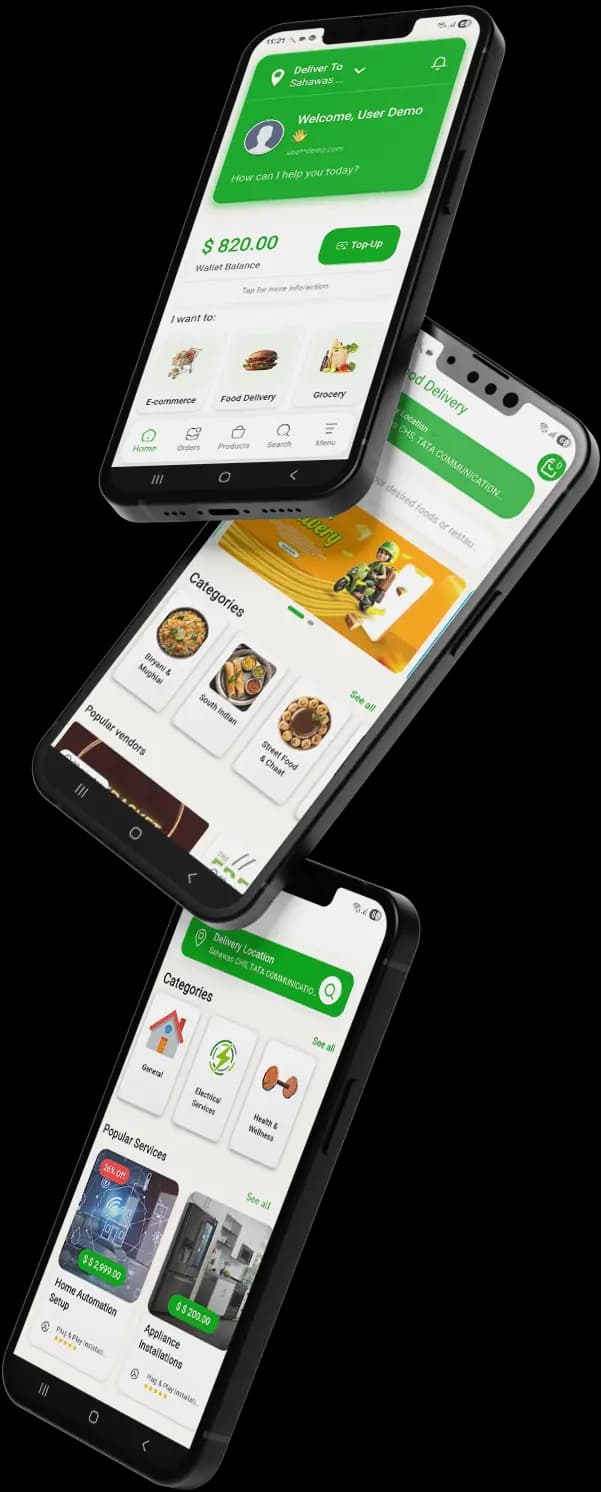
The platform includes a customer app with a configurable service grid, provider apps where drivers and couriers switch earning modes, a merchant panel for partner storefronts, and an admin console that toggles services per city, prices commissions per vertical, and reports across all of them. Underneath, a shared identity, wallet, and ledger core serves every vertical independently.
Multi-service platforms dominate consumer mobile usage across much of Asia, the Middle East, and Latin America according to widely published industry analyses, and the model keeps expanding into new regions and verticals. Operators who build on a modular, vertical-ready core can ride that expansion without rebuilding their platform for each new service.
The summary layer above the panels: what makes multi-service actually work.
Rides, food, courier, and grocery ship as independent modules over a shared core, so a food spike can never take down rides.
A single double-entry ledger funds every vertical, with balances, refunds, and loyalty posting to one auditable book.
Service availability, pricing, and supply are scoped by city or zone, so each market launches with the mix you choose.
Customers find a store, a service, or a destination from one search bar, which is what makes the app a daily habit.
Loyalty earned on rides spends on food, the compounding loop that makes the model worth building.
Drivers and couriers switch job types in a single app, raising utilization and simplifying onboarding and KYC.
Cohort, funnel, and utilization dashboards span services, showing which vertical acquires customers and which keeps them.
Commissions, promos, and surge rules set per vertical, tier, and city from the panel, with no code release.
What these buyers share: an existing market position or serious capital, and the conviction that one platform with many verticals beats funding four startups.
Operators with an existing on-demand business, usually delivery or rides, defending share by adding the verticals their customers already ask for.
Entering a market with no local incumbent, where buying one platform with many verticals beats funding four startups.
Digitizing into consumer services, converting fleet density and depot infrastructure into a consumer super app.
Adding on-demand channels to physical networks, with stores doubling as pickup and fulfillment infrastructure.
Needing one proven multi-service platform to deploy for clients across several countries, with per-city toggles per deployment.
A service framework, not a fixed bundle: switch verticals on per market.
The home screen your market opens daily.
One app, multiple earning modes.
Where your supply side manages demand.
One console for every vertical and city.
The product journey, end to end.
The customer lands on a service grid where rides, food, parcels, and more appear as tiles, each enabled per city by the admin.
A single top-up funds every vertical; balances, loyalty points, and membership perks are shared accounts, not per-service silos.
Each service runs its own booking flow: pick a car, order food, or send a parcel, with pricing rules and supply pools scoped to that category.
Vertical dispatch modules assign nearby providers over a common identity and ledger core, so one driver app can serve several job types.
Live tracking runs per service type, and payment draws from the shared wallet, card, or cash with every line posted to one ledger.
Cross-service ratings and loyalty tiers reward frequency, which is the compounding loop that makes a super app worth building.
Five model-driven systems working the same cross-vertical job stream. Each ships pre-tuned for multi-service operations and sharpens as your data compounds.
Scores nearby drivers and couriers on proximity, active load, and rating for every job type, re-scoring as conditions change across verticals.
Provider locations, active jobs across verticals, ratings, traffic
Faster assignments in every vertical from one supply pool
Projects demand per service, zone, and daypart so each vertical's supply is positioned before its rush arrives.
Order history per vertical, zone activity, weekday patterns
Balanced supply across services instead of feast and famine
Ranks the service grid and storefronts per customer from cross-vertical history, so the home screen sells the next booking before it is searched.
Booking history across verticals, browsing, wallet spend
Higher open-to-book conversion and more services per customer
Flags top-up anomalies, collusive patterns, and refund abuse across every vertical before they reach the settlement run.
Top-up sources, cross-vertical spend patterns, refund history
Lower fraud losses on the ledger that touches everything
Tunes loyalty tiers and provider bonuses per city and vertical from acceptance and retention data, so perks spend where they compound.
Acceptance rates, tier uptake, cross-vertical retention
Loyalty economics that pay for themselves
platform concepts
Every job is a state machine on a shared event backbone. Rides, food, and parcels each carry their own states (requested, accepted, preparing, picked up, delivered, cancelled), and every transition is an idempotent event with an actor and a timestamp. One admin panel governs every vertical because every vertical writes to the same event log.
Zone and market economics set the price of everything. Service zones carry their own fare books, commission rates, and surge rules, and commissions price per vertical, tier, and city from the admin panel. That layering is what lets you discount rides in one market while food margins carry another, and add a new market as configuration rather than code.
Supply lives in one provider catalog with many modes. Drivers and couriers switch job types from a single profile that carries documents, vehicle classes, and KYC status, so onboarding happens once and utilization rises across verticals. For deeper grocery depth, see grocery delivery app development.
revenue model
Each vertical contributes its own commission line, and the shared wallet multiplies all of them: balances loaded for a ride get spent on food, which means acquisition cost amortizes across services. Add delivery fees, sponsored placement, membership subscriptions, advertising inventory, and corporate or institutional accounts. The admin panel prices every lever per city, so you can discount rides in one market while food margins carry another.
The engineering reality of a super app is service independence: the food vertical must survive a dispatch outage, and the wallet must never go down. We build the verticals as separable modules over a shared identity and ledger core, which is also what makes them easy to extend, for example by adding a grocery vertical via our grocery delivery app development team or logistics depth through our logistics software development practice.
Standard inclusions on every engagement, almost-ready or custom. Nine things you never have to ask for.
The complete unencrypted codebase transfers to you, with documentation and deployment scripts. No per-ride licensing, no vendor lock-in.
Your logo, colors, typography, and store accounts applied across every panel, plus branded customer communications.
App store and Play Console submissions handled end to end, with production monitoring switched on at go live.
Stripe, PayPal, and regional gateways configured, with automated split payouts across platform, partners, and providers.
Cross-service dispatch, demand forecasting, and personalized discovery arrive configured for multi-service operations, not as raw APIs.
Languages, currencies, and tax display configured for your markets during the launch window.
Containerized services on AWS or Azure with autoscaling and queue-backed job intake for peak-hour traffic.
Operations dashboards, finance reconciliation views, and CSV exports so your team starts informed on day one.
Included support window plus product updates covering bug fixes, OS compatibility, and version upgrades.
Shared core, independent verticals.
Identity, wallet, and ledger services on PostgreSQL with double-entry records; the wallet is its own service with its own uptime budget.
Modular dispatch and catalog services (rides, food, courier) that can deploy and fail independently, wired through Redis queues.
Flutter or React Native with a module registry, so a new service tile ships as a client update without touching the core.
Stripe, Adyen, and regional gateways with per-vertical settlement splits and automated provider payouts.
AWS, GCP, or Azure on Kubernetes with per-service autoscaling and horizontal dashboards for cross-vertical funnels.
POS systems, accounting exports, SMS and WhatsApp providers, and mapping ship as configured integrations, so the platform plugs into the tools your operations already run on.
Role-based access, append-only audit logs, encrypted traffic and secrets, and rate-limited endpoints come standard, so compliance questions have answers before they are asked.
Day by day for the almost-ready AI build. Store review can add a short buffer outside our control, and custom builds take 3 to 4 weeks.
Service categories, launch sequencing, payment rails, and commission logic locked with a written scope, and your identity applied across all four panels.
Gateways, wallet rules, per-city service toggles, and fare books configured and tested against your live accounts.
Drivers, couriers, merchants, and zones bulk-imported with KYC checks armed, then live test jobs run end to end across two verticals: booking, dispatch, completion, payout.
App store and Play Console submissions with review buffers accounted for, production monitoring switched on, and full launch with post-launch support and product updates included.
Both tracks ship the same dispatch and wallet core. The difference is time, price structure, and how much you want to change.
| Criteria | Almost-Ready AI Launch | Custom Build |
|---|---|---|
| Time to live | 6 working days from branding handoff | 3 to 4 weeks, scoped before work starts |
| Pricing | Fixed written quote after a short scoping call, no hourly meter | Estimated per module after the discovery call |
| Source code and IP | 100% ownership on delivery | 100% ownership on delivery |
| AI layer | Dispatch, forecasting, and personalization pre-tuned for mobility | AI services designed around your workflows and data |
| Service verticals | Rides, food, and courier configured and ready | Any vertical mix engineered to your spec |
| Branding | White-label: your name, colors, and store accounts | Built to your product spec end to end |
| After launch | Post-launch support and product updates included | Post-launch support and product updates included |
$ moxace launch --nowBook a walkthrough and we will demo the dispatch core, the shared wallet, and the per-city toggles on a live build, then send the written scope.
Share your idea
a quick call, no deck required
See the live demo
every screen, admin to user
Launch with source
full code, your brand, your servers
No two launches price the same. These are the factors that shape the written quote you receive after scoping.
The almost-ready AI build covers the proven feature set. Extra verticals, bespoke loyalty schemes, or regional compliance work add scoped estimate work.
Service toggles, fare books, and language packs are configured per market. Adding cities or verticals means more configuration, never a rebuild.
Payment gateways, POS systems, and regional rails are wired during the build, and each integration is estimated individually.
Out of the box, dispatch, forecasting, and discovery are pre-tuned for multi-service operations. Training models on your historical cross-vertical data is an optional, separately scoped workstream.
Multi-service is an architecture decision before it is a business decision.
Rides, food, and courier ship on day one; each new vertical is a module, not a rebuild. Launch sequencing stays your choice, per city.
Double-entry ledger, separated refund flows, and reconciliation reports that survive a finance review, because the wallet touches every vertical.
A food spike cannot take down rides. Services are isolated by design, which is the difference between a super app and a monolith with many buttons.
100% source-code ownership. Add verticals with our custom mobile app development team or your own engineers, no permission needed.
A sample of platforms our system has shipped, with the numbers they report in production.
An on-demand mobility platform from the same engineering system, proving the dispatch core holds under city-wide, real-time load.
A gaming platform from the same engineering system, holding uptime through launch windows and tournament-scale traffic.
A global brand-content platform our team ships and operates, carrying campaign video to worldwide audiences at broadcast scale.
One wallet moving money across many services must be strict by design. These controls keep the ledger trustworthy.
Rides, food, groceries, and every other vertical post to the same double-entry ledger, so balances and liabilities reconcile across services instead of drifting in per-silo books.
Cancellations and refunds reverse the original transaction path by rule, never as manual adjustments, so wallet math stays auditable when a month of activity is replayed.
Spend ceilings and payout rights tier by verification level, with higher limits unlocking only after KYC clears, so the wallet grows trust and exposure together.
Device, behavior, and velocity signals score every payment attempt before capture, stepping up or blocking risky patterns while honest users checkout without friction.
Merchant and driver settlements run on defined cycles with statements issued per partner, so any dispute starts from shared numbers rather than memory.
insight
You start with a discovery call that locks service categories, launch sequencing, payment rails, and commission logic, and you receive a written quote and dated plan. On the almost-ready path your brand, service grid, and wallet are configured and the apps are submitted to both stores inside the 6 to 9 day window. Custom verticals or regional compliance work run as scoped sprints with staging access throughout.
After handover, post-launch support and product updates are included. A realistic first 90 days: weeks one to four build driver, courier, and merchant density in your launch zones, weeks five to eight tune commissions, promos, and wallet incentives against real cross-vertical data, and by week twelve the cohort dashboards tell you which service acquires customers best and which city or vertical to open next.
Open the web app, sign in with the printed demo credentials, or install the Android build — no signup, no sales call. What you see is what you launch.
$ moxace launch --nowBook a free scoping call: written plan, fixed quote, and a go-live date inside the 6 to 9 day window.
Share your idea
a quick call, no deck required
See the live demo
every screen, admin to user
Launch with source
full code, your brand, your servers
All product names, trademarks, and brands referenced are the property of their respective owners, used for identification purposes only. Read the full legal notice on our disclaimer page.