True Multi-party calling
One-to-one and group video calls with adaptive bitrate, built on a peer-to-peer media layer with an SFU fallback when networks or group sizes demand it.
AI-Built Skype Clone
An AI-first build of every Skype mechanic: adaptive WebRTC calling that routes around weak networks, presence intelligence that knows who is reachable, and meeting summaries that turn conversations into searchable records. Three synced panels ship white-label with 100% source code, owned by you from day one. The almost-ready AI build goes live in 6 working days; a custom build takes 3 to 4 weeks.
Launch-ready from
$2,799
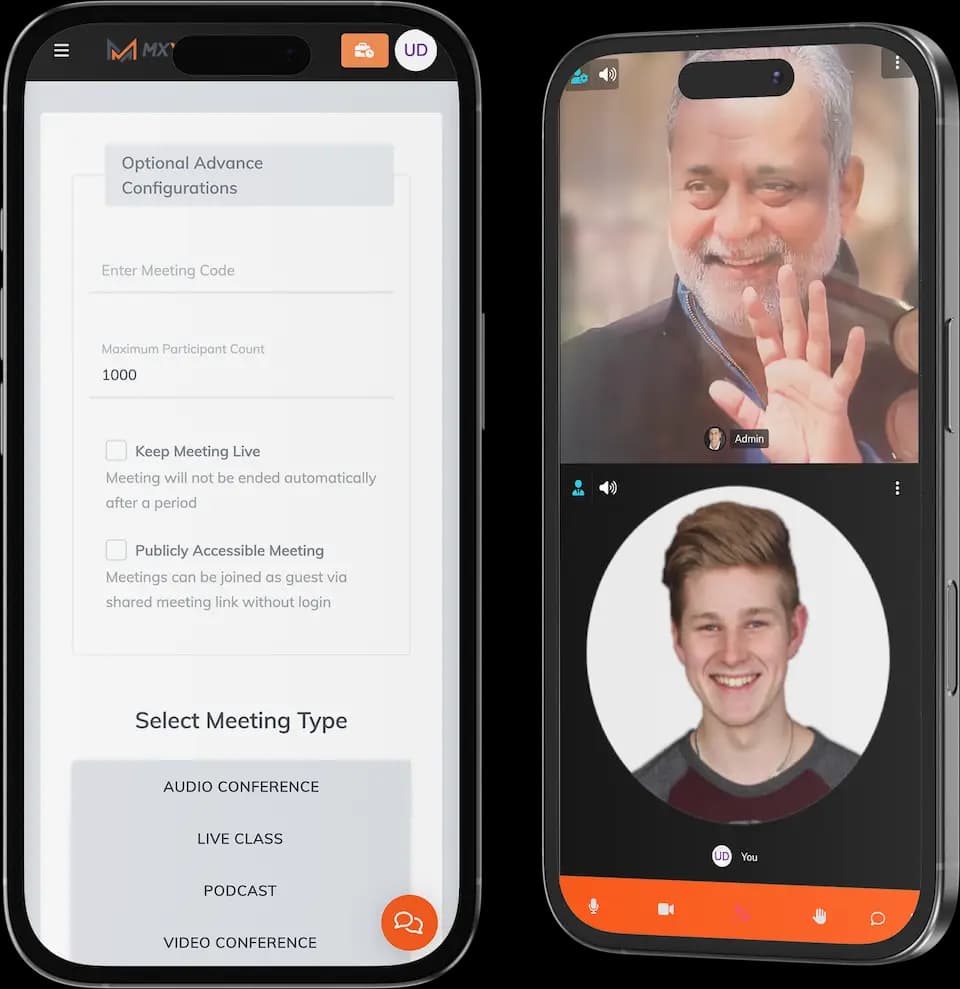
Synced Panels
Almost-ready AI launch
Custom build
Source-code ownership
Trusted by the brands we build for



What a production-grade clone buys you.
overview
A Skype clone app is a branded video calling and communication platform built on the same product shape: one-to-one and group calls, screen sharing, in-call chat, and a business layer for organizations. The label describes the category, not the code. You launch under your own brand, on your own infrastructure, with source code you own outright.
The business problem it solves is subscription communication without per-seat SaaS rent. Companies, communities, and education providers already pay monthly for calling tools, and an operator who owns the platform captures that recurring revenue instead of renting someone else's network.
A complete build includes the end-user calling app for iOS, Android, and web, a team and business panel for organizations, an admin console for tenants, plans, and call-quality monitoring, and the WebRTC media backend that carries the calls themselves.
Remote work and online learning have made owned communication platforms a durable category. Rather than quote market sizes, the practical signal is simpler: organizations already budget for calling per seat, and that budget is exactly what a white-label platform competes for.
The headline layer above the panels: what sells the platform.
One-to-one and group video calls with adaptive bitrate, built on a peer-to-peer media layer with an SFU fallback when networks or group sizes demand it.
Share a window, a full screen, or a document mid-call, with in-call chat and file drop so decisions and artifacts stay in the same session.
Captions, summaries, and action items generated after each call, so conversations produce searchable records instead of fading from memory.
Speech isolation tuned per device and environment, so calls stay intelligible from a cafe, a car, or a shared office.
Media paths chosen per session from network conditions and server load, with reconnects that resume the same call instead of dropping it.
Persistent channels, scheduled meetings, and call queues for organizations that treat calling as a workflow rather than an occasional event.
Record calls with a participant consent notice, store per tenant, and manage retention windows from the admin console.
Manage users, plans, quotas, and call-quality dashboards across every organization on your network from one place.
iOS, Android, and web apps from one codebase, so your brand shows up wherever a conversation starts.
What these buyers share: an audience that meets inside their product and the desire to own the software rather than rent it.
Building communications into an industry product, from telehealth to tutoring. The calling core ships ready, so your roadmap stays on the domain, not on media plumbing.
Deploying branded calling platforms for corporate clients under separate tenants. White-label configuration and 100% source code make every deployment a standalone business.
Running paid sessions at scale, with summaries and recordings as the retention features that keep students enrolled.
Whose delivery happens over video and who need consent-aware recording, waiting rooms, and audit trails they control.
Wanting calling under their own brand so the relationship, the data, and the subscription all stay in-house.
Three products operating as one system. Every panel ships in every build.
Calling your users will actually stay on.
For organizations running calls as a workflow.
Run the network from one console.
Four consoles, one view of tenants, media, and money.
User and tenant management with plan and seat assignment, quotas and retention policies per tenant, and the directory that lets a free tier and an enterprise tier coexist.
TURN and media server monitoring, AI call-quality anomaly detection, capacity planning per region, and reconnect and failure telemetry that keeps quality measurable.
Abuse and blocklist controls, moderation tooling for channels and rooms, encryption and access-policy administration, and audit logs ready for enterprise security reviews.
Usage metering reports, billing and invoicing across seat and usage lines, add-on and API entitlement administration, and data export tooling for finance.
The end-to-end journey of a single call, the flow your users repeat daily.
The user authenticates once and the contact list fills with presence dots from the realtime signaling layer.
They tap a contact for an instant call or book a meeting that posts invites and calendar entries to participants.
Guests and team members enter through a waiting lobby the host controls, keeping unscheduled drop-ins out.
Adaptive bitrate adjusts to the weakest network in the call while participants mute, share screens, and drop files into in-call chat.
When recording starts, every participant sees the consent notice and the recording lands in the host's library when the call ends.
Captions, the meeting summary, and action items attach to the call history so decisions survive the hang-up.
Five model-driven systems working the same call stream. Each ships pre-tuned for communication platforms and sharpens as your data compounds.
Watches packet loss, jitter, and device conditions per participant and re-routes media or drops to audio before users notice a problem.
Packet telemetry, device profiles, network type, region
Calls that degrade gracefully instead of dying at the worst moment
Transcribes, summarizes, and extracts action items after each call, and makes the whole call history searchable by meaning.
Call audio, captions, participant context, past summaries
Conversations that produce records instead of fading from memory
Learns real availability from calendar, device, and response patterns, and routes calls and queues to the person most likely to answer.
Presence signals, calendars, response history, time zones
Fewer missed calls and support queues that clear faster
Flags spam, harassment, and unusual calling patterns across tenants so your admin team acts on evidence, not complaints.
Calling patterns, reports, rate signals, content flags
A network that stays clean as tenant volume grows
Projects media and TURN capacity from usage curves so you provision for the Monday standup spike, not the average afternoon.
Usage history, tenant growth, daypart patterns
Media infrastructure sized to demand instead of guesswork
platform concepts
The first concept is the call state machine: a call moves from ringing to connecting to live to ended, and every transition is confirmed by the signaling server rather than assumed by the client. That is why a dropped packet stream degrades the call instead of corrupting it, and why reconnects resume the same session rather than spawning a duplicate.
The second is seat economics. Plans gate features such as recording length, transcription, and admin controls per seat, while usage metering tracks recording storage and premium minutes separately. The two together are your commercial model, and both are admin-configurable so you can repackage tiers without a code release.
The third is the tenant catalog. Organizations, channels, rooms, and plans live in a structured directory that the admin console governs, with seat assignments, quotas, and retention policies attached per tenant. That structure is what lets you run a free tier, an enterprise tier, and everything between on the same deployment.
Four groups, each mapped to the part of the calling promise it protects.
Calls moving through a server-confirmed state machine from ringing to ended, WebRTC media with TURN fallback, simulcast video that adapts to bandwidth, and reconnects that resume the same session rather than spawning duplicates.
One-to-one and group chat with delivery and read states, presence and availability signaling, file sharing on the same infrastructure, and history search that respects retention policies per tenant.
Scheduled and instant meetings with room links, server-side recording with retention policies, live transcription, and meeting summaries generated for participants who missed the call.
Organizations, channels, and plans in a structured directory with seat assignments and quotas, per-seat subscription tiers, usage metering for recording storage and premium minutes, and admin-configurable packaging without code releases.
insight
Unified communications keeps compounding past the hundred-billion-dollar mark globally by 2030 on widely published forecasts, accelerated by hybrid work making voice, video, and messaging a single procurement decision. Telephony and meetings have consolidated into platforms; the wedge for new operators is vertical and regional builds the big suites under-serve.
The engineering wedge is call quality and tenant economics: server-confirmed call state and adaptive media are what make a calling product feel instant, and per-seat packaging with usage metering is what makes it profitable. Operators who under-engineer either lose tenants to the incumbents. The revenue table below quantifies the lines.
Six monetization lines across the platform, quantified against published industry benchmarks. Every rate is admin-configurable; the figures here are modelling inputs, not projections of your platform's earnings.
| Criteria | Revenue line | How it is charged | Typical range | What sets the ceiling |
|---|---|---|---|---|
| Seat subscriptions | Per-seat tiers gating call length, recording, and admin controls | Seats commonly $5 to $30+ per user per month | Plan value. Tiers hold while features earn their price | |
| Usage metering | Recording storage, transcription and phone minutes | Metering commonly $0.01 to $0.10+ per unit | Adoption depth. Usage scales while quotas stay fair | |
| Business add-ons | Branded rooms, priority routing, API access | Add-ons commonly $50 to $500+ per month per tenant | Tenant size. Add-ons stick while enterprises depend on them | |
| Telephony minutes | Phone-number and PSTN minute billing | Minutes commonly $0.01 to $0.05+ per minute | Regulated supply. Margin holds while carrier costs stay managed | |
| White-label deployments | Branded instances for vertical operators | Deployments commonly $10,000 to $100,000+ | Vertical demand. Deals close while per-tenant config stays cheap | |
| Support and SLAs | Premium support tiers with response guarantees | Tiers commonly 10% to 20% of account value | Mission-critical use. SLAs sell while uptime stays proven |
Subscription tiers billed per seat, with free, team, and business plans gated by call length, recording, and admin controls.
Usage metering for recording storage, transcription minutes, and phone-number minutes where you enable them.
Business add-ons: branded meeting rooms, priority media routing, and API access sold to larger tenants.
Every rate and quota lives in the admin panel, so you can repackage tiers as your market matures without a code release.
Standard inclusions on every engagement, almost-ready or custom. Nine things you never have to ask for.
The complete unencrypted codebase transfers to you, with documentation and deployment scripts.
Your logo, colors, and store accounts across all three panels, plus branded user communications.
App store and Play Console submissions handled end to end, with production monitoring switched on.
Stripe, PayPal, and regional gateways configured for seat and usage billing across your tenant base.
Call-quality intelligence, meeting summaries, and presence routing arrive configured for communication workloads, not as raw APIs.
Languages, currencies, and tax display configured for your markets during the launch window.
Containerized media and app services on AWS or GCP with autoscaling and region-aware TURN coverage.
Usage dashboards, call-quality reports, and CSV exports so your operations team starts informed on day one.
Included support window plus product updates covering bug fixes, OS compatibility, and version upgrades.
Real-time media is where cheap clones fail. We engineer it first.
Peer-to-peer calls with an SFU fallback for group sessions, adaptive bitrate, and jitter buffers so audio stays intelligible on weak networks.
Socket-based signaling with idempotent reconnects, so a dropped train tunnel does not end a call or corrupt presence state.
Stripe, PayPal, and regional gateways with seat subscriptions and usage metering for storage and premium minutes.
Containerized media nodes on AWS or GCP with region-aware routing. For the wider real-time picture, see our work on scaling real-time systems.
Calendars, CRM systems, telephony providers, and webhooks ship as configured integrations, so the platform plugs into the tools your tenants already run on.
Role-based access, consent-aware recording, encrypted traffic and media, and rate-limited endpoints come standard, so compliance questions have answers before they are asked.
The almost-ready AI build, day by day. Store review times can add a short buffer outside our control.
Tenant model, seat tiers, and recording policy locked with a written scope, and your identity applied across all three panels.
Payment gateways, calendars, media servers, and TURN coverage configured and tested against your live accounts.
Call-quality alerts wired, then live test calls run across devices: one-to-one, group, screen share, recording, and reconnect.
App store submissions with review buffers accounted for, production monitoring on, and full launch with post-launch support and product updates included.
Both tracks ship the same calling core. The difference is time, price structure, and how much you want to change.
| Criteria | Almost-Ready AI Launch | Custom Build |
|---|---|---|
| Time to live | 6 working days from branding handoff | 3 to 4 weeks, scoped before work starts |
| Pricing | Fixed written quote after a short scoping call, no hourly meter | Estimated per module after the discovery call |
| Source code and IP | 100% ownership on delivery | 100% ownership on delivery |
| AI layer | Call quality, summaries, and routing pre-tuned for communication platforms | AI services designed around your workflows and data |
| Media quality | Adaptive bitrate and SFU fallback engineered in | Plus custom media features such as telephony or compliance recording |
| Best for | Operators who want to launch this quarter | Teams with bespoke workflows or a unique model |
| After launch | Post-launch support and product updates included | Post-launch support and product updates included |
$ moxace launch --nowBook a walkthrough and we will demo a live call, the summaries, and the admin console on a running build, then send the written scope.
Share your idea
a quick call, no deck required
See the live demo
every screen, admin to user
Launch with source
full code, your brand, your servers
No two launches price the same. These are the factors that shape the written quote you receive after scoping.
The almost-ready AI build covers the proven feature set. Telephony, compliance recording, or bespoke workspace logic add scoped estimate work.
Seat tiers, language packs, and currency setups are configured per market. Adding regions means more configuration, never a rebuild.
Calendars, CRM systems, telephony, and analytics are wired during the build, and each integration is estimated individually.
Out of the box, call quality, summaries, and routing are pre-tuned for communication workloads. Training models on your own call data is an optional, separately scoped workstream.
Extend the Skype-style build once the core calling loop is running.
Phone numbers, inbound and outbound PSTN calling with per-minute billing, and number porting, the line that turns a chat app into a phone company.
Real-time captions and translated subtitles on calls, the accessibility and cross-border feature enterprise buyers ask for first.
Action items, decisions, and follow-ups extracted into tenant workspaces, converting calls into artifacts teams return to.
Queues, IVR, agent desktops, and SLA dashboards layered on the calling core, opening the support-desk market on the same media infrastructure.
Call recording consent management, legal-hold retention, and regional data residency configuration, the checkboxes regulated industries require.
Deploy the platform for ISPs, vertical SaaS, and regional brands under their own identity, with per-tenant plans and media configuration.
Ready-made speed with custom-build engineering discipline.
Adaptive bitrate, packet-loss concealment, and region-aware routing are core, not plugins.
Captions, summaries, and searchable call transcripts ship on day one, the features users now expect.
A ready-made launch costs a fraction of a ground-up media stack, with a fixed written quote before work starts.
One hundred percent of the source code transfers to you, refined across 3,900+ delivered apps. No per-seat royalties, no black-box dependencies.
Canonical deployments from our own portfolio. Metrics are reported from live platforms, not projections.
A high-traffic consumer platform our team ships and operates at national-carrier scale, the same bar every build is held to.
A media platform delivered by the same engineering system, proving the streaming core holds under global launch traffic.
A brand platform our team built and operated at global-campaign scale, the same discipline behind every build.
Tap a card to see how the platform defends its calls.
Every call transition from ringing to ended is confirmed by the signaling server rather than assumed by the client, so a dropped packet stream degrades the call instead of corrupting the session.
A reconnecting client resumes the same confirmed session rather than spawning a duplicate, so billing, recording, and participant state stay honest across network hops.
Seat assignments, storage, and premium minutes enforce at the platform level per tenant, so plan boundaries hold no matter how hard a workspace leans on them.
Recording retention policies attach per tenant and delete on schedule, so storage costs stay predictable and compliance promises stay keepable.
Abuse and blocklist controls with moderation tooling gate channels and rooms, so spam and harassment get handled from the console rather than in tickets.
Data export and audit logs capture tenant activity end to end, so enterprise security reviews meet evidence instead of reassurance.
the process
The engagement starts with a discovery call where we map your tenant model, calling scale, and recording policy, then send a written scope and fixed quote. Once you approve, you hand over your brand assets and we configure the platform: your logo and colors across all three panels, your payment gateways, and your media regions. The almost-ready AI build goes live in 6 working days; a custom build takes 3 to 4 weeks, planned with you up front.
Launch is not the finish line. You get an included support window and product updates covering bug fixes and OS compatibility. In the first 90 days expect to onboard your first tenants, watch call-quality dashboards, and tune plan limits; the platform handles the engineering, and your adoption motion is what turns it into a business.
$ moxace launch --nowBook a free consultation and get a written scope and price.
Share your idea
a quick call, no deck required
See the live demo
every screen, admin to user
Launch with source
full code, your brand, your servers
Moxace is an independent software development company. We are not affiliated with, sponsored by, or endorsed by Skype.
The phrase “Skype clone” is used descriptively. It is how the software industry refers to building a platform with similar functionality, and how buyers search for one.
The design and codebase are built entirely by our in-house team. Nothing is taken from the Skype website, applications, or brand assets.
Skype and all third-party names and marks remain the property of their respective owners, referenced here only to describe the category of software we build.
Read the full legal notice on our disclaimer page.