Arabic-first RTL design
Right-to-left layouts, bilingual search, and locale-aware formats designed in from the start, including the admin panel.
AI-Built Noon Clone
An AI-first build of the Noon-style regional model: bilingual recommendations and search, delivery-slot forecasting that keeps express promises, and fraud signals tuned for COD markets. Four synced panels ship white-label with 100% source code, owned by you from day one. The almost-ready AI build goes live in 6 working days; a custom build takes 3 to 4 weeks.
Launch-ready from
$2,799
Synced panels
Almost-ready AI launch
Custom build
Source-code ownership
Trusted by the brands we build for



Regional platforms need local UX, payments, and logistics from day one.
overview
A Noon-style marketplace is a multi-country e-commerce platform engineered for the Gulf and wider MENA region: Arabic-first interfaces with true right-to-left layouts, regional payment habits including cash on delivery, express delivery slots backed by real capacity, and country-level catalog, tax, and commission configuration from one console. Noon built the regional benchmark; the architecture travels to any multilingual, multi-country market.
The purpose is to solve localization as engineering, not translation. Most marketplaces bolt Arabic onto an English core and lose trust immediately. This platform treats RTL mirroring, bilingual search, regional wallets, and COD reconciliation as core systems, which is what makes the buyer experience native and the operations auditable across borders.
The platform includes a fully bilingual buyer app with express and standard delivery slots, a seller panel with Arabic and English dashboards and slot-based fulfillment, and an admin console managing multi-country and multi-currency setup, vendor KYC, per-market commissions, COD settlement reporting, and campaign scheduling.
E-commerce across the Middle East keeps growing faster than the global average according to widely published industry analyses, while most regional demand still runs through a handful of incumbents. A code-owned, Arabic-first platform lets a regional operator compete on experience and payment fit rather than marketing spend alone.
The platform-level capabilities above the role panels, built for MENA-first operations.
Right-to-left layouts, bilingual search, and locale-aware formats designed in from the start, including the admin panel.
Zone capacity management means the app only sells windows the operation can genuinely keep, even on peak days.
COD orders settle through the ledger with collection reporting your finance team can audit per market.
Catalogs, currencies, tax rules, and commissions scope per country from one console, so expansion is configuration, not forking.
Integrations for the payment habits your market already trusts, itemized in every order record.
Document-based seller approval flows with status tracking in both languages.
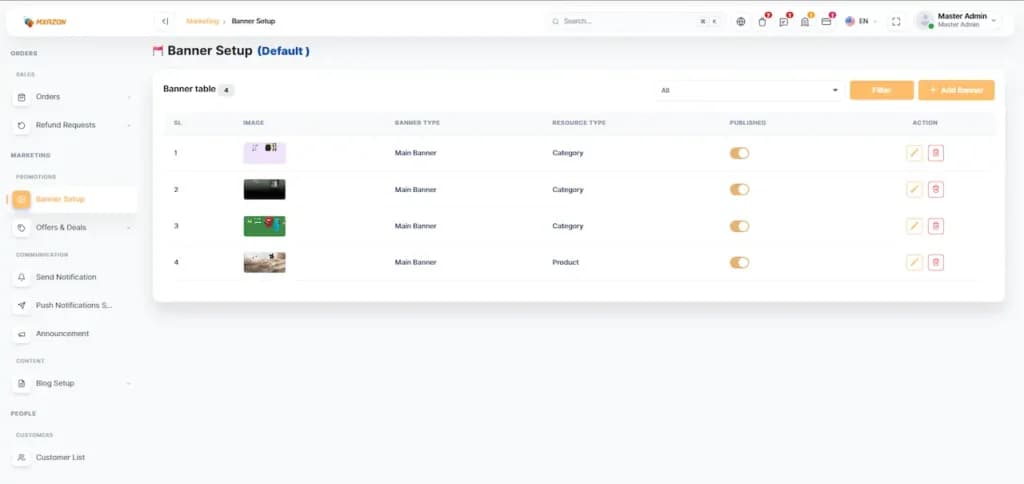
Campaigns, banners, and product content managed in Arabic and English from one tool.
Revenue, COD exposure, and seller performance reported by market without exporting anything.
What these buyers share: regional knowledge and merchant relationships, and the intent to compete on localization and payment fit instead of marketing spend.
They hold merchant relationships and regional brand trust, and the platform digitizes both into a multi-country marketplace.
Payment fit and Arabic-first UX are exactly where generic platforms lose them sales, and where this build wins them.
Their delivery networks become the fulfillment backbone, with slot capacity they already control.
Moving from marketplace tenants to platform owners with proper settlements and vendor tools in both languages.
Deploying commerce platforms with Arabic-first UX as the differentiator, white-label per client.
Built for right-to-left languages, regional payment habits, and fast urban delivery. All three surfaces sync to one backend.
A bilingual shopping experience that treats Arabic as primary, not an afterthought.
Merchant operations tuned for regional categories and fulfillment.
Operate a multi-country marketplace from one console.
Four consoles, one view of the network's markets, cash, and revenue position.
Currencies with operator-set exchange rates and per-market defaults, VAT tax classes bound per zone with per-product overrides, delivery country codes and zip allowlists, and bilingual content management, so a new country is a settings exercise.
Per-agent cash balances with collection-versus-banked reporting, agent KYC and approvals, COD settlement reports per market and currency, and prepaid-only switching under per-country policy.
Vendor approval and KYC in both languages, commission rules per country and category, seller plan definitions with express-slot eligibility, campaign scheduling, and payout queues on the settlement cycle you set.
Slot-capacity forecasting against zone demand, COD risk scoring per market, fraud controls over accounts and review networks, and analytics by country showing revenue and cash exposure without exporting anything.
The product journey, end to end.
The buyer opens a fully RTL, bilingual app where layout, search, and notifications are native in both languages, not mirrored afterthoughts.
Express and standard windows show only slots the operation can genuinely keep, with capacity managed per zone.
Cards, regional wallets, and COD with reconciliation cover the market's payment habits, itemized in the order record.
Sellers pick fulfillment slots from their panel, pick and pack, and hand off to the courier flow with bilingual tracking updates.
Returns raise in-app with status visible in both languages, and COD refunds reconcile back through the settlement ledger.
Commissions apply per country, category, and tier, and settlement reports generate per market with COD totals reconciled.
Five model-driven systems working the same order stream. Each ships pre-tuned for regional commerce and sharpens as your data compounds.
Ranks products and home feeds per buyer from Arabic and English browsing history, so discovery works natively in both languages.
Bilingual search queries, browsing, purchase history
Discovery that converts in Arabic and English alike
Projects order volume per zone and window so express slots stay honest during peak seasons and campaigns.
Order history, slot uptake, zone capacity, seasonal curves
Express promises the network actually keeps
Scores addresses and buyers for COD return risk, applying prepaid-only switching within per-country policy.
Address history, return rates, order values, market rules
Cash-on-delivery that stays profitable per market
Orders search and category results by relevance, seller performance, and conversion, keeping multi-country catalogs shoppable.
Listing quality, seller metrics, conversion rates
Better products surface without manual curation
Flags account abuse, COD anomalies, and review manipulation before they reach settlement in any market.
Account signals, COD patterns, review networks
Trust that holds across borders
platform concepts
Every order is a state machine that reports in two languages. Placed, paid, fulfilled, shipped, delivered, returned: each transition is an idempotent event with bilingual notifications, and returns raise in-app with status visible to buyer and seller in either language.
Multi-country economics run on tenancy. Catalogs, currencies, tax rules, commission rates, and delivery zones scope per country from one admin console, so a new market is a configuration project. Country-level analytics show revenue and COD exposure per market without exporting anything, which keeps expansion auditable.
The seller catalog carries verification and slot discipline. Vendor KYC runs document-based approval flows in both languages, express delivery is a capacity contract with sellers opting in and the buyer app only selling windows the network can keep, and COD reconciliation reports into one ledger your finance team can audit.
Four groups, each mapped to the part of the multi-country promise it protects.
Currencies with operator-set exchange rates and a per-market default, tax classes bound per zone with per-product overrides and inclusive-or-exclusive display, and delivery country codes with zip allowlists, so a second state is configuration rather than a parallel deployment.
Entity-level translation so a listing carries its own content per locale rather than one shared description, bilingual dashboards and notifications, and operator-configured languages across every surface, so the storefront reads like home.
A server-verified code at handover, a cash-collected balance per agent settled to the operator wallet, an operator-set handling fee, and settlement records held per gateway and per currency, so the cash habit survives the border with its ledger intact.
Express delivery windows sold only where capacity exists, loyalty points earned per order or category and redeemed at checkout, and referral codes rewarding both sides, keeping the market's repeat habit compounding.
Commission on completed orders, configurable per country, category, and seller tier.
Seller subscription plans with express-delivery eligibility perks.
Sponsored products and homepage placement sales.
Fulfillment service fees where you operate warehousing and last-mile capacity.
All levers are admin-configurable per market, so expanding to a new country is a settings exercise, not a fork.
insight
Regional e-commerce in the Gulf and wider MENA keeps compounding according to widely published industry analyses, with high average baskets, a COD habit that persists outside the metros, and no single dominant player in most national markets. The structural problem an operator faces is not demand; it is that a second country traditionally meant a second deployment whose books drift out of step.
The wedge is one deployment serving several states honestly: pricing, VAT, payouts, and refunds resolving in the local currency at the local rate, cross-border serviceability offered only where a route exists, and the cash ledger spanning every market you open. The revenue table below quantifies the lines.
Six monetization lines across the multi-market platform, quantified against published industry benchmarks. Every lever is admin-configurable per market; the figures here are modelling inputs, not projections of your platform's earnings.
| Criteria | Revenue line | How it is charged | Typical range | What sets the ceiling |
|---|---|---|---|---|
| Commission | A percentage per completed order, set per country, category, seller, or product; reversed on refund | Retail commissions commonly run 5% to 25% by category and market | Category bands per market. High-basket markets carry thinner rates that still compound | |
| Seller subscriptions | Tiered plans with product-count limits, reduced commission, and express-slot eligibility | Plan prices set per market | Slot economics. Express eligibility is a perk sellers pay for when capacity is real | |
| Cash handling | A handling fee on COD orders plus a settlement fee on agent withdrawals | Structural; a flat fee per cash order | COD share per market. The fee prices collecting money by hand, market by market | |
| Delivery margin | A mark-up on the shipping charge, set per zone and route | Cross-border routes price separately from city routes | Route economics. Per-category overrides keep a cross-border drop from subsidizing a city one | |
| Placement | Sponsored products, homepage banners, and flash-deal participation fees | Priced per slot or per event | Curation quality. Placement earns while bilingual search stays trustworthy | |
| Fulfillment services | Fees where you operate warehousing and last-mile capacity | Per-unit or per-slot pricing | Capacity utilization. Slots sold are promises kept, which is what makes the service sellable |
Standard inclusions on every engagement, almost-ready or custom. Nine things you never have to ask for.
The complete unencrypted codebase transfers to you, with documentation and deployment scripts. No per-order licensing, no vendor lock-in.
Your logo, colors, typography, and store accounts applied across every panel, plus branded customer communications.
App store and Play Console submissions handled end to end, with production monitoring switched on at go live.
Stripe, PayPal, and regional gateways configured, with automated split payouts across platform, sellers, and partners.
Bilingual recommendations, slot forecasting, and COD risk scoring arrive configured for regional commerce, not as raw APIs.
Languages, currencies, and tax display configured for your markets during the launch window.
Containerized services on AWS or Azure with autoscaling and queue-backed checkout for peak-hour traffic.
Sales dashboards, finance reconciliation views, and CSV exports so your operations team starts informed on day one.
Included support window plus product updates covering bug fixes, OS compatibility, and version upgrades.
RTL support and regional rails are engineering, not translation.
One codebase with native-grade RTL mirroring, bilingual typography, and locale-aware number and date formats.
Multi-tenant order and settlement services with per-country tax and commission rules enforced at the ledger level.
Integrations for regional card networks, wallets, and COD reconciliation, each with settlement reporting your finance team can audit.
Delivery zone and capacity management so express promises are kept during peak seasons.
AWS or Azure with in-region hosting options, autoscaling, and data residency where rules require it.
Regional couriers, accounting exports, SMS and WhatsApp providers, and banking rails ship as configured integrations, so the platform plugs into the tools your market already runs on.
Role-based access, append-only audit logs, encrypted traffic and secrets, and rate-limited endpoints come standard, so compliance questions have answers before they are asked.
Day by day for the almost-ready AI build. Store review can add a short buffer outside our control, and custom builds take 3 to 4 weeks.
Markets, categories, and commission model locked with a written scope, and your bilingual identity applied across buyer, seller, and admin surfaces.
Regional payment gateways, COD reconciliation, courier APIs, and Arabic content and RTL layouts configured and tested.
Sellers and catalogs onboarded with KYC and slot capacity armed, then pilot orders run end to end in both languages: checkout, COD, express slot, return, and settlement.
App store and Play Console submissions with review buffers accounted for, production monitoring switched on, and full launch with post-launch support and product updates included.
Both tracks ship the same order and settlement core. The difference is time, price structure, and how much you want to change.
| Criteria | Almost-Ready AI Launch | Custom Build |
|---|---|---|
| Time to live | 6 working days from branding handoff | 3 to 4 weeks, scoped before work starts |
| Pricing | Fixed written quote after a short scoping call, no hourly meter | Estimated per module after the discovery call |
| Source code and IP | 100% ownership on delivery | 100% ownership on delivery |
| AI layer | Recommendations, ranking, and personalization pre-tuned for marketplace commerce | AI services designed around your workflows and data |
| Localization depth | RTL layouts, bilingual CMS, and COD rails pre-configured | Any language or payment model engineered to spec |
| Branding | White-label: your name, colors, and store accounts | Built to your product spec end to end |
| After launch | Post-launch support and product updates included | Post-launch support and product updates included |
$ moxace launch --nowBook a walkthrough and we will demo the Arabic-first buyer app, slot management, and the admin console, then send the written scope.
Share your idea
a quick call, no deck required
See the live demo
every screen, admin to user
Launch with source
full code, your brand, your servers
No two launches price the same. These are the factors that shape the written quote you receive after scoping.
The almost-ready AI build covers the proven feature set. Additional country setups and custom payment rails add scoped estimate work.
Catalogs, currencies, tax rules, and commissions scope per country. Adding markets means more configuration, never a fork.
Regional payment rails, couriers, and messaging providers are wired during the build, and each integration is estimated individually.
Out of the box, recommendations, slot forecasting, and COD risk scoring are pre-tuned for regional commerce. Training models on your historical order data is an optional, separately scoped workstream.
Each ships as an optional module on the same commerce core, scoped separately.
KYC'd agents, assignment feed, OTP handover, and per-agent cash balances spanning every market, so the last mile and the cash stay under your brand across borders.
A fully mirrored right-to-left interface across the storefront, seller panel, console, and apps, custom-scoped because honest RTL is engineering, not mirrored CSS afterthoughts.
Operator-run warehousing with slot-based fulfillment services sold to sellers, turning last-mile capacity into a service line rather than a cost center.
Tiered loyalty with wallet conversion, referral codes rewarding both sides, and add-fund bonus tiers steering top-up size, on the wallet rails the platform already runs.
Agencies and networks stand up a branded marketplace per client or per state from one codebase, with market packs configured per deployment.
Regional e-commerce wins on localization and payment fit. Both are architecture here, not translation.
RTL layouts, bilingual search, and Arabic content management ship in the core, because bolt-on translation loses trust immediately.
Catalogs, currencies, and commissions scope per country from one console, so expansion is configuration rather than forking.
One hundred percent of the source code transfers to you. No per-order royalties, no black-box dependencies.
Regional commerce is proven, and teams often pair it with our delivery management software or broader marketplace app development tracks.
A sample of platforms our system has shipped, with the numbers they report in production.
A high-volume ordering platform from the same engineering system, with recommendation and settlement engines running at consumer scale.
A gaming and digital-goods platform from the same engineering system, holding uptime through flash-sale-scale traffic spikes.
A global brand-content platform our team ships and operates, carrying campaign video to worldwide audiences at broadcast scale.
Selling across borders multiplies the things that must agree. These controls keep them agreeing.
Exchange rates and per-market defaults live in admin configuration rather than a live feed, so pricing, payouts, and refunds resolve in the local unit without overnight surprises.
Tax classes bind per zone with per-product overrides and inclusive-or-exclusive display, itemized on every order, so five percent in one state and fifteen in another never blur into one rate.
A server-verified code at handover, a cash-collected balance per agent, and settlement records held per gateway and per currency keep the cash habit accounted in every market you open.
Entity-level translation holds each listing's content per locale, so a market reads its own language natively instead of one shared description doing four jobs badly.
A return walks its own state machine, settles as wallet credit or down the original rail, and reverses commission and loyalty points alongside the money in the local currency.
insight
You start with a discovery call covering markets, categories, and commission model, and receive a written quote with a dated plan. On the almost-ready path your bilingual brand application, regional payment connections, and Arabic content setup complete before the platform goes live inside the 6 to 9 day window. Additional country setups are configuration projects, and custom integrations are quoted per sprint.
After launch, included support and product updates cover the early period. A realistic first 90 days: seller onboarding and slot-capacity tuning in weeks one to four, adjusting commissions, COD policy, and delivery windows against real order data in weeks five to eight, and by week twelve deciding which country or category expands next from per-market dashboards.
Open the web app, sign in with the printed demo credentials, or install the Android build — no signup, no sales call. What you see is what you launch.
Delivery: [email protected] or +91 9876543212 | Delivery_$321
$ moxace launch --nowBook a free scoping call: written plan, fixed quote, and a launch date inside the 6 to 9 day window.
Share your idea
a quick call, no deck required
See the live demo
every screen, admin to user
Launch with source
full code, your brand, your servers
Moxace is an independent software development company. We are not affiliated with, sponsored by, or endorsed by Noon.
The phrase “Noon clone” is used descriptively. It is how the software industry refers to building a platform with similar functionality, and how buyers search for one.
The design and codebase are built entirely by our in-house team. Nothing is taken from the Noon website, applications, or brand assets.
Noon and all third-party names and marks remain the property of their respective owners, referenced here only to describe the category of software we build.
Read the full legal notice on our disclaimer page.