DRM-protected playback
Widevine, FairPlay, and PlayReady license integration with token-authenticated URLs, so protected content stays protected.
AI-Built Netflix Clone
An AI-first build of every OTT mechanic: a recommendation engine that ranks rows per viewer, watch-time prediction that guides scheduling, and churn-risk scoring that protects subscriber revenue. Four synced panels ship white-label with 100% source code, owned by you from day one. The almost-ready AI build goes live in 6 working days; a custom build takes 3 to 4 weeks.
Launch-ready from
$3,699
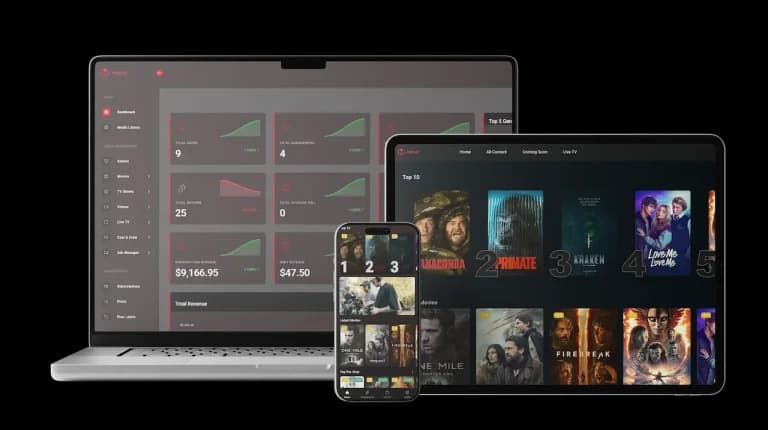
Synced panels
Almost-ready AI launch
Custom build
Source-code ownership
Trusted by the brands we build for



What a production-grade OTT clone buys you.
overview
A Netflix clone app is an OTT video streaming platform: viewers browse a catalog, press play on DRM-protected streams that adapt to their bandwidth, and resume where they left off on any device. It ships as a viewer app, a content studio for uploading and scheduling, an admin panel, and a billing panel, all under your brand.
The business purpose is owning a subscription video service for an audience the global platforms underserve. Regional catalog, local language content, and community-specific programming all support OTT businesses the incumbents will never prioritize, and an owned platform keeps subscription revenue, ad inventory, and viewer data in-house.
The platform is a content supply chain as much as an app: ingest, transcode, package with DRM, publish, and deliver over CDN, with subscriptions and dunning handled by the billing engine behind it.
Streaming keeps growing its share of global video consumption in widely published industry trackers, and regional and niche services remain the fastest-growing slice because general catalog alone no longer wins a subscription.
The summary layer above the panel-by-panel detail below.
Widevine, FairPlay, and PlayReady license integration with token-authenticated URLs, so protected content stays protected.
Per-title encoding ladders and CDN delivery that step quality down under weak networks instead of stalling.
Resume points and watch history that sync across devices and feed the recommendation engine.
Household profiles with separate histories, restrictions, and age-appropriate catalogs.
DRM-protected local storage with expiry windows, controlled per plan and per title from the admin panel.
Recurring charges, retry schedules, and proration that survive card declines.
Pre-roll, mid-roll, and pause ad slots that stay in sync across devices for AVOD revenue.
Bulk upload, transcoding presets, scheduled publishing, and geo restrictions for catalog teams.
What these buyers share: catalog or an audience, and the desire to own the service rather than rent shelf space inside someone else's app.
Studios, production houses, and broadcasters sitting on catalogs that earn nothing on a shelf. The platform converts an archive into recurring subscription revenue with the AI layer working the catalog from day one.
Extend linear channels into on-demand apps for local-language audiences the global platforms ignore. Recommendation rows do the merchandising a small content team cannot.
Faith, sports, education, and fitness communities pay for focused catalog. Your subscription, your data, and recommendation models tuned to your genre mix.
Bundle streaming into existing subscriptions and keep churn down with a service that learns what each household watches.
Deploy the platform for multiple clients under separate brands. White-label configuration and 100% source code make every deployment a standalone business.
$ moxace launch --nowThree things: studio-grade encryption at the packager, license servers that speak Widevine, FairPlay, and PlayReady, and a player that fails closed. We build all three into every OTT delivery.
Share your idea
a quick call, no deck required
See the live demo
every screen, admin to user
Launch with source
full code, your brand, your servers
Playback polish means nothing if the panels behind it cannot run a content business. Here is what ships in each.
Where your audience watches, resumes, and binge-watches.
For teams uploading and scheduling catalog at volume.
The control room for catalog, subscriptions, and revenue.
Subscriptions that survive card declines and dunning.
Beyond catalog administration: the operational systems that keep an OTT business governable at scale.
Content proposals route through submission, review, approval or rejection, and publication, with acquisition status tracked so partner content never stalls in an inbox.
Movies, series, seasons, episodes, live channels, and trailers administered centrally, with metadata imports and API-driven catalog sync for acquired content.
Subscription plans, rental windows, pay-per-view pricing, and coupon campaigns configured from one surface, with invoices and purchase history auditable per viewer.
Producer earnings, payout thresholds, withdrawal requests, and watch-minute reconciliation reviewed before settlement, so the money side of the producer economy stays clean.
A permission matrix across content modules by role, protected admin routes, and audit-friendly logs of content, subscription, and payment changes.
Subscribers, expiring plans, storage, rentals, revenue, top genres, and CDN spend reported with trend charts, so operations sees the business not just the player.
The content and viewer journey your OTT platform automates for every title and every session.
A studio uploads a master file through the content studio, where it enters the transcoding queue with metadata and artwork attached.
Per-title encoding ladders produce multiple bitrates, packaged into HLS and MPEG-DASH with DRM encryption applied at the packager.
The title goes live under its publishing window, with geo and device restrictions enforced from the catalog rules.
A viewer browses rows ordered by recommendation and editorial curation, reads the detail page, and adds to a watchlist.
The player requests a DRM license, verifies the subscription entitlement, and starts adaptive bitrate playback protected by token-authenticated URLs.
Watch events update resume points that sync across devices, feed the recommendation engine, and drive new-episode notifications.
Five model-driven systems working the same watch stream. Each ships pre-tuned for video streaming and sharpens as your data compounds.
Ranks the home screen per viewer and per profile, so no two accounts open onto the same catalog.
Watch history, completion rates, search behavior, time of day
Higher engagement and longer sessions without editorial workload
Projects how far viewers will get through a title so scheduling, promotions, and acquisitions lean on predicted watch-through.
Episode completion curves, drop-off points, session length
Scheduling and licensing decisions backed by predicted demand
Flags subscriptions likely to cancel from declining viewing before the cancellation happens.
Session frequency, billing events, profile activity
Retention offers reach at-risk subscribers while they still watch
Watches streaming telemetry for regional delivery degradation so quality issues surface before reviews mention them.
Bitrate switching, rebuffer rates, CDN edge performance
Fewer playback complaints and faster root-cause fixes
Selects which artwork and trailer a viewer sees for a title based on what their profile responds to.
Genre affinity, click-through by artwork variant
More title click-through from the exact same catalog
The modules that turn a player into a full OTT business, each toggleable and configurable per market.
Studios and creators onboard to their own panel: content submission with metadata and documents, watch-performance analytics, revenue-share visibility, and payout requests, all under your admin approval.
Watch-minute logs per title feed contract-configured payout rules, so producers get paid on measured performance and your finance team settles from platform data.
API-based catalog ingestion pulls partner and aggregator catalogues straight in, so the platform launches with something to watch instead of an empty shelf.
Live channels with categories, stream sources, and access rules, free or plan-gated, extending the service beyond on-demand.
Fixed or percentage coupons with validity windows and plan or content mapping, plus referral and win-back campaigns for acquisition and retention.
360 VR-ready playback workflows, quality selection, subtitles, and offline downloads with expiry, covering the formats your catalog actually contains.
platform concepts
OTT is a chain of four disciplines, and each has its own concept. Ingest and packaging turn one master file into a ladder of encrypted renditions; per-title encoding keeps animation from paying sports bitrates. License servers issue Widevine, FairPlay, and PlayReady keys only to entitled, token-authenticated players, and a player that fails closed is what keeps studio content safe.
Playback delivery rides the CDN with adaptive bitrate, so the stream steps down under a weak network instead of stalling. Resume state is a per-profile record that syncs across devices. On the operations side, concurrency flags and piracy monitoring watch for credential sharing, while billing runs a recurring engine with dunning, because a lapsed card should never be the reason a viewer churns.
The third concept is entitlement architecture. Every play request resolves against the subscriber's plan, the title's rights window, and the device's DRM capability in one check, which is what lets you run subscriptions, rentals, and ad tiers over the same catalog without access rules drifting apart.
insight
Streaming keeps taking share of global video time, and the growth is not at the top of the market. Widely published industry trackers put streaming at roughly 40% of television consumption in mature markets and still climbing, while the fastest-growing slice is regional and niche services, because general catalog alone no longer wins a subscription anywhere.
The economics follow the audience. Global digital payment value around $37 trillion in 2026 tells you the billing rails are commoditized; what is scarce is catalog with an audience attached. Producers and studios increasingly license direct to platforms that pay transparently on performance, which is exactly the revenue-sharing machinery a modern OTT platform ships with.
revenue model
Subscription tiers are the base layer: monthly and annual plans with per-tier device limits, download allowances, and stream quality caps, all configurable in the admin panel. On top of that, the platform supports transactional video on demand for premium titles, a rental window model, and pay-per-event access for live broadcasts.
Advertising is the third line. Pre-roll, mid-roll, and pause ad slots are server-side inserted, so ad breaks stay in sync across devices. Sponsorship placements on category rows and an affiliate tier for telco bundles round out the mix. Every revenue line reports separately so you can see which tier of your catalog pays for itself.
Six monetization lines on one catalog. The figures here are modelling inputs drawn from observed market pricing, not projections of your platform's earnings.
| Criteria | Revenue line | How it is charged | Typical range | What sets the ceiling |
|---|---|---|---|---|
| Subscription tiers | Recurring monthly or annual plans with per-tier limits | $5 to $20+ per user per month by market and tier | Churn, which is why retention tooling ships in the platform rather than as an afterthought | |
| Rentals and pay-per-view | One-time unlock of a premium title with an expiry window | $2 to $15 equivalent per title or event | Catalog scarcity; rental pricing holds only on titles viewers cannot get elsewhere | |
| Advertising (AVOD/hybrid) | Server-side-inserted pre-roll, mid-roll, and pause slots | $10 to $40 CPM equivalents by market and format | Ad demand in your market, and completion rates, which quality monitoring protects | |
| Live TV and events | Gated access to live channels and one-off event passes | Plan inclusion or per-event pricing | Rights costs and delivery capacity; event nights are revenue and load at the same time | |
| Bundles and telco partnerships | Bundled access sold through partners at wholesale | 20% to 50% of retail price per bundled subscriber | Partner economics and churn on their base; bundles trade margin for acquisition | |
| Producer revenue share | Your platform's share of content performance against producer shares | Contract-specific, driven by minutes-viewed rules | Your payout rules; transparent watch-minute accounting is what keeps producers licensing to you |
Standard inclusions on every engagement, almost-ready or custom. Nine things you never have to ask for.
The complete unencrypted codebase transfers to you, with documentation and deployment scripts.
Your logo, colors, and store accounts across every panel, plus branded customer communications.
App store and Play Console submissions handled end to end, with production monitoring switched on.
Stripe, PayPal, and regional gateways configured for recurring subscription billing with automated dunning and payouts.
Recommendation ranking, watch-time prediction, and churn scoring arrive configured for streaming, not as raw APIs.
Languages, currencies, and tax display configured for your markets during the launch window.
Containerized services on AWS or Azure with autoscaling and queue-backed intake for peak traffic.
Operational dashboards, finance reconciliation views, and CSV exports so your team starts informed on day one.
Included support window plus product updates covering bug fixes, OS compatibility, and version upgrades.
The parts that break on cheap clones are the parts we engineer first.
FFmpeg pipelines with HLS and MPEG-DASH output, CMAF packaging, and per-title encoding ladders so animated content does not pay the bitrate cost of sports.
Widevine, FairPlay, and PlayReady license integration, token-encrypted media URLs, and ExoPlayer, AVPlayer, and HLS.js players with Redis-backed resume states.
PostgreSQL for billing integrity, Kafka for watch-event streams feeding recommendations, and CDN-fronted object storage for origin offload.
Containerized origin services on AWS or Azure with autoscaling engineered for premiere-night concurrency. See how we approach scaling real-time systems.
Payment gateways, analytics providers, CRM and marketing tools, ad servers for AVOD, and subtitle vendors ship as configured integrations, so the platform plugs into the tools your operations already run on.
Signed playback tokens, concurrency limits, role-based access, append-only audit logs, and encrypted traffic and secrets come standard, so studio and broadcaster due diligence has answers before it is asked.
The almost-ready AI build, day by day. Store review times can add a short buffer outside our control.
Catalog plan, DRM license accounts, and launch markets locked with a written scope, and your identity applied across all four panels.
Payment gateways, CDN, DRM packaging, languages, and plan structures configured and tested against your live accounts.
Launch titles ingested, transcoded, and published, then pilot playback run end to end across mobile, web, and TV targets.
App store submissions with review buffers accounted for, production monitoring on, and full launch with post-launch support and product updates included.
Both tracks ship the same streaming core. The difference is time, price structure, and how much you want to change.
| Criteria | Almost-Ready AI Launch | Custom Build |
|---|---|---|
| Time to live | 6 working days from branding handoff | 3 to 4 weeks, scoped before work starts |
| Pricing | Fixed written quote after a short scoping call, no hourly meter | Estimated per module after the discovery call |
| Source code and IP | 100% ownership on delivery | 100% ownership on delivery |
| AI layer | Dispatch, forecasting, and personalization pre-tuned for the vertical | AI services designed around your workflows and data |
| Catalog and rights | Your launch catalog ingested and DRM-wired inside the standard build window | Ingest pipelines and rights windows built to your licensing model |
| Best for | Operators who want to launch this quarter | Teams with bespoke workflows or a unique model |
| After launch | Post-launch support and product updates included | Post-launch support and product updates included |
$ moxace launch --nowBook a walkthrough and we will demo the player, recommendation rows, and the admin console on a live build, then send the written scope.
Share your idea
a quick call, no deck required
See the live demo
every screen, admin to user
Launch with source
full code, your brand, your servers
No two launches price the same. These are the factors that shape the written quote you receive after scoping.
The almost-ready AI build covers the proven feature set. Bespoke workflows, custom AVOD rules, or blended monetization models add scoped estimate work.
Mobile, web, and TV targets, language packs, and currency setups are configured per market. Adding markets means more configuration, never a rebuild.
Payment gateways, ad servers, analytics, and rights-management vendors are wired during the build, and each integration is estimated individually.
Out of the box, recommendations, watch-time prediction, and churn scoring are pre-tuned for streaming. Training models on your historical viewing data is an optional, separately scoped workstream.
The core build is a complete OTT service. These modules add screens, intelligence, or monetization depth, from day one or as you scale.
Native builds for Android TV, Apple TV, Fire TV, Roku, Samsung, and LG, so your service sits on the living-room screen where watching actually happens.
Deeper license-server configuration, offline policy enforcement, and forensic watermarking for premium rights windows.
Deeper ML ranking using watch history, genre behavior, and profile activity across the whole catalog, beyond the pre-tuned core.
VAST-compatible ad serving, sponsor placements, and hybrid free/paid access tiers managed as a product line.
Extended producer contracts, automated statements, content licensing terms, and multi-producer analytics for platform-scale content operations.
Referral codes, launch offers, retention coupons, win-back discounts, and partner campaigns configured against your ARPU.
Enhanced immersive playback and browsing for VR-compatible catalog, a differentiator for sports, travel, and events content.
Several branded OTT services on one shared core, with separate branding, catalog, and monetization per deployment for agencies and media groups.
Ready-made speed with custom-build engineering discipline.
Adaptive bitrate, resume points, and download expiry are core product logic, tested on real networks before launch.
A ready-made launch costs a fraction of a ground-up build, with a fixed written quote before work starts.
One hundred percent of the source code transfers to you. No per-subscriber royalties, no black-box dependencies.
Our team ships consumer video at national-carrier scale. For a fully custom platform, see our video streaming app development track.
Canonical deployments from our own portfolio. Metrics are reported from live platforms, not projections.
A high-traffic video platform our engineering system ships and operates at franchise scale, the same bar every streaming build is held to.
A branded video destination proving watch-time mechanics hold at global campaign scale, from the same delivery discipline.
A high-traffic consumer platform our team ships and operates, the standard every OTT engagement is measured against.
An OTT service handles payments, viewing data, content rights, and producer earnings. The controls are built in, and stated plainly.
DRM encryption at the packager, license servers that only answer entitled players, token-authenticated playback URLs, concurrency limits, and piracy monitoring for credential sharing.
JWT/OAuth2 flows, optional 2FA for admins and high-risk roles, role-based access separating viewer, producer, admin, and super-admin scopes, and login-history visibility.
Recurring billing with dunning, auditable subscription and rental records, producer payout review before settlement, and reconciliation views your finance team can actually audit.
GDPR-ready workflows: consent at signup, account deletion and data-export flows, configurable retention and anonymization policies, and structured profile records.
Producer submission approval and rejection, publishing-state control, content-rights workflow tracking, and moderation tooling, so what ships under your brand is what you approved.
the process
The engagement starts with a discovery call where we map your catalog, device targets, and monetization model, then send a written scope and fixed quote. Once you approve, you hand over your brand assets and we configure the platform: your identity across all four panels, your payment gateways, languages, and plan structures. The almost-ready AI build goes live in 6 working days; a custom build takes 3 to 4 weeks, planned with you up front.
Launch is not the finish line. You get 60 days of included support and 12 months of updates covering bug fixes and OS compatibility releases. In the first 90 days expect to spend most of your effort on the operator side: watching where viewers drop off in the funnel, tuning recommendation rows and plan structure, and tightening dunning windows as real card-failure data arrives. The software handles the transactions; your catalog strategy is what turns it into a service.
Open the web app, sign in with the printed demo credentials, or install the Android build — no signup, no sales call. What you see is what you launch.
$ moxace launch --nowBook a free consultation and get a written scope and quote.
Share your idea
a quick call, no deck required
See the live demo
every screen, admin to user
Launch with source
full code, your brand, your servers
Moxace is an independent software development company. We are not affiliated with, sponsored by, or endorsed by Netflix.
The phrase “Netflix clone” is used descriptively. It is how the software industry refers to building a platform with similar functionality, and how buyers search for one.
The design and codebase are built entirely by our in-house team. Nothing is taken from the Netflix website, applications, or brand assets.
Netflix and all third-party names and marks remain the property of their respective owners, referenced here only to describe the category of software we build.
Read the full legal notice on our disclaimer page.