AI resume screening
Parses resumes into structured profiles and ranks applicants against each role's requirements, so recruiters review the strongest matches first instead of page one of a list.
AI-Built Job Portal Clone
An AI-first build of every jobs-board mechanic: resume screening that ranks candidates on evidence, employer subscriptions that meter postings and searches, and candidate matching that improves with every application. Four synced panels ship white-label with 100% source code, owned by you from day one. The almost-ready AI build goes live in 6 working days; a custom build takes 3 to 4 weeks.
Launch-ready from
$2,499
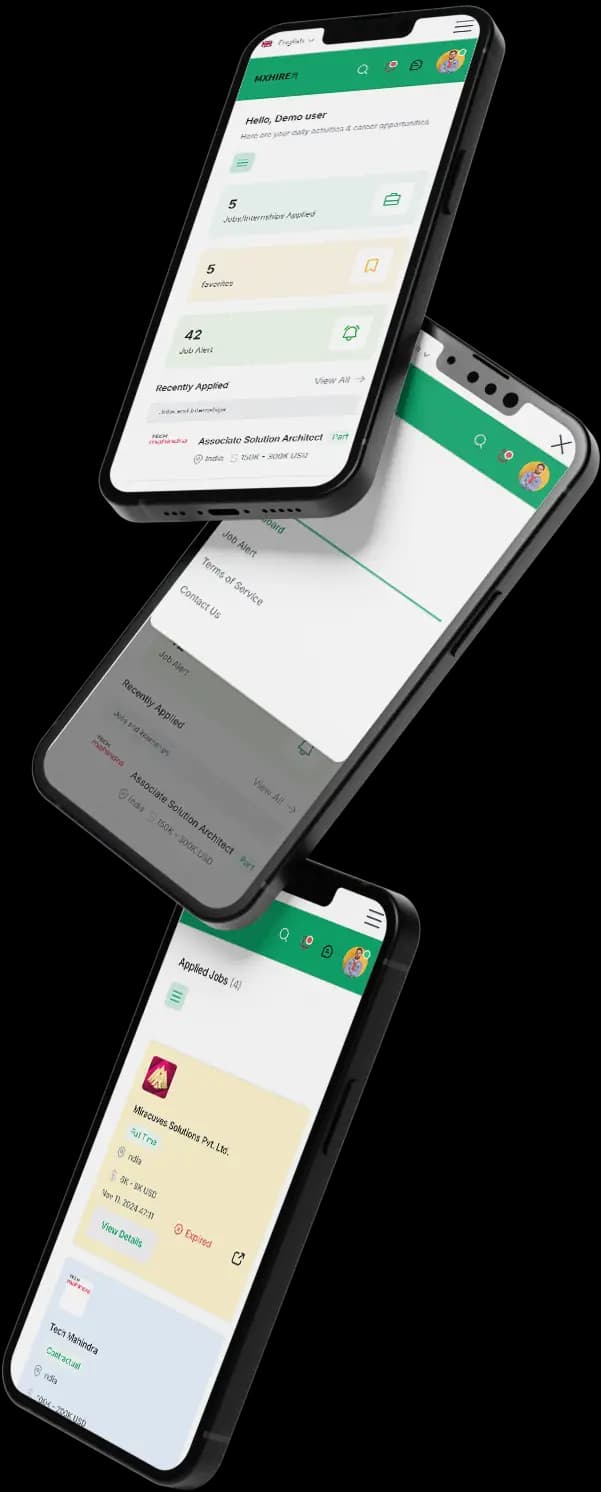
Synced panels
Almost-ready AI launch
Custom build
Source-code ownership
Trusted by the brands we build for



Canonical facts, not promises.
overview
An Indeed-style job portal is a two-sided recruitment marketplace: employers post roles and search talent, candidates build profiles and apply, and the platform earns on the employer side through sponsored postings, subscriptions, and search access.
Its purpose is commercial as much as technical. Recruitment is a budget line every company already carries, and an operator who owns the portal captures that spend in their own market instead of passing it to a global board. Revenue tracks employer demand, and matching quality is the moat that keeps both sides returning.
At a high level the platform includes a candidate app with profile building and one-tap applications, an employer dashboard for postings and applicant pipelines, recruiter search tooling, and an admin panel over categories, plans, moderation, and fees.
Market context, hedged: job boards remain one of the most durable internet categories, and regional or vertical boards keep winning share where global players serve generically. We make no claims about any specific market's size; the practical opportunity is focus, a portal aimed at one geography or industry competes on fit, not feature count.
The headline capabilities, at product level.
Parses resumes into structured profiles and ranks applicants against each role's requirements, so recruiters review the strongest matches first instead of page one of a list.
Candidates apply with a stored profile, and the matching engine surfaces relevant roles proactively as new postings go live.
A pipeline view over every posting with stages, notes, interview scheduling, and team collaboration, so hiring decisions leave the inbox.
Boolean and semantic search across the candidate database, with saved searches and alerts for profiles matching open demand.
Employer profiles with openings, culture content, and moderated reviews that give candidates context before they apply.
Keyword and location alerts delivered by push and email, engineered to bring candidates back without flooding them.
Configurable knock-out questions and skills assessments attached per role, filtering applications before they reach a human.
Posting quotas, featured slots, and resume-view credits metered per employer plan, all configurable from the admin panel.
What these buyers share: a market they know and the desire to own the venue rather than rent a seat on someone else's board.
Building the default board for a city or country global players serve generically. The AI matching core runs the hard product part while you win employers locally.
Serving one industry, from healthcare to logistics, where niche candidates are the asset and general boards leak them.
Productizing a placement business into a subscription platform, with your client employers posting directly.
Adding a marketplace layer to existing HR software, with matching and ATS tooling wired into the stack you already sell.
Deploying the white-label build for multiple clients under separate brands, every deployment a standalone business on 100% source code.
Four products operating as one system. Every panel ships in every build.
Where job seekers live, apply, and get found.
For hiring teams running roles to close.
Direct talent sourcing for subscribers.
Run the marketplace from one console.
Four consoles, one view of employers, candidates, and money.
Employer verification and moderation with badge controls, plan and quota configuration, and account management across tiers.
The content moderation queue, category and taxonomy controls, and regional settings that shape what the board surfaces per market.
Featured-posting management, search and recommendation tuning, and quality reporting on reply rates and posting performance.
Revenue reporting across subscriptions, featured slots, and credits, invoice and billing oversight, and CSV exports for finance.
The core journey both sides repeat, from posting to offer.
The employer creates a posting from a template, attaches screening questions, and publishes against their plan quota, with featured slots available.
The AI matching engine scores the new role against candidate profiles and pushes it into recommendations and alerts for the strongest fits immediately.
Job seekers apply in a tap with stored profiles, answering the role's screening questions, and each application lands in the employer's pipeline pre-parsed.
The pipeline shows applicants ranked by fit with resume highlights, so the first screen happens in minutes rather than days.
Stages, notes, and interview scheduling move the shortlist forward with the whole hiring team visible on one record.
The hire closes, outcome data feeds the matching models, and the employer's posting analytics show what worked for the next role.
Five model-driven systems working the same hiring stream. Each ships pre-tuned for recruitment and sharpens as your data compounds.
Turns unstructured resumes into structured profiles and ranks every applicant against role requirements with evidence attached.
Resume documents, role requirements, hire outcomes
Recruiters screen the best matches first, not the loudest
Learns from application and outcome history to recommend roles to candidates and candidates to roles, improving with every cycle.
Profiles, applications, view patterns, employer feedback
Higher application quality and faster time-to-shortlist
Scores postings for clarity, bias language, and completeness before they publish, so quality stays high without manual review.
Posting text, past performance, category norms
Better-performing postings and fewer moderation rejections
Flags fake employers, duplicate postings, and scam patterns so the marketplace stays trustworthy for candidates.
Employer signals, posting velocity, content patterns
Cleaner marketplace with less manual moderation
Watches employer usage and candidate activity to flag accounts going quiet while there is still time to win them back.
Login recency, posting cadence, application rates
Retention interventions fired before churn, not after
platform concepts
The first concept is two-sided liquidity. Candidates come for relevant roles and employers for relevant candidates, and the cold-start discipline is to seed one side deliberately: a curated launch inventory of real postings, or a pre-loaded candidate pool for a vertical you already know, rather than an empty board hoping both arrive.
The second is plan economics. Postings, featured slots, resume views, and seat counts are all metered per employer plan, and every quota lives in the admin panel. That structure is what lets you run a free tier, an SME subscription, and an enterprise contract on the same deployment without engineering tickets.
The third is the moderation and trust layer. Verified-employer badges, candidate data controls, and abuse detection are product features, not chores, because the marketplace's asset is the quality of its database and the trust both sides place in it.
Employer subscriptions with posting quotas, seat counts, and applicant-tracking features tiered by company size.
Featured and sponsored postings sold per slot or per campaign, ranked higher in search and recommendations.
Resume-search credits and recruiter seats sold as add-ons to subscription plans.
Every rate and quota is admin-configurable, so you can reprice for your market without a code release.
Four groups, each mapped to the part of the marketplace promise it protects.
Cold-start discipline that seeds one side deliberately, a curated launch inventory of real postings or a pre-loaded candidate pool for a vertical you already know, rather than an empty board hoping both arrive.
Postings, featured slots, resume views, and seat counts metered per employer plan with every quota in the admin panel, so a free tier, an SME subscription, and an enterprise contract run on the same deployment.
Search and recommendation ranking that surfaces relevant roles and relevant candidates, because relevance is the currency both sides judge the board by.
Verified-employer badges, candidate data controls, an abuse-detection layer, and a moderation queue, because the marketplace's asset is database quality and the trust both sides place in it.
insight
Online job platforms keep compounding past the thirty-billion-dollar mark globally by 2030 on widely published forecasts, with vertical and regional boards outgrowing generic aggregators where relevance beats reach and employers pay for quality over volume.
The engineering wedge is matching quality and trust tooling: candidates who get replies and employers who trust the database are what make both sides renew. The revenue table below quantifies the lines.
Six monetization lines across the platform, quantified against published industry benchmarks. Every rate is admin-configurable; the figures here are modelling inputs, not projections of your platform's earnings.
| Criteria | Revenue line | How it is charged | Typical range | What sets the ceiling |
|---|---|---|---|---|
| Employer subscriptions | Posting quotas, seats, ATS features by size | Plans commonly $50 to $1,000+ per month | Hiring outcomes. Subs hold while postings perform | |
| Featured postings | Sponsored slots and campaigns | Ads commonly $50 to $500+ per slot | Ranking honesty. Placement earns while organic stays fair | |
| Resume-search credits | Per-view or pack-based recruiter searches | Credits commonly $1 to $10+ per view | Candidate quality. Credits earn while the database stays real | |
| Recruiter seats | Per-seat pricing for hiring teams | Seats commonly $30 to $200+ per month | Team adoption. Seats grow while workflow stays in-platform | |
| Employer branding | Company pages and campaigns | Packages commonly $500 to $10,000+ per month | Brand demand. Branding sells while audiences stay relevant | |
| White-label deployments | Branded boards for associations and publishers | Deployments commonly $10,000 to $100,000+ | Market demand. Deals close while per-tenant config stays cheap |
Standard inclusions on every engagement, almost-ready or custom. Nine things you never have to ask for.
The complete unencrypted codebase transfers to you, with documentation and deployment scripts.
Your logo, colors, and store accounts across all four panels, plus branded candidate and employer communications.
App store and Play Console submissions handled end to end, with production monitoring switched on.
Stripe, PayPal, and regional gateways configured for employer billing, with a reconciliation view for finance.
Resume screening, matching, and spam detection arrive configured for recruitment, not as raw APIs.
Languages, currencies, and tax display configured for your markets during the launch window.
Containerized services with queue-backed resume processing and search indexing that keeps pace with your database.
Revenue dashboards, marketplace-liquidity views, and CSV exports so your operations team starts informed on day one.
Included support window plus product updates covering bug fixes, OS compatibility, and version upgrades.
Search quality is the product. We engineer it that way.
Hybrid keyword and semantic search across postings and candidate profiles, with ranking signals you can tune from the admin panel as the marketplace matures.
Queue-backed document parsing that handles PDFs, images, and odd formats, structured so your database is queryable from the first import.
Stripe, PayPal, and regional gateways with subscription billing, credit metering, and invoicing for enterprise employers.
Containerized services on AWS or GCP with autoscaling for application spikes. See how this fits our wider AI development services practice.
Email and SMS providers, calendars, ATS webhooks, and analytics exports ship as configured integrations, so the portal plugs into the tools employers already run.
Candidate data deserves privacy-grade handling: role-based access, data-retention controls, encrypted traffic and secrets, and audit logs come standard.
The almost-ready AI build, day by day. Store review times can add a short buffer outside our control.
Verticals, plan tiers, and category taxonomy locked with a written scope, and your identity applied across all four panels.
Payment gateways, email and SMS providers, and plan quotas configured and tested against your live accounts.
Launch employers onboarded with real postings, candidate seed profiles imported, and the full loop tested: post, match, apply, screen, hire.
App store submissions with review buffers accounted for, production monitoring on, and full launch with post-launch support and product updates included.
Both tracks ship the same marketplace core. The difference is time, price structure, and how much you want to change.
| Criteria | Almost-Ready AI Launch | Custom Build |
|---|---|---|
| Time to live | 6 working days from branding handoff | 3 to 4 weeks, scoped before work starts |
| Pricing | Fixed written quote after a short scoping call, no hourly meter | Estimated per module after the discovery call |
| Source code and IP | 100% ownership on delivery | 100% ownership on delivery |
| AI layer | Resume screening, matching, and spam detection pre-tuned for recruitment | AI services designed around your workflows and data |
| Plan structure | Quota-based employer plans ready to configure | Billing model designed around your commercial strategy |
| Best for | Operators who want to launch this quarter | Teams with bespoke workflows or a unique model |
$ moxace launch --nowBook a walkthrough and we will demo matching, the applicant pipeline, and the admin console on a live build, then send the written scope.
Share your idea
a quick call, no deck required
See the live demo
every screen, admin to user
Launch with source
full code, your brand, your servers
No two launches price the same. These are the factors that shape the written quote you receive after scoping.
The almost-ready AI build covers the proven feature set. Bespoke assessments, custom ATS stages, or niche matching logic add scoped estimate work.
Taxonomies, language packs, and currency setups are configured per market. Adding regions means more configuration, never a rebuild.
HR systems, calendars, background-check vendors, and analytics are wired during the build, and each integration is estimated individually.
Out of the box, screening and matching are pre-tuned for recruitment. Training models on your historical hiring data is an optional, separately scoped workstream.
Extend the job portal build once the core marketplace loop is running.
Pipeline stages, interview scheduling, and team notes inside the employer plan, the retention feature that keeps recruiters in-platform.
Structured assessments attached to applications, the signal layer that lifts match quality for both sides.
Rich company profiles with culture content and video, sold as a premium line to hiring brands.
Resume parsing, skill extraction, and match scoring, the relevance engine that decides reply rates.
One-tap apply, application tracking, and job alerts, the engagement surface that keeps candidates returning.
Deploy the platform for associations and publishers under their own identity, with per-tenant plans, taxonomy, and pricing.
Marketplace economics with matching-grade engineering.
Ranking quality, not posting counts, is what keeps both sides returning, so the AI matching core ships tuned on day one.
Moderation, verification, and liquidity dashboards are core product logic, because marketplaces are operations problems as much as software.
One hundred percent of the source code transfers to you. No per-posting royalties, no black-box dependencies.
Pair the portal with our fintech app development work for payroll and contractor-payment extensions on the same design language.
Canonical deployments from our own portfolio. Metrics are reported from live platforms, not projections.
A high-traffic consumer platform our team ships and operates at national-carrier scale, the same bar every build is held to.
A consumer platform from the same engineering system, proving the infrastructure core holds under real-time load with strict uptime demands.
A high-volume consumer experience our team ships at global-release scale, the same discipline applied to every launch.
Tap a card to see how the platform defends its marketplace.
Verified-employer badges, candidate data controls, and abuse detection treat database quality as product, because the trust both sides place in it is the marketplace's entire value.
Featured postings rank higher without rotting organic results, so sponsored placement earns revenue without burning candidate trust.
Postings, featured slots, resume views, and seat counts all meter per employer plan and configure from the admin panel, so repricing takes no code release.
Resume-view tracking, data controls, and per-plan visibility limits keep candidate information from leaking across employer accounts.
The moderation queue and abuse-detection layer catch fake postings and scraper behavior before they degrade the database.
Curated launch inventory and pre-loaded candidate pools are first-class tooling, because two-sided liquidity is seeded deliberately.
the process
The engagement starts with a discovery call and ends with a written scope and quote before work begins. On the almost-ready AI path you hand over branding assets, we apply them across every panel, configure plans and categories, and go live in 6 working days. Custom modules are scoped as sprints and quoted in writing first.
After launch, support and product updates are included. The first 90 days are a liquidity ramp, not a software phase: onboarding the first cohort of employers personally, curating early candidate quality, and watching matching analytics to tune ranking. The consoles make that work efficient, but marketplaces are grown, not deployed.
Open the web app, sign in with the printed demo credentials, or install the Android build — no signup, no sales call. What you see is what you launch.
Login: Candidate: [email protected] | User_321 Employer: [email protected] | Employer_321
$ moxace launch --nowBook a free consultation and get a written scope and price.
Share your idea
a quick call, no deck required
See the live demo
every screen, admin to user
Launch with source
full code, your brand, your servers
Moxace is an independent software development company. We are not affiliated with, sponsored by, or endorsed by Job Portal.
The phrase “Job Portal clone” is used descriptively. It is how the software industry refers to building a platform with similar functionality, and how buyers search for one.
The design and codebase are built entirely by our in-house team. Nothing is taken from the Job Portal website, applications, or brand assets.
Job Portal and all third-party names and marks remain the property of their respective owners, referenced here only to describe the category of software we build.
Read the full legal notice on our disclaimer page.