Unit and availability management
Every unit's status, pricing, and availability in one structured catalog, with floor plans and amenities driving search and leasing.
AI-Built Greystar Clone
An AI-first build of the property management pattern: leasing funnels that convert, rent optimization that reads the market, and maintenance workflows that close tickets instead of collecting them. Four synced panels ship white-label with 100% source code, owned by you from day one. The almost-ready AI build goes live in 6 working days; a custom build takes 3 to 4 weeks.
Launch-ready from
$4,299
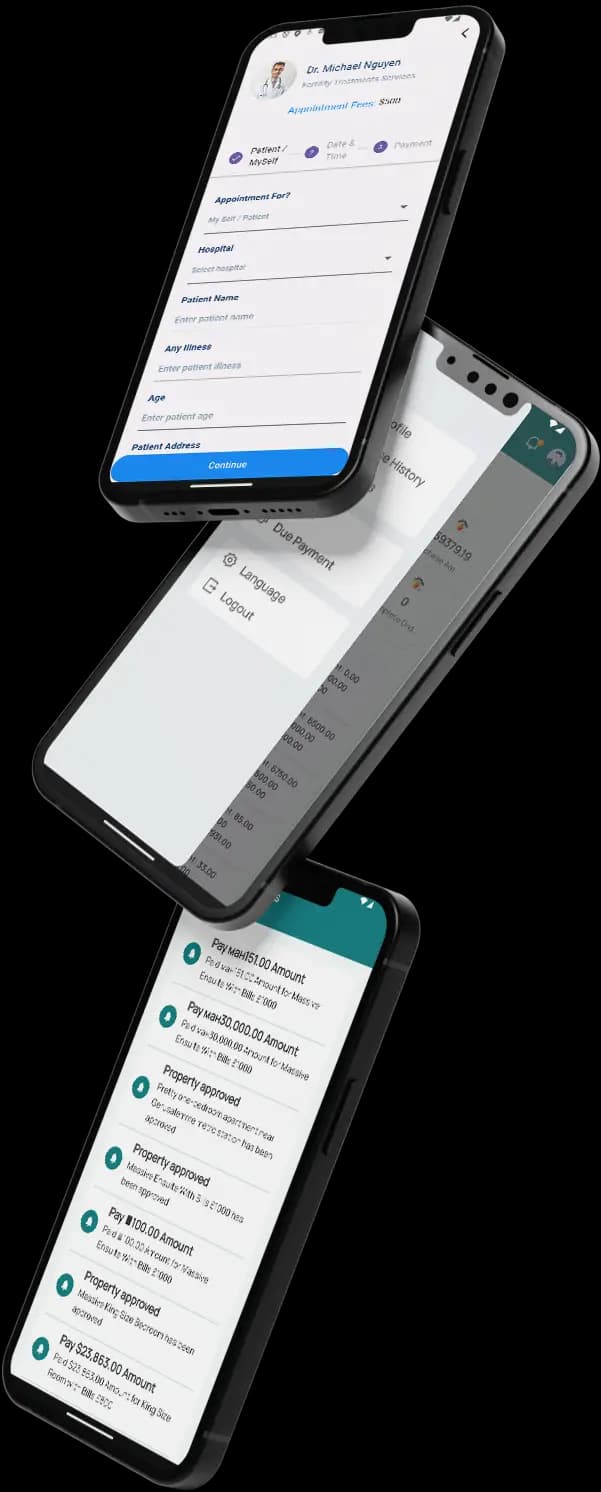
Synced panels
Almost-ready AI launch
Custom build
Source-code ownership
Trusted by the brands we build for



Canonical facts, not promises.
overview
A Greystar-style platform is the software layer of a professional property manager: unit and availability management, a leasing funnel from inquiry to signed lease, rent collection and accounting, maintenance ticketing with vendor dispatch, and resident communication, all under the operator's brand.
The label describes the category benchmark, not the code. You launch under your own brand with source code you own, which matters in property management because the incumbent platforms price per unit per month, and a large operator's software bill rivals a maintenance budget.
A complete build includes the resident app for payments, requests, and communication, the leasing site and agent tools for applications and screening, a maintenance and vendor management system, and an admin panel over units, leases, accounting, and portfolio analytics.
Market context, hedged: institutional and professional residential management keeps consolidating, and operators increasingly treat software as a differentiator rather than a line item. We make no claims about market size; the practical signal is portfolio size, because per-unit platform rent is the expense this build eliminates.
The headline capabilities, at product level.
Every unit's status, pricing, and availability in one structured catalog, with floor plans and amenities driving search and leasing.
Inquiry to application to screening to e-signed lease, with agent pipelines so no lead goes quiet without a recorded follow-up.
Market-aware rent recommendations per unit from comps, seasonality, and vacancy risk, reviewed by humans rather than trusted blindly.
Recurring payments, late-fee automation, and partial-payment policies enforced by configuration, with a reconciliation view for accounting.
Resident-submitted requests routed by category and priority, with vendor assignment, status tracking, and SLA clocks that hold people to timelines.
Announcements, documents, and package or amenity notifications in one thread per resident, so nothing lives only in a property manager's inbox.
Application screening workflows with fair-housing-aware configuration, so your process is consistent and defensible by design.
Occupancy, delinquency, maintenance cost, and renewal dashboards per property and portfolio, exported for owners and lenders.
What these buyers share: units to run and frustration with per-unit software rent. If you bring the portfolio, the platform side is the part we handle.
Operators whose per-unit platform fees have become a board-level expense. The AI leasing and maintenance cores run the daily grind.
Bringing management in-house with software your teams own, and reporting your investors actually want.
Mid-size managers professionalizing operations to compete for institutional mandates, with tooling that makes scale look deliberate.
Whose lease cycles, guarantor flows, and seasonal turnover break generic platforms.
Deploying white-label management platforms across client portfolios, every deployment standalone on 100% source code.
Four products operating as one system. Every panel ships in every build.
The experience your residents judge.
For agents filling units.
Where service levels are won.
Run the portfolio from one console.
Four consoles, one view of units, service, and money.
Unit and lease management with the rent roll and arrears views, late-fee and policy automation, and owner and lender reporting that reconciles from the ledger.
The lead pipeline with follow-up tasks, tour scheduling, screening workflow oversight with audit trails, and concession and promotion tracking.
Vendor and PO management, SLA clocks and escalation, cost tracking per unit, and inspection checklists that write to the service ledger.
AI delinquency risk alerts with intervention workflows, accounting exports, role-based permissions, and full audit trails.
The portfolio lifecycle from listing to renewal, end to end.
Availability publishes to your leasing site with pricing drawn from the AI recommendations, and inquiries feed the agent pipeline.
Tours schedule themselves, applications flow through screening workflows configured to be consistent and fair-housing-aware.
Leases e-sign, deposits and move-in checklists record in the system, and the resident app activates on day one.
Rent collects with automated arrears policies, and maintenance tickets route to staff or vendors with SLA clocks running.
Communication, amenity bookings, and document requests all happen in the resident app, creating the record that prevents disputes.
Renewal offers generate from market data, and turnovers run through checklists so units re-lease fast and cleanly.
Five model-driven systems working the same portfolio stream. Each ships pre-tuned for property operations and sharpens as your data compounds.
Recommends asking rents per unit from comps, seasonality, and vacancy risk, presented as reviewed recommendations rather than opaque rules.
Market comps, vacancy data, seasonality, unit attributes
Revenue per unit managed by evidence instead of instinct
Flags households likely to fall behind from payment patterns, so teams intervene with plans before arrears harden.
Payment history, employment signals where shared, seasonality
Collections that start early and land softer
Classifies ticket urgency from text and photos, prioritizes dispatch, and predicts recurring-failure units for preventive work.
Ticket text and photos, unit history, vendor performance
Emergency repairs down and resident satisfaction up
Scores and routes leasing inquiries by conversion likelihood so agents work the leads that will actually sign.
Inquiry behavior, response times, tour outcomes
Faster lease-ups on the same marketing spend
Identifies residents at renewal risk and prices renewal offers that retain them profitably.
Payment behavior, service history, market rates
Turnover costs reduced where retention is cheapest
platform concepts
The first concept is the lease as a state machine. Applications, leases, and renewals move through defined states with documents and payments attached at each step, so a unit's status is always answerable from the system rather than from a property manager's memory.
The second is unit economics. Rent recommendations, concessions, and fee schedules attach per unit and market, and the platform earns its keep by improving occupancy, collection rates, and maintenance cost per unit. Because every rule is admin-configurable, portfolio strategy changes never wait on a vendor's release cycle.
The third is the service ledger. Every maintenance ticket, communication, and inspection writes to the unit's history, which is what makes owner reporting credible, disputes resolvable, and preventive maintenance possible rather than aspirational.
Eliminated per-unit software rent: the license model that makes incumbents expensive at scale disappears when you own the platform.
Revenue lift from AI rent optimization and faster lease-ups on the same marketing budget.
Reduced arrears from early-risk interventions and automated, consistent policies.
Lower maintenance cost per unit through triage, SLA enforcement, and preventive scheduling.
The platform's value lives in the portfolio metrics it improves; every rule is admin-configurable so strategy changes are configuration, not procurement.
Four groups, each mapped to the part of the property promise it protects.
Applications, leases, and renewals moving through defined states with documents and payments attached at each step, so a unit's status is answerable from the system rather than a property manager's memory.
AI rent recommendations, concessions, and fee schedules attaching per unit and market, with delinquency risk alerts starting collections early and renewal targeting retaining residents where retention is cheapest.
Every maintenance ticket, communication, and inspection writing to the unit's history, with triage, vendor dispatch, SLA clocks, and preventive scheduling making owner reporting credible and disputes resolvable.
Lead scoring and routing by conversion likelihood, tour scheduling, application intake with fair-housing-defensible screening workflows, and conversion funnel reports on the same marketing spend.
insight
Property management software keeps compounding toward the ten-billion-dollar mark globally by 2030 on widely published forecasts, with institutional owners consolidating operations onto integrated platforms and resident experience becoming the retention lever. The category's economics reward operators who own their stack.
The engineering wedge is the service ledger and unit economics: a rent roll that is a query rather than a spreadsheet ritual, and maintenance cost per unit that falls through triage and SLA enforcement, are what operators actually buy. The revenue table below quantifies the value.
Six value lines across the platform, quantified against published industry benchmarks. Every rule is admin-configurable; the figures here are modelling inputs, not projections of your platform's performance.
| Criteria | Value line | How it works | Typical range | What sets the ceiling |
|---|---|---|---|---|
| Software rent eliminated | No per-unit SaaS royalties after delivery | Savings commonly $2 to $8+ per unit per month | Portfolio scale. Savings grow with every unit added | |
| Revenue lift from rent optimization | AI pricing on vacancies and renewals | Lift commonly 1% to 5% of rental revenue | Market data quality. Lift holds while pricing stays defensible | |
| Arrears reduction | Early-risk interventions and consistent policies | Reductions commonly 10% to 30% of delinquency | Intervention timing. Reductions earn while alerts stay early | |
| Maintenance cost per unit | Triage, SLA enforcement, preventive scheduling | Savings commonly 5% to 15% of maintenance spend | Triage accuracy. Savings hold while routing stays right | |
| Turnover cost reduction | Renewal targeting and retention offers | Turns commonly cost $2,000 to $5,000+ per unit | Resident experience. Savings hold while service stays good | |
| White-label deployments | Branded platforms for property groups | Deployments commonly $50,000 to $500,000+ | Institution demand. Deals close while the lease engine stays configurable |
Standard inclusions on every engagement, almost-ready or custom. Nine things you never have to ask for.
The complete unencrypted codebase transfers to you, with documentation and deployment scripts.
Your logo, colors, and store accounts across all four panels, plus branded resident communications.
App store and Play Console submissions handled end to end, with production monitoring switched on.
Stripe, PayPal, and regional gateways configured for rent collection, with reconciliation and accounting exports.
Rent optimization, triage, and risk models arrive configured for property operations, not as raw APIs.
Languages, currencies, and regional settings configured for your markets during the launch window.
Containerized services with autoscaling, sized for leasing-season traffic and portfolio growth.
Occupancy, arrears, and maintenance dashboards plus owner-ready exports so your team starts informed on day one.
Included support window plus product updates covering bug fixes, OS compatibility, and version upgrades.
Operational reliability is the product. We engineer it that way.
Lease states, recurring billing, and arrears automation with reconciliation, so the rent roll is a query, not a spreadsheet ritual.
Ticket routing, vendor dispatch, SLA clocks, and cost tracking wired together, because service levels are systems, not intentions.
Configurable screening workflows designed for consistency and fair-housing defensibility, with audit trails on every decision point.
Containerized services on AWS or GCP with autoscaling. See how this fits our wider fintech app development practice for the payment rails.
Screening vendors, payment gateways, e-signature providers, and listing syndication ship as configured integrations, so the platform plugs into the stack your operation already runs.
Role-based access, append-only audit logs, encrypted traffic and secrets, and data-residency controls come standard, so resident-data questions have answers.
The almost-ready AI build, day by day. Store review times can add a short buffer outside our control.
Portfolio structure, fee policies, and screening workflows locked with a written scope, and your identity applied across all four panels.
Payment gateways, screening vendors, e-signature, and listing channels configured and tested against your live accounts.
Units and leases imported, staff trained on the consoles, and a pilot property runs the full cycle: inquiry, lease, payment, ticket.
App store submissions with review buffers accounted for, production monitoring on, and full launch with post-launch support included.
Both tracks ship the same management core. The difference is time, price structure, and how much you want to change.
| Criteria | Almost-Ready AI Launch | Custom Build |
|---|---|---|
| Time to live | 6 working days from branding handoff | 3 to 4 weeks, scoped before work starts |
| Pricing | Fixed written quote after a short scoping call, no hourly meter | Estimated per module after the discovery call |
| Source code and IP | 100% ownership on delivery | 100% ownership on delivery |
| AI layer | Rent, triage, and risk models pre-tuned for property ops | AI services designed around your portfolio and data |
| Ongoing cost | No per-unit royalties after delivery | Same ownership economics |
| Portfolio migration | Bulk unit and lease import included | Migration tooling designed around your systems |
| Best for | Operators who want to launch this quarter | Institutions with bespoke workflows or reporting |
$ moxace launch --nowBook a walkthrough and we will demo the leasing funnel, maintenance system, and accounting views, then send the written scope.
Share your idea
a quick call, no deck required
See the live demo
every screen, admin to user
Launch with source
full code, your brand, your servers
No two launches price the same. These are the factors that shape the written quote you receive after scoping.
The almost-ready AI build covers the proven feature set. Bespoke accounting integrations or owner-portal reporting add scoped estimate work.
Unit and lease migration effort scales with portfolio complexity and legacy system exports, estimated from your data during scoping.
Screening vendors, gateways, and e-signature providers are wired during the build, and each integration is estimated individually.
Out of the box, models are pre-tuned for property operations. Training on your historical portfolio data is an optional, separately scoped workstream.
Extend the Greystar-style build once the core leasing loop is running.
Commercial lease structures with CAM reconciliation and escalations, opening institutional commercial portfolios.
Per-entity reporting with distributions and performance benchmarks, the transparency institutional capital expects.
Bookable amenities with dynamic pricing and membership options, turning shared spaces into a revenue line.
IoT sensors for leaks, HVAC, and access feeding maintenance triage, the preventive layer that cuts emergency repairs.
Engagement programs, referral rewards, and renewal journeys, the retention lever that beats acquisition cost.
Deploy the platform for property groups under their own identity, with per-tenant policies, screening workflows, and reporting.
Property operations discipline without the per-unit rent.
Leasing pipelines, SLA clocks, and audit trails are core product logic, because property management is won in the workflows.
No per-unit royalties after delivery. At institutional scale, that difference funds the entire build every year.
Consistent screening workflows and audit trails ship built in. Licenses and legal positions are yours to hold; the software enforces the process.
Pair with our Airbnb-style marketplace for the short-stay side of residential on the same engineering system.
Canonical deployments from our own portfolio. Metrics are reported from live platforms, not projections.
A high-traffic consumer platform our team ships and operates at national-carrier scale, the same bar every build is held to.
A consumer platform from the same engineering system, proving the infrastructure core holds under real-time load with strict uptime demands.
A high-volume consumer experience our team ships at global-release scale, the same discipline applied to every launch.
Tap a card to see how the platform defends its portfolio.
Applications, leases, and renewals move through defined states with documents and payments attached, so a unit's status is answerable from the system rather than a manager's memory.
Lease states, recurring billing, and arrears automation run with reconciliation, so the rent roll is a query, not a spreadsheet ritual.
Screening workflows run with audit trails on every decision point, designed for consistency and fair-housing defensibility.
Ticket routing, vendor dispatch, and SLA clocks are wired together with cost tracking per unit, because service levels are systems, not intentions.
Delinquency risk alerts flag households from payment patterns so teams intervene with plans before arrears harden.
Rent recommendations, concessions, and fee schedules attach per unit and market and configure from the admin panel, so portfolio strategy never waits on a release.
the process
The engagement starts with a discovery call and ends with a written scope and quote before any work begins. On the almost-ready AI path you hand over branding assets and portfolio data, we apply your identity across every panel, configure policies and integrations, and go live in 6 working days. Custom modules are scoped as sprints and quoted in writing first, so there are no surprise invoices.
After launch you have post-launch support and product updates included. Expect the first 90 days to be about adoption and data quality: training site teams on the new consoles, cleaning the first rent roll imports, and watching SLA clocks change behavior. The platform handles workflows, payments, and analytics; the operating discipline of your teams is what makes the portfolio perform.
Open the web app, sign in with the printed demo credentials, or install the Android build — no signup, no sales call. What you see is what you launch.
Access: Available on request
Access: Shared on a call
$ moxace launch --nowBook a free consultation and get a written scope and price.
Share your idea
a quick call, no deck required
See the live demo
every screen, admin to user
Launch with source
full code, your brand, your servers
Moxace is an independent software development company. We are not affiliated with, sponsored by, or endorsed by Greystar.
The phrase “Greystar clone” is used descriptively. It is how the software industry refers to building a platform with similar functionality, and how buyers search for one.
The design and codebase are built entirely by our in-house team. Nothing is taken from the Greystar website, applications, or brand assets.
Greystar and all third-party names and marks remain the property of their respective owners, referenced here only to describe the category of software we build.
Read the full legal notice on our disclaimer page.