One app, every service
Rides, food, parcels, and more appear as tiles in a single home screen, each enabled per city. Customers learn one app and never leave it.
AI-Built Grab Clone
An AI-first build of the Grab-style super app: one dispatch core that learns across rides, food, and parcels, demand forecasting that positions drivers before the rush, and a shared wallet guarded by fraud screening on every transaction. Four synced panels ship white-label with 100% source code, owned by you from day one. The almost-ready AI build goes live in 6 working days; a custom build takes 3 to 4 weeks.
Launch-ready from
$3,399
Synced panels
Almost-ready AI launch
Custom build
Source-code ownership
Trusted by the brands we build for



overview
A Grab-style super app is a single mobile platform that bundles several on-demand services, most commonly ride-hailing, food delivery, parcel courier work, and a stored-value wallet, behind one account and one interface. Instead of customers installing four separate apps, they open yours for every daily transaction, which is the model Grab itself popularized across Southeast Asia.
The purpose is commercial as much as technical. Customer acquisition is the most expensive line in any on-demand business, and a super app amortizes that cost across every vertical: a rider downloaded for cheap airport trips becomes a weekly food delivery customer without a second marketing dollar. Operators launch these platforms to become the default transaction layer of a city or region rather than a single-purpose utility.
The platform includes four surfaces working from one backend: a customer app with the service grid and wallet, provider apps for drivers and couriers, a merchant panel for food and retail partners, and an admin and dispatch console where fares, commissions, zones, and supply quality are governed. Every vertical shares identity, payments, ratings, and the ledger.
Multi-service consumer platforms have become the dominant mobile model across much of Asia, the Middle East, and Latin America, according to widely published industry analyses, and operators in other regions are adopting the pattern as single-service apps struggle with retention. Building the architecture correctly from day one matters, because retrofitting a shared wallet onto separate apps is far harder than starting with one.
The summary layer above the panels: what makes the platform work as one product.
Rides, food, parcels, and more appear as tiles in a single home screen, each enabled per city. Customers learn one app and never leave it.
A shared matching engine assigns rides and deliveries by proximity, ETA, and rating, with idempotent state handling so no job is ever double-booked.
One balance funds every vertical. Top-ups, fares, refunds, and commissions post as double-entry records your finance team can audit.
Switch any vertical on or off by city or zone. Launch rides in one market this month and add food there next month without new code.
Food and retail partners run storefronts, promotions, and sponsored placement inside your app, generating commission revenue you set.
Enterprise clients get approval chains, spend limits, and consolidated monthly invoicing, a procurement requirement most consumer apps fail.
Two-way ratings, SOS flows, document-gated driver onboarding, and a full trip audit trail in the admin console.
Commission rates, surge rules, fare books, and promos are panel-configurable per city and category, so strategy ships as settings.
What these buyers share: a market they understand and the desire to own the software rather than rent it. If you bring the supply and the local knowledge, the platform side is the part we handle.
The natural first profile: they already hold driver supply and local brand recognition, and a super app adds food and parcel revenue to vehicles that would otherwise run empty between fares.
Take the same logic in reverse, adding rides to existing courier density so one driver network earns across every service category.
Entering emerging markets where no local champion has locked in yet, with one build and a shared wallet serving many markets and verticals.
Digitizing before a global player does it for them, keeping their fleet, their compliance record, and their customer relationships on their own platform.
Deploying white-label platforms for clients across several countries, with per-city toggles making every deployment a standalone business.
One backend, four surfaces. Each panel ships complete and configurable from day one.
The single app your customers open for every service category.
Everything a part-time or full-time driver needs to earn without calling support.
For food, retail, and parcel partners selling inside your super app.
The command center for a multi-city, multi-service operation.
Four consoles, one view of the platform's supply, services, and revenue position.
Driver and merchant onboarding through the approval pipeline, document and vehicle-class verification with expiry tracking, commission tiers, and completion-rate review triggers, so supply quality is administered, not hoped for.
Service-zone drawing with per-zone fare books, commission rates, and surge rules by time and weather, per-city service toggles, and promo budgets, all editable without a code release.
Dispatch-policy tuning, manual override and escalation queues, driver gating from ratings and completion data, and wallet fraud screening, so the marketplace's trust systems are operated as disciplines.
Revenue and cohort dashboards per service and city, utilization reporting, corporate-account billing, and settlement reconciliation across platform, merchant, and driver shares, generated on schedule.
The product journey, end to end.
The rider opens the app and chooses rides, food, or parcels from the service grid, with pricing and availability loaded per city.
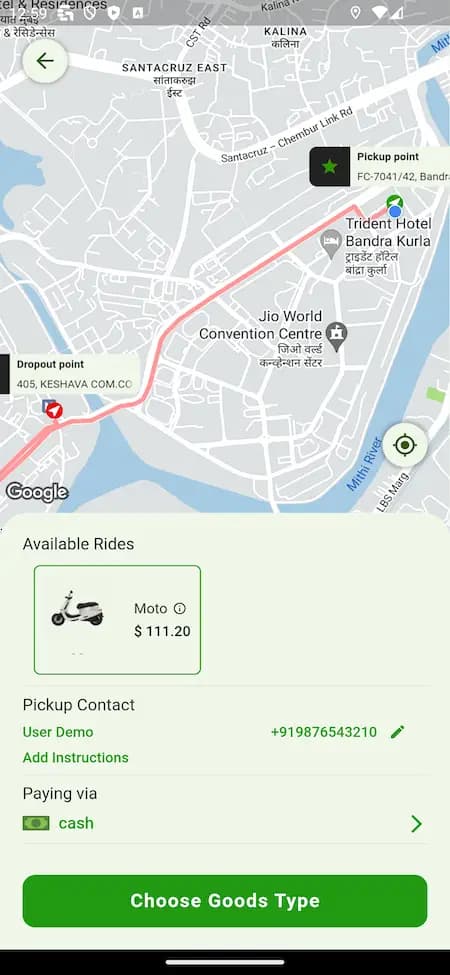
The rider sets pickup and destination, sees an upfront fare estimate across vehicle classes, and confirms booking from wallet, card, or cash.
The dispatch engine scores nearby drivers by distance, ETA, and rating, then assigns the trip with retries handled idempotently so no driver is double-dispatched.
Rider and driver see each other on the live map with a countdown ETA, plus in-app chat or call masked behind platform numbers.
Trip completion triggers the fare calculation, applies promos and surge rules, and charges the wallet, card, or records cash against the driver ledger.
Both sides rate the trip; ratings feed driver gating thresholds and low scores route into the trust-and-safety queue.
Commission is deducted in the ledger, driver and merchant payouts run on the settlement cycle the admin sets, and statements reconcile line by line.
Five model-driven systems working the same job stream. Each ships pre-tuned for multi-service operations and sharpens as your data compounds.
Scores nearby drivers and couriers on proximity, active load, and rating for every ride, food, and parcel job, then re-scores candidates as conditions change.
Provider locations, active jobs, ratings, live traffic
Faster assignments and fewer unassigned jobs across every vertical
Projects order volume per service, zone, and daypart so drivers are positioned before the rush arrives instead of reacting to it.
Order history, zone activity, daypart and weekday patterns
Driver supply matched to demand instead of guesswork
Ranks the service grid and merchant storefronts per customer from booking history, so the home screen sells the next trip before the customer searches.
Booking history, browsing, wallet spend patterns
Higher conversion from open to booked across services
Flags top-up anomalies, collusive trip patterns, and refund abuse before they reach the settlement run.
Top-up sources, trip patterns, refund history
Lower fraud losses and a cleaner wallet ledger
Tunes quest bonuses and peak incentives per city from acceptance and completion data, shaping supply where it thins.
Acceptance rates, zone coverage, incentive costs
Supply balanced at peak without blanket bonus spend
Four groups, each mapped to the part of the multi-service model it protects or accelerates.
One account system and one double-entry wallet across rides, food, and parcels, with top-ups, spends, refunds, and loyalty posting to a single ledger, so balances are spendable anywhere in the app and finance reconciles once.
One supply pool scoring drivers and couriers across every job type with per-vertical dispatch logic and per-city service toggles, so adding a vertical reuses the fleet instead of recruiting a second one.
Merchant panels with menus, pricing, and prep states for food, store tooling for parcels, and structured supply catalogs with document expiry through an approval pipeline, so every vertical runs self-service.
Cross-service ratings feeding driver gating, loyalty tiers rewarding frequency, subscription tiers, and corporate accounts, so the app compounds usage per customer instead of renting each trip from discounts.
platform concepts
Every booking is a state machine. A ride moves through requested, accepted, arriving, in-trip, completed, or cancelled, and each transition is an idempotent event with an actor and a timestamp. Food and parcel orders carry their own states (accepted, preparing, picked up, delivered) on the same event backbone, which is why one admin panel can govern every vertical without one vertical breaking another.
Zone economics set the price of every job. Service zones are drawn in the admin panel with their own fare books, commission rates, and surge rules, so a two-kilometer run and a nine-kilometer run pay the driver differently and cost the rider predictably. Per-city service toggles sit on top of the same zone layer, which is what lets you run rides in one market and add food there later as a configuration exercise rather than a rebuild.
Supply lives in a structured catalog. Driver and merchant profiles carry documents, vehicle classes, commission tiers, and expiry dates through an approval pipeline, and completion rates below threshold trigger automatic review. That catalog structure is what lets you onboard a merchant on different economics, run a launch promotion in one neighborhood, and keep the accounting for all of it clean. For a deeper single-service core, see ride-hailing app development.
insight
The super-app model wins because the marginal cost of the second vertical is tiny once the first exists: one account system, one wallet, one driver pool, and one dispatch engine serve every service, so adding food or parcels to rides is a configuration exercise rather than a new company. Industry analysis of Southeast Asia's platform economy consistently shows that the leaders in the category became durable through exactly this leverage.
The wallet is the compounding asset underneath. Riders who preload balance book more often and churn less, wallet float is a revenue line where regulation allows, and every service the app adds gives the balance one more reason to exist. The revenue table below quantifies the lines a multi-service platform stacks.
revenue model
A super app stacks revenue streams that single-service apps cannot combine: per-trip commission on rides, per-order commission on food and parcels, merchant sponsored placement, wallet float interest where regulation allows, delivery fees, surge uplift, subscription tiers for frequent riders, and corporate mobility accounts billed monthly. Every line above is admin-configurable, so you can tune commission by city, category, or driver tier without a code release.
The wallet is the compounding asset. Riders who preload balance book more often and churn less, which is why the Grab-style model pairs a ride-hailing core with stored value. We integrate regional payment rails, reconciliation, and refund flows so the wallet survives an audit, not just a demo.
Six monetization lines across the platform, quantified against published industry benchmarks. Every rate is configurable in your admin panel; the figures here are modelling inputs, not projections of your platform's earnings.
| Criteria | Revenue line | How it is charged | Typical range | What sets the ceiling |
|---|---|---|---|---|
| Per-trip and per-order commissions | A percentage of every ride, food order, and parcel job, set per service, city, and tier | Ride-hailing platforms commonly take 15% to 25% per trip; food commissions commonly 15% to 30% | Density in every vertical. Shared supply makes each added category nearly marginless to launch | |
| Delivery and surge fees | Delivery fees per order with surge uplift during peak windows | Commonly $1 to $5 per order, multiplied at surge hours | Zone economics. Distance bands and surge rules decide whether peak jobs cost or earn | |
| Merchant sponsored placement | Sponsored ranking and campaign packages sold to merchants | Contract-specific per campaign | Discovery attention across the service grid, which cross-vertical traffic feeds | |
| Wallet economics | Float interest where regulation allows, plus top-up-driven retention | Structural; the line is retention as much as revenue | Wallet adoption. Preloaded riders book more often and churn less, compounding every other line | |
| Subscription tiers | Recurring plans for frequent riders with discounted fees and perks | Subscription tiers commonly priced monthly per user | Ride frequency. Subscriptions pay back when weekly bookings clear the fee math | |
| Corporate mobility accounts | Billed monthly with approval hierarchies, employee limits, and cost centers | Contract-specific per account | Institutional relationships. Enterprise contracts anchor weekday volume across all services |
Standard inclusions on every engagement, almost-ready or custom. Nine things you never have to ask for.
The complete unencrypted codebase transfers to you, with documentation and deployment scripts. No per-ride licensing, no vendor lock-in.
Your logo, colors, typography, and store accounts applied across every panel, plus branded customer communications.
App store and Play Console submissions handled end to end, with production monitoring switched on at go live.
Stripe, PayPal, and regional gateways configured, with automated split payouts across platform, partners, and providers.
Dispatch scoring, demand forecasting, and personalized discovery arrive configured for multi-service operations, not as raw APIs.
Languages, currencies, and tax display configured for your markets during the launch window.
Containerized services on AWS or Azure with autoscaling and queue-backed job intake for peak-hour traffic.
Operations dashboards, finance reconciliation views, and CSV exports so your team starts informed on day one.
Included support window plus product updates covering bug fixes, OS compatibility, and version upgrades.
Chosen for multi-service load, not for a slide deck.
Node.js and NestJS microservices on PostgreSQL, with Redis-backed queues separating dispatch, payments, and notifications so one service never starves another.
Flutter or React Native for rider, driver, and merchant apps sharing one typed API layer; native modules where maps or payment SDKs demand it.
Google Maps Platform or Mapbox with geofenced zones, eta engine, and a matching service that batches nearby requests idempotently.
Stripe, Adyen, and regional gateways (2C2, Xendit, or local equivalents) with ledger-grade double-entry records and separated refund flows.
AWS or GCP with Terraform, Kubernetes autoscaling, and per-service dashboards so dispatch latency is a monitored number, not a support ticket.
POS systems, accounting exports, SMS and WhatsApp providers, mapping, and analytics ship as configured integrations, so the platform plugs into the tools your operations already run on.
Role-based access, append-only audit logs, encrypted traffic and secrets, and rate-limited endpoints come standard, so compliance questions have answers before they are asked.
The almost-ready AI build, day by day. App store review can add a short buffer outside our control, and custom builds take 3 to 4 weeks.
Service categories, cities, payment methods, and commission rules locked with a written scope, and your identity applied across all four panels.
Payment gateways, SMS, currencies, languages, and per-city service toggles configured and tested against your live accounts.
Drivers, merchants, and zones bulk-imported with documents and fare rules, then live test jobs run end to end: booking, dispatch, completion, payout, and receipt.
App store and Play Console submissions with review buffers accounted for, production monitoring switched on, and full launch with post-launch support and product updates included.
Both tracks ship the same dispatch core. The difference is time, price structure, and how much you want to change.
| Criteria | Almost-Ready AI Launch | Custom Build |
|---|---|---|
| Time to live | 6 working days from branding handoff | 3 to 4 weeks, scoped before work starts |
| Pricing | Fixed written quote after a short scoping call, no hourly meter | Estimated per module after the discovery call |
| Source code and IP | 100% ownership on delivery | 100% ownership on delivery |
| AI layer | Dispatch, forecasting, and personalization pre-tuned for mobility | AI services designed around your workflows and data |
| Service verticals | Rides, food, and parcels configured and ready | Any vertical mix engineered to your spec |
| Branding | White-label: your name, colors, and store accounts | Built to your product spec end to end |
| After launch | Post-launch support and product updates included | Post-launch support and product updates included |
$ moxace launch --nowBook a walkthrough and we will demo the dispatch core, the shared wallet, and the admin console on a live build, then send the written scope.
Share your idea
a quick call, no deck required
See the live demo
every screen, admin to user
Launch with source
full code, your brand, your servers
No two launches price the same. These are the factors that shape the written quote you receive after scoping.
The almost-ready AI build covers the proven feature set. Bespoke workflows, custom loyalty schemes, or extra verticals add scoped estimate work.
Service zones, language packs, and currency setups are configured per market. Adding markets means more configuration, never a rebuild.
Payment gateways, POS systems, and regional rails are wired during the build, and each integration is estimated individually.
Out of the box, dispatch, forecasting, and personalization are pre-tuned for multi-service operations. Training models on your historical booking data is an optional, separately scoped workstream.
Each ships as an optional module on the same dispatch and wallet core, scoped separately.
Dark-store and grocery catalogs on the same fleet and wallet, filling midday troughs the dinner peak leaves open.
Where licensing allows: payables, merchant cash advances against settlement history, and deeper wallet services that turn the ledger into a financial product.
Deeper enterprise tooling: departmental budgets, approval chains, and reporting exports that close procurement cycles at larger accounts.
A self-serve merchant advertising console with auction-based placement, monetizing the attention the service grid already commands.
Run the super app as separate country instances with per-market services, currencies, and commission structures, on one codebase you own.
Ready-made speed with custom-build engineering discipline.
Shared wallet, per-city toggles, and vertical dispatch modules are core product logic, not plugins fighting each other.
A ready-made launch costs a fraction of a ground-up build, with a fixed written quote before work starts.
One hundred percent of the source code transfers to you. No per-ride royalties, no black-box dependencies.
Super apps are the most proven multi-service model. For a fully custom platform, see our food delivery app development track.
Canonical deployments from our own portfolio. Metrics are reported from live platforms, not projections.
An on-demand mobility platform from the same engineering system, proving the dispatch core holds under city-wide, real-time load.
A gaming platform from the same engineering system, holding uptime through launch windows and tournament-scale traffic.
A high-traffic consumer platform our team ships and operates at national-carrier scale, the same bar every build is held to.
A super app moves people, food, parcels, and stored value every minute. The controls are built in, and stated plainly.
Top-ups, spends, refunds, and loyalty post as ledger entries regardless of vertical, so balances survive an audit rather than a demo, and every service draws from the same checkable truth.
Bookings move through explicit states with idempotent events, so a retry cannot double-charge a rider or double-book a driver during a network hiccup.
Top-up anomalies, collusive trips, and refund abuse flag before the settlement run, so losses are caught as patterns rather than discovered as write-offs.
Driver gating runs on ratings, completion rates, and document expiry through an approval pipeline, so the fleet's quality is enforced by data rather than by memory.
Commission edits, surge rules, and zone changes write to append-only audit logs, so the pricing riders and drivers live under is reviewable months later.
the process
The engagement starts with a discovery call where we lock service categories, cities, payment rails, and commission logic, then hand you a written quote and a dated launch plan. Once you approve, your branding is applied across all four surfaces, payments and wallets are connected in sandbox, and supply is onboarded with documents verified. The almost-ready AI build goes live in 6 working days; a custom build takes 3 to 4 weeks, planned with you up front.
After launch you have post-launch support and product updates included. The realistic first 90 days look like this: weeks one to four are about driver and merchant onboarding density in your launch zones, weeks five to eight are tuning commission, promo, and surge settings against real demand data, and by week twelve you are deciding which vertical or city to open next from the cohort dashboards rather than from guesswork.
Open the web app, sign in with the printed demo credentials, or install the Android build — no signup, no sales call. What you see is what you launch.
Login: Rider +91 9876543210 | User_321 and driver +91 9876543211 | Driver_321
$ moxace launch --nowBook a free scoping call and get a written plan, a fixed quote, and a launch date inside the 6 to 9 day window.
Share your idea
a quick call, no deck required
See the live demo
every screen, admin to user
Launch with source
full code, your brand, your servers
Moxace is an independent software development company. We are not affiliated with, sponsored by, or endorsed by Grab.
The phrase “Grab clone” is used descriptively. It is how the software industry refers to building a platform with similar functionality, and how buyers search for one.
The design and codebase are built entirely by our in-house team. Nothing is taken from the Grab website, applications, or brand assets.
Grab and all third-party names and marks remain the property of their respective owners, referenced here only to describe the category of software we build.
Read the full legal notice on our disclaimer page.