Free-form task requests
Customers describe any errand in plain terms, with pickup and drop points, item notes, and a quoted price before confirming.
AI-Built Dunzo Clone
An AI-first build of the errand economy: task matching that routes every job to the right partner in seconds, fare prediction that quotes a fair price before booking, and route optimization that chains compatible tasks without breaking their deadlines. Four synced panels ship white-label with 100% source code, owned by you from day one. The almost-ready AI build goes live in 6 working days; a custom build takes 3 to 4 weeks.
Launch-ready from
$2,499
Synced panels
Almost-ready AI launch
Custom build
Source-code ownership
Trusted by the brands we build for



Errand delivery is a matching problem. We engineer the matching.
overview
A Dunzo-style platform is a hyperlocal errand and delivery app: couriers buy what you need from any store, pick up packages, or deliver orders from partner merchants, with no fixed catalog required. It is the anything-done-for-you layer of a city, run by one operator under their own brand.
The purpose is flexibility as a product. Not every job fits a storefront, collecting documents, buying medicine, dropping keys, and an errand model captures that long tail of tasks alongside partner commerce. Operators launch it because errand frequency is high, competition from catalog-only apps is thin, and each task carries a fee the operator sets.
The platform includes the customer app with task descriptions and live tracking, a courier app with task acceptance and proof-of-delivery flows, partner store tools where commerce is enabled, and an admin console for zones, task pricing, courier management, and partner commissions.
Hyperlocal task platforms have proven durable in published coverage of Indian consumer apps precisely because they monetize jobs other models ignore. Cities with dense commerce and unreliable last-mile options are the natural habitat.
The headline layer above the role panels.
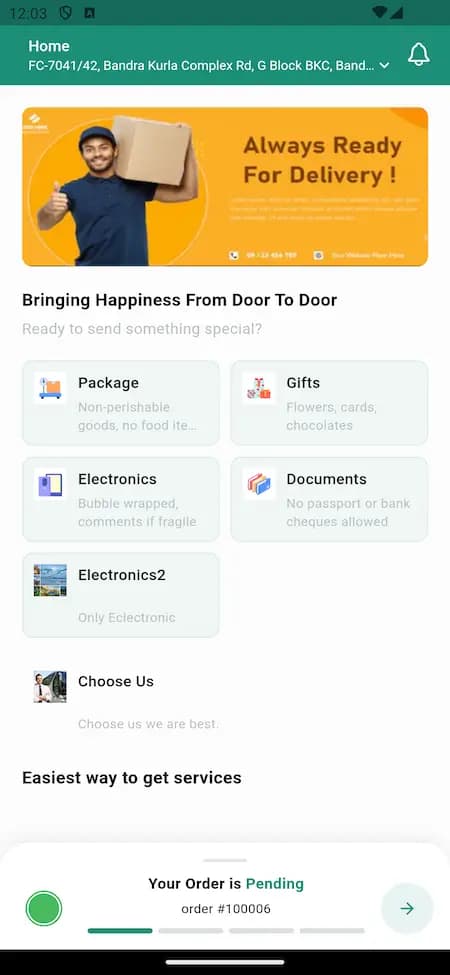
Customers describe any errand in plain terms, with pickup and drop points, item notes, and a quoted price before confirming.
Distance bands, item value, and task type drive pricing, all configurable per zone from the admin console.
Couriers accept tasks with full details up front, including expected purchase amounts and drop priorities.
Couriers pay for purchases and get reimbursed through tracked expense capture with admin reconciliation.
Local merchants plug in as pickup points with their own order flow and commissions.
Customers follow their courier on the map with status updates from acceptance to handoff.
Photos, OTPs, and signatures close every task with an auditable record.
Quotes combine distance, size, and live demand before booking, and the quoted price holds after acceptance.
Compatible tasks are chained into single runs where task type and deadlines allow, raising courier earnings per hour.
What these buyers share: knowledge of their city's errand economy, and the desire to own the platform that monetizes the tasks nobody else will fetch.
Transport entrepreneurs and neighborhood business groups turn city knowledge into a platform that monetizes small daily tasks.
Add consumer errands to business fleets, smoothing utilization between commercial jobs.
Use partner mode for deliveries you currently run ad hoc, with commissions and pickup flows handled by the platform.
Start with low supply-side complexity: errands need couriers and a zone map, not warehouses or vendor negotiations.
Launch the platform for multiple cities on one codebase, with 100% source ownership keeping each deployment independent.
Send-anything, fetch-anything delivery is four products operating as one.
Describe the task, watch it get done.
Partners handle mixed errands without confusion.
Partner stores handle pickup and billable orders.
Run tasks, partners, and cities from one console.
Four consoles, one view of tasks, runners, and money.
City and zone configuration, fare rules by distance and size, surge window administration, and demand forecasting per zone and daypart positioning runners before peaks.
Task assignment and reassignment tooling, live task monitoring with state overrides, dispute resolution bound to task evidence, and exception queues for stuck or unclaimed tasks.
Runner onboarding and verification, earnings and payout dashboards, expense reimbursement review, and quality scoring that feeds assignment weighting.
Merchant partner onboarding and SLA tracking, membership and bundle administration, promotion engine configuration, and finance reconciliation across every settlement path.
The errand journey from request to handover, guarded at every state.
The customer posts a task, deliver a package, pick up a prescription, or buy from a specific shop, described in plain terms rather than chosen from a catalog.
The platform prices the task from distance, size, and time of day, and the customer pays upfront with the quote locked.
A nearby partner accepts the task with the pickup details, item notes, and any cash-handling instructions attached.
The partner confirms at the pickup point, with photo confirmation where the task involves collecting an item from a third party.
Live tracking runs to the drop-off, where proof of delivery or handover confirmation closes the task.
The task settles to the partner's earnings, and any cash collected en route reconciles against the task record.
Five model-driven systems working the same task stream. Each ships pre-tuned for hyperlocal errands and sharpens as your data compounds.
Assigns errands by proximity, active load, and rating, re-scoring candidates as new tasks enter the queue.
Partner locations, task mix, load, ratings
Faster acceptance and fewer unassigned tasks
Quotes fares from distance, package size, and live demand before booking, and the price holds after acceptance.
Distance bands, task types, demand curves
Fair quotes that still cover partner time and distance
Sequences multi-stop runs against live traffic and task deadlines, chaining only what each task type allows.
Traffic conditions, deadlines, task types
More tasks per hour without missed windows
Forecasts partner supply by zone and hour so recruitment and incentives target real gaps.
Partner shift patterns, zone demand, daypart curves
Courier liquidity where and when it matters
Flags task patterns and accounts that suggest fraud or promo abuse before they drain the ledger.
Task patterns, account signals, refund history
Promo budgets spent on real customers
platform concepts
The task model is the defining concept: unlike catalog commerce, the request is a description with pickup and drop points, so the product's job is to price and route an open-ended instruction reliably rather than to merchandise a catalog.
Point-to-point routing is the second concept. Each task is an independent route with its own quote, and the pricing engine has to hold the quoted price even when traffic or distance moves after acceptance.
Partner economics are the third. Earnings accrue per task with per-task time and distance visible, and batching is constrained by task type, because an errand with a pharmacy wait cannot be chained the way two restaurant pickups can.
Four groups, each mapped to the part of the task promise it protects.
Requests captured as descriptions with pickup and drop points, priced by distance, package size, and priority, and routed as independent point-to-point tasks whose quoted price holds even when traffic moves after acceptance.
Assignment weighted by proximity, load, and task type, with reassignment tooling when a task changes hands and batching constrained by task type, because an errand with a pharmacy wait cannot chain like two restaurant pickups.
Earnings accruing per task with time and distance visible, expense reimbursement for runner-paid purchases, COD reconciliation, and weekly payout views that keep the fleet retained.
Merchant pickup and delivery partnerships billed monthly or per order, customer membership plans and task bundles for regulars, and dispute resolution bound to task evidence.
insight
Hyperlocal services and last-mile courier demand keeps compounding past the hundred-billion-dollar mark globally by 2030 on widely cited forecasts, and task-based errands sit at the flexible end of that market: one runner pool serves groceries, pharmacy, documents, and repairs without category-specific supply.
The wedge is pricing integrity and task fidelity: an open-ended instruction must be priced reliably and honored after acceptance, because errands are trust products. Operators who reprice or renege lose both runners and regulars. The revenue table below quantifies the lines.
Six monetization lines across the platform, quantified against published industry benchmarks. Every rate is admin-configurable; the figures here are modelling inputs, not projections of your platform's earnings.
| Criteria | Revenue line | How it is charged | Typical range | What sets the ceiling |
|---|---|---|---|---|
| Task fees | Per-task fees by distance, size, and priority | Fees commonly $2 to $10+ per task | Pricing integrity. Fees hold while quotes stay honored | |
| Surge pricing | Weather and peak-hour surges per zone | Surges commonly 1.5x to 2x at peak | Runner supply. Surge earns while the fleet stays responsive | |
| Merchant partnerships | Monthly retainers or per-order fees for pickup lines | Retainers commonly $100 to $1,000+ per month | Service reliability. Partnerships hold while SLAs keep | |
| Membership plans | Plans and bundles for regular users | Plans commonly $5 to $20+ per month | Errand frequency. Plans hold while tasks stay dependable | |
| Business logistics | B2B same-day and intra-city courier accounts | Contracts commonly $500 to $10,000+ per month | SLA performance. Contracts scale while proof of delivery holds | |
| White-label deployments | Branded instances for regional operators | Deployments commonly $10,000 to $100,000+ | City demand. Deals close while per-tenant config stays cheap |
Per-task delivery fees with distance, package size, and priority components.
Surge pricing during weather and peak-hour windows, configured per zone.
Merchant pickup and delivery partnerships billed monthly or per order.
Customer membership plans and task bundles for regular users.
Every one of these is configurable from the admin panel, so you can tune rates and test new revenue lines without a code release.
Standard inclusions on every engagement, almost-ready or custom. Nine things you never have to ask for.
The complete unencrypted codebase transfers to you, with documentation and deployment scripts.
Your logo, colors, and store accounts across all four panels, plus branded customer communications.
App store and Play Console submissions handled end to end, with production monitoring switched on.
Stripe, PayPal, and regional gateways configured with automated split payouts, expense reimbursement, and COD reconciliation.
Task matching, fare prediction, and route optimization arrive configured for hyperlocal errands, not as raw APIs.
Languages, currencies, and tax display configured for your markets during the launch window.
Containerized services on AWS or Azure with autoscaling and queue-backed intake, so citywide demand spikes never break task creation.
Zone dashboards, finance reconciliation views, and CSV exports so your operations team starts informed on day one.
Included support window plus product updates covering bug fixes, OS compatibility, and version upgrades.
What a hyperlocal task network actually runs on.
Assignment weighted by proximity, active load, and rating, so errands route to the right partner without manual dispatch.
Fare quotes combine distance, package size, and live demand, calculated before booking so customers commit to a known price.
Masked chat between user and partner handles gate codes and package questions while protecting phone numbers.
Containerized services with autoscaling and queue-backed intake, so citywide demand spikes never break task creation.
Accounting exports, SMS and WhatsApp providers, mapping, and analytics ship as configured integrations, so the platform plugs into the tools your operations already run on.
Role-based access, masked contacts, append-only audit logs, encrypted traffic and secrets, and rate-limited endpoints come standard, so trust and compliance questions have answers before they are asked.
The almost-ready AI build, day by day. Store review times can add a short buffer outside our control.
Cities, fare rules, and task types locked with a written scope, and your identity applied across all four panels.
Payment gateways, fare tables, zone boundaries, and languages configured and tested against your live accounts.
Delivery partners verified and merchants imported so launch day has real supply, then test tasks run end to end including a bill-on-behalf errand.
App store submissions with review buffers accounted for, production monitoring on, and full launch with post-launch support and product updates included.
Both tracks ship the same task-matching core. The difference is time, price structure, and how much you want to change.
| Criteria | Almost-Ready AI Launch | Custom Build |
|---|---|---|
| Time to live | 6 working days from branding handoff | 3 to 4 weeks, scoped before work starts |
| Pricing | Fixed written quote after a short scoping call, no hourly meter | Estimated per module after the discovery call |
| Source code and IP | 100% ownership on delivery | 100% ownership on delivery |
| AI layer | Matching, fare, and route models pre-tuned for hyperlocal errands | AI services designed around your workflows and data |
| Task coverage | Parcel, store pickup, and custom errand types configured at launch | Task logic extended to your service roadmap |
| Best for | Operators who want to launch this quarter | Teams with bespoke workflows or a unique model |
| After launch | Post-launch support and product updates included | Post-launch support and product updates included |
$ moxace launch --nowBook a walkthrough and we will demo task creation, fare prediction, and the admin console on a live build, then send the written scope.
Share your idea
a quick call, no deck required
See the live demo
every screen, admin to user
Launch with source
full code, your brand, your servers
No two launches price the same. These are the factors that shape the written quote you receive after scoping.
The almost-ready AI build covers the proven feature set. Bespoke errand flows, wallet features, or blended verticals add scoped estimate work.
City zones, language packs, and currency setups are configured per market. Adding markets means more configuration, never a rebuild.
Regional payment gateways, SMS providers, and mapping services are wired during the build, and each integration is estimated individually.
Out of the box, matching and fare models are pre-tuned for hyperlocal errands. Training models on your historical task data is an optional, separately scoped workstream.
Extend the Dunzo-style build once the core task loop is running.
B2B same-day and intra-city courier products with invoicing, SLA dashboards, and API intake, monetizing the runner pool on contract revenue.
Recurring errands and scheduled pickup windows, converting one-off tasks into predictable, planned runs.
Vehicle-based tasks for rentals, moves, and furniture transport with fare tables by vehicle class, opening the heavier end of errands.
Per-trip insurance coverage wired to the task ledger, the benefit that keeps a gig fleet stable.
Structured reimbursement flows with receipt capture and admin review, the trust layer for runner-paid purchases.
Deploy the platform per city or partner brand under their own identity, with per-tenant fare rules and partner configuration.
Built by engineers who have shipped courier and hyperlocal platforms since 2010.
Task types beyond store orders, like parcel runs and bill payments, are first-class flows rather than workarounds.
Admin dashboards for zone fares, partner rosters, and disputes, because hyperlocal operations run on exceptions.
A fixed written quote, 100% source-code ownership, and no per-task commission to us, ever.
Start with one city and expand zone by zone. For scheduled courier lines, our courier delivery software covers pickup-and-drop formats too.
Canonical deployments from our own portfolio. Metrics are reported from live platforms, not projections.
An on-demand mobility and delivery platform from the same engineering system, proving the matching and tracking core holds under city-wide, real-time load.
A high-traffic consumer platform our team ships and operates at national-carrier scale, the same bar every build is held to.
Tap a card to see how the platform defends its errands.
Each task is an independent route with its own quote, and the pricing engine honors the quoted price even when traffic or distance moves after acceptance, so the number a customer saw is the number they pay.
Batching is constrained by task type, so an errand with a pharmacy wait never gets chained against two restaurant pickups and blown past its promise.
Expense reimbursement flows capture receipts and route through admin review, so runner-paid purchases settle from evidence rather than negotiation.
Assignment, reassignment, state changes, and handover proofs all write to the task record, so disputes resolve against records instead of memories.
Task reassignment logs who took over, when, and why, protecting both the customer's promise and the runner's earnings history.
Merchant partners see pickup-line SLAs and volumes from live data, so contracts renew on measured service rather than sales talk.
the process
The engagement starts with a discovery call on your city, task types, and courier pool, followed by a written scope and fixed quote. After brand handoff we configure task pricing, zones, payments, and partner modes across the panels. The almost-ready AI build goes live in 6 working days; a custom build takes 3 to 4 weeks, planned with you up front.
Launch is not the finish line. You get 60 days of included support and 12 months of updates covering bug fixes and OS compatibility releases. In the first 90 days the work is courier liquidity and trust: recruiting enough partners that tasks get accepted fast, setting fair reimbursement routines for bill-on-behalf errands, and building the repeat habit with early users. Errand platforms win on reliability at the neighborhood level.
Open the web app, sign in with the printed demo credentials, or install the Android build — no signup, no sales call. What you see is what you launch.
$ moxace launch --nowBook a free demo of the Dunzo-style platform and get a written scope.
Share your idea
a quick call, no deck required
See the live demo
every screen, admin to user
Launch with source
full code, your brand, your servers
Moxace is an independent software development company. We are not affiliated with, sponsored by, or endorsed by Dunzo.
The phrase “Dunzo clone” is used descriptively. It is how the software industry refers to building a platform with similar functionality, and how buyers search for one.
The design and codebase are built entirely by our in-house team. Nothing is taken from the Dunzo website, applications, or brand assets.
Dunzo and all third-party names and marks remain the property of their respective owners, referenced here only to describe the category of software we build.
Read the full legal notice on our disclaimer page.