Multi-vendor catalog at scale
Sellers list products with variants and bulk CSV uploads, while search and category pages stay fast under millions of SKUs.
AI-Built Amazon Clone
An AI-first build of the Amazon-style marketplace: recommendations that learn from every browse, listing ranking that steers demand to your best sellers, and fraud signals that protect reviews and payouts. Four synced panels ship white-label with 100% source code, owned by you from day one. The almost-ready AI build goes live in 6 working days; a custom build takes 3 to 4 weeks.
Launch-ready from
$2,799
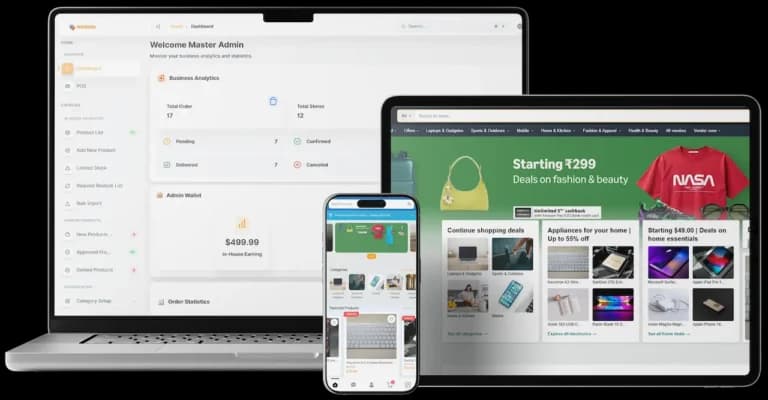
Synced panels
Almost-ready AI launch
Custom build
Source-code ownership
Trusted by the brands we build for



Multi-vendor platforms refined across 9,000+ projects since 2010.
overview
An Amazon-style marketplace is a multi-vendor e-commerce platform: independent sellers list products and run storefronts, buyers browse, review, and order through a unified experience, and the platform operator earns a commission on every transaction while governing quality, disputes, and payouts from a central admin panel. The retailer becomes a platform, and third-party inventory becomes the growth engine.
The purpose for an operator is leverage. A single-seller store caps at the inventory you can hold; a marketplace caps at the sellers you can onboard, which scales far faster and turns category breadth into a moat. Commission income, seller subscriptions, and advertising revenue also arrive with structurally better margins than first-party retail, because the seller carries the inventory risk.
The platform includes a buyer app with faceted search and personalized recommendations, a self-serve seller panel with catalog, order fulfillment, and statement tools, and an admin panel covering vendor approvals, commission rules, payout scheduling, dispute arbitration, fraud flags, and merchandising.
Third-party sellers account for a large and growing share of major marketplace sales according to widely published industry data, and the model keeps expanding into vertical and regional marketplaces where a focused operator can out-curate the giants. Owning the platform means that commission flow lands on your ledger, not Amazon's.
The platform-level capabilities above the role panels.
Sellers list products with variants and bulk CSV uploads, while search and category pages stay fast under millions of SKUs.
Elasticsearch-backed discovery with typo tolerance and ranking weights you tune from the admin console.
Vendors register, pass KYC, and start selling without your team touching a listing, so vendor count scales without headcount.
Per-category and per-tier commission rules with ledger-backed settlements that reconcile to the cent.
Reviews tied to confirmed purchases with seller responses and moderation queues, protecting ranking integrity.
A structured return state machine with admin override, so exceptions resolve on a documented timeline.
Automated flags for review rings, return abuse, and vendor fraud before they distort the marketplace.
Sellable homepage slots and search placement that turn seller demand into advertising revenue.
What these buyers share: buyer traffic or seller relationships already in hand, and the intent to own the platform layer every transaction runs through.
Opening their shelf to third-party sellers converts owned buyer traffic into commission revenue, with the customer data staying yours.
From building materials to pet supplies, depth plus curation beats generalist coverage in focused markets.
Digitizing their vendor networks so every tenant storefront becomes a listing inside one branded platform.
Their category knowledge becomes a marketplace moat, with complementary sellers filling the catalog they cannot hold.
Needing a proven multi-vendor platform to deploy for retail clients across regions, white-label per client.
Three connected surfaces: buyers browse and buy, sellers run storefronts, you operate the network. All synced to one backend.
A storefront experience that converts on mid-range phones and slow networks.
Everything a third-party merchant needs to run a storefront without your intervention.
The control room for commissions, disputes, and platform health.
Four consoles, one view of the marketplace's catalog, cash, and trust position.
Product moderation queues between vendors and the shop front, category tree and brand governance, clearance and restock-alert tooling, and AI catalog-copy budgets with per-feature token accounting, so the storefront stays curated at any vendor count.
Commission rates per category, vendor, and product, vendor subscription tiers, tax classes bound per zone with per-product rules, withdrawal queues, and per-gateway settlement reconciliation across four wallets.
Delivery-agent KYC and approval, assignment and zone management, zip allowlists deciding where checkout is offered at all, COD per-agent balances settled to the operator wallet, and handling-fee rules on cash orders.
Vendor quality scores from fulfillment and defect data, fraud and abuse flags for review rings and return abuse, refund and dispute queues with documented timelines, and revenue dashboards split by every monetization line.
The product journey, end to end.
A seller self-registers, passes KYC and admin approval, then uploads a catalog with variants, pricing, and stock that syncs from CSV or feed.
Faceted search with typo tolerance and personalized recommendations surfaces products; wishlists, reviews, and Q&A build the decision context.
Checkout reserves inventory, charges through the gateway with retry-safe idempotency, and confirms the order into the fulfillment queue.
The seller processes the order, generates shipping labels, and tracking updates flow to the buyer's app at each step.
Completed orders close the sale; returns follow a state machine with admin arbitration, and refunds post back through the same ledger.
Verified-purchase reviews publish with seller responses, commissions deduct in the ledger, and vendor payouts run on the settlement schedule you set.
Five model-driven systems working the same order stream. Each ships pre-tuned for multi-vendor commerce and sharpens as your data compounds.
Ranks the home feed and product carousels per buyer from order history and browsing, so no two shoppers see the same store.
Purchase history, browsing, cart patterns, repeat favorites
Higher home-feed conversion and larger average carts
Orders search and category results by relevance, quality scores, and fulfillment performance, steering demand toward sellers who deliver.
Listing quality, conversion rates, seller metrics
A catalog that stays shoppable as vendor count grows
Projects category demand per region and season so sellers stock ahead and you schedule promotions with evidence.
Order history, seasonal patterns, regional activity
Inventory that meets demand instead of chasing it
Flags review rings, return abuse, and vendor fraud before they distort rankings or drain payouts.
Review patterns, return rates, account signals
Trust metrics buyers can rely on
Models commission rates and sponsored placement pricing against real conversion, so every rate card earns its keep.
Category margins, ad uptake, seller tiers
Revenue lines priced from data, not instinct
Four groups, each mapped to the marketplace problem it solves.
Unlimited-depth category trees, SKU-level variant matrices with their own price and stock, brand and attribute libraries, and faceted search with ranking weights, so a million-SKU catalog stays shoppable.
Four separate wallets (buyer, seller, driver, and platform) with an append-only history per actor, commission deducted at order completion and reversed on refund, and withdrawal queues with per-gateway settlement records, so every balance has an audit trail.
An owned delivery fleet as a first-class identity: assignment feed with accept and reject, live location, status checkpoints, OTP-verified handover, and cash-on-delivery reconciled through its own ledger, turning last-mile cost into a margin line you control.
Verified-purchase reviews with moderation queues, vendor quality scores feeding ranking weights, AI-assisted catalog copy with per-feature token accounting, and loyalty with coupon and wallet combined at checkout.
platform concepts
The order is a state machine shared by three parties. Placed, paid, fulfilled, shipped, delivered, returned: each transition is an idempotent event visible to buyer, seller, and admin, which is why a refund dispute has one timeline instead of three stories. Inventory reserves at checkout and releases on abandonment, so oversells stay rare.
Market economics live in the commission layer. Rules set per category or vendor tier deduct at order completion, escrow-style holds release after delivery windows, and payout batches reconcile to the cent against gateway reports. Vendor statements generate automatically, which removes the support queue that manual marketplaces drown in.
Trust is enforced through the seller catalog. Reviews tie to verified purchases, moderation queues remove abuse, and vendor quality scores from fulfillment speed and defect rates feed the ranking weights, so the marketplace steers demand toward its best operators without manual curation. For storefront-first models, see eCommerce app development.
insight
Third-party sellers account for a large and growing share of major marketplace sales according to widely published industry data, and the margin structure is the reason operators chase the model: commission, seller subscriptions, and advertising arrive without first-party inventory risk, while the seller carries the stock and the fulfillment cost.
The underweighted lever is the last mile. Operators who run their own delivery fleet convert shipping from an invoice they receive into a margin line they control, and in cash-heavy markets the COD reconciliation ledger, a per-agent cash balance settled back to the operator wallet, is the difference between offering cash and drowning in it. The revenue table below quantifies the lines.
Commission on every completed order, set per category or per vendor tier from the admin panel.
Vendor subscription plans with tiered visibility and fulfillment perks.
Sponsored product placements and homepage slots sold to merchants.
Fulfillment and warehousing fees where you operate your own logistics.
Every rate and plan is admin-configurable, so you can tune margins and test new revenue lines without a code release.
Six monetization lines across the marketplace, quantified against published industry benchmarks. Every rate is admin-configurable; the figures here are modelling inputs, not projections of your platform's earnings.
| Criteria | Revenue line | How it is charged | Typical range | What sets the ceiling |
|---|---|---|---|---|
| Commission | A percentage on every completed order, set globally, per category, per vendor, or per product; reversed automatically on refund | Marketplace commissions commonly run 8% to 30% by category | Category mix and vendor density. Per-category rules let you price electronics and apparel differently instead of one flat rate | |
| Vendor subscription tiers | Recurring plans carrying reduced commission rates and visibility perks | Plan prices set per market; the benefit is the rate discount | Seller economics. Tiers sell when the commission saving is provably larger than the plan price | |
| Sponsored placement | Search placement and homepage slots sold to merchants | Auction or fixed-rate per slot; ad lines commonly reach mid-teens percentage of GMV at scale | Search integrity. Placement earns when ranking stays relevant, so sellers keep bidding | |
| Delivery margin | Delivery fees minus courier payout on your own fleet, per order | Set per zone and weight band | Fleet density. Own-fleet economics beat courier invoices only when utilization is managed | |
| COD handling fee | Operator-set handling fee on cash-on-delivery orders | Structural; commonly a flat fee per COD order | Cash exposure. The per-agent reconciliation ledger is what makes offering cash safe to scale | |
| Payment and withdrawal margin | Gateway cost spread and withdrawal processing terms | Structural; a few tenths of a percent on volume | Volume. The margin only matters once transactions compound, which is why the ledger reconciles to the cent |
Standard inclusions on every engagement, almost-ready or custom. Nine things you never have to ask for.
The complete unencrypted codebase transfers to you, with documentation and deployment scripts. No per-order licensing, no vendor lock-in.
Your logo, colors, typography, and store accounts applied across every panel, plus branded customer communications.
App store and Play Console submissions handled end to end, with production monitoring switched on at go live.
Stripe, PayPal, and regional gateways configured, with automated split payouts across platform, sellers, and partners.
Recommendations, listing ranking, and fraud screening arrive configured for multi-vendor commerce, not as raw APIs.
Languages, currencies, and tax display configured for your markets during the launch window.
Containerized services on AWS or Azure with autoscaling and queue-backed checkout for peak-hour traffic.
Sales dashboards, finance reconciliation views, and CSV exports so your operations team starts informed on day one.
Included support window plus product updates covering bug fixes, OS compatibility, and version upgrades.
Stack choices made for catalog scale and checkout reliability.
One codebase for iOS and Android buyer apps, with a Next.js storefront for web SEO so category pages rank from day one.
Idempotent order and payment flows with retry-safe checkout, because double charges kill marketplace trust faster than anything else.
Elasticsearch-backed faceted search with typo tolerance and ranking weights you tune from the admin console.
Gateway integrations with split settlements to vendors, ledger-backed so every commission and payout reconciles.
AWS or Azure with autoscaling and queue-backed checkout, load-tested for sale-day traffic before launch.
Shipping carriers, accounting exports, SMS and email providers, and ERP or POS systems ship as configured integrations, so the platform plugs into the tools your operations already run on.
Role-based access, append-only audit logs, encrypted traffic and secrets, and rate-limited endpoints come standard, so compliance questions have answers before they are asked.
The almost-ready AI build, day by day. App store review can add a short buffer outside our control, and custom builds take 3 to 4 weeks.
Categories, vendor commission model, and payout terms locked with a written scope, and your identity applied across buyer, seller, and admin surfaces.
Payment gateways, shipping APIs, tax rules, and commission tiers configured and tested against your live accounts.
Vendors and catalogs bulk-imported with KYC checks armed, then live test orders run end to end: listing, purchase, fulfillment, payout, return, and refund.
App store and Play Console submissions with review buffers accounted for, production monitoring switched on, and full launch with post-launch support and product updates included.
Both tracks ship the same order and payout core. The difference is time, price structure, and how much you want to change.
| Criteria | Almost-Ready AI Launch | Custom Build |
|---|---|---|
| Time to live | 6 working days from branding handoff | 3 to 4 weeks, scoped before work starts |
| Pricing | Fixed written quote after a short scoping call, no hourly meter | Estimated per module after the discovery call |
| Source code and IP | 100% ownership on delivery | 100% ownership on delivery |
| AI layer | Recommendations, ranking, and personalization pre-tuned for marketplace commerce | AI services designed around your workflows and data |
| Catalog and vendors | Bulk import, KYC, and commission tiers pre-configured | Any catalog or vendor workflow engineered to spec |
| Branding | White-label: your name, colors, and store accounts | Built to your product spec end to end |
| After launch | Post-launch support and product updates included | Post-launch support and product updates included |
$ moxace launch --nowBook a walkthrough and we will demo recommendations, seller tooling, and the admin console on a live build, then send the written scope.
Share your idea
a quick call, no deck required
See the live demo
every screen, admin to user
Launch with source
full code, your brand, your servers
No two launches price the same. These are the factors that shape the written quote you receive after scoping.
The almost-ready AI build covers the proven feature set. Bespoke workflows, custom loyalty schemes, or blended models add scoped estimate work.
Commission tiers, language packs, and currency setups are configured per market. Adding categories or regions means more configuration, never a rebuild.
Payment gateways, shipping carriers, and ERP or POS systems are wired during the build, and each integration is estimated individually.
Out of the box, recommendations, ranking, and fraud screening are pre-tuned for marketplaces. Training models on your historical order data is an optional, separately scoped workstream.
Each ships as an optional module on the same commerce core, scoped separately.
The full deliveryman surface: KYC'd agents, assignment feed, live location, OTP handover, and the COD ledger, for operators who want the last mile under their brand instead of a courier API.
A buyer membership plan bundling free delivery, loyalty multipliers, and early access, billed on the same wallet rails the marketplace already runs.
Product descriptions, SEO titles, tag suggestions, and image alt text generated per listing with token quotas and cost logging, so a million-SKU catalog can be maintained by a small team.
Operator-set exchange rates, polymorphic translation across every surface, per-country delivery rules, and cross-border tax classes, so a second market is configuration rather than a second deployment.
Run the platform as separate branded deployments per client or region, with their own commission tables and admin scopes, on one codebase you own.
Ready-made speed with custom-build engineering discipline.
Split payouts, vendor KYC, and commission tiers are core product logic, not plugins fighting each other.
A ready-made launch costs a fraction of a ground-up build, with a fixed written quote before work starts.
One hundred percent of the source code transfers to you. No per-order royalties, no black-box dependencies.
Multi-vendor commerce is the most proven marketplace model. The same lineage powers our marketplace app development platforms.
Canonical deployments from our own portfolio. Metrics are reported from live platforms, not projections.
A high-volume ordering platform from the same engineering system, with recommendation and settlement engines running at consumer scale.
A gaming and digital-goods platform from the same engineering system, holding uptime through flash-sale-scale traffic spikes.
A high-traffic consumer platform our team ships and operates at national-carrier scale, the same bar every build is held to.
A marketplace's trust is arithmetic before it is policy. These controls keep the arithmetic honest.
Every balance change writes an append-only entry per actor, so no refund, commission, or payout can alter history, only add to it, and any dispute replays from the record.
COD collections live in a dedicated transaction table with per-agent balances, reconciled to the operator wallet on settlement, so cash at the door is accounting rather than a leap of faith.
Stock decrements at the SKU level when the order is placed and releases on abandonment, so oversells stay rare even with several vendors in one cart.
A refund reverses the commission, the wallet entries, and the settlement lines automatically, leaving no balance that nobody can explain.
Review rings, return abuse, and vendor fraud flag before they distort rankings or drain payouts, and the moderation queue keeps the trust signals the AI learns from honest.
the process
The engagement starts with a discovery call that locks categories, commission model, and payout terms, and closes with a written quote and dated launch plan. Once you approve, your branding is applied across buyer, seller, and admin surfaces, payments are connected, and vendors are onboarded. The almost-ready AI build goes live in 6 working days; a custom build takes 3 to 4 weeks, planned with you up front.
Post-launch you have included support and product updates. A realistic first 90 days: weeks one to four are vendor recruitment, because marketplace liquidity is supply-side first, weeks five to eight tune commission tiers and merchandising against real conversion data, and by week twelve you are deciding between advertising products and new categories from the revenue dashboards rather than instinct.
Open the web app, sign in with the printed demo credentials, or install the Android build — no signup, no sales call. What you see is what you launch.
Login: [email protected] or +91 9876543212 | Delivery_$321
$ moxace launch --nowBook a free scoping call and get a written plan, a fixed quote, and a launch date inside the 6 to 9 day window.
Share your idea
a quick call, no deck required
See the live demo
every screen, admin to user
Launch with source
full code, your brand, your servers
Moxace is an independent software development company. We are not affiliated with, sponsored by, or endorsed by Amazon.
The phrase “Amazon clone” is used descriptively. It is how the software industry refers to building a platform with similar functionality, and how buyers search for one.
The design and codebase are built entirely by our in-house team. Nothing is taken from the Amazon website, applications, or brand assets.
Amazon and all third-party names and marks remain the property of their respective owners, referenced here only to describe the category of software we build.
Read the full legal notice on our disclaimer page.