RFQ workflow
Buyers post requirements with quantity and specs, suppliers quote through a structured builder, and accepted quotes convert to orders with full audit trails.
AI-Built Alibaba Clone
An AI-first build of the Alibaba-style trade platform: RFQ matching that routes inquiries to qualified suppliers, verification intelligence that ladders trust, and pricing signals drawn from your own closed trades. Four synced panels ship white-label with 100% source code, owned by you from day one. The almost-ready AI build goes live in 6 working days; a custom build takes 3 to 4 weeks.
Launch-ready from
$3,099
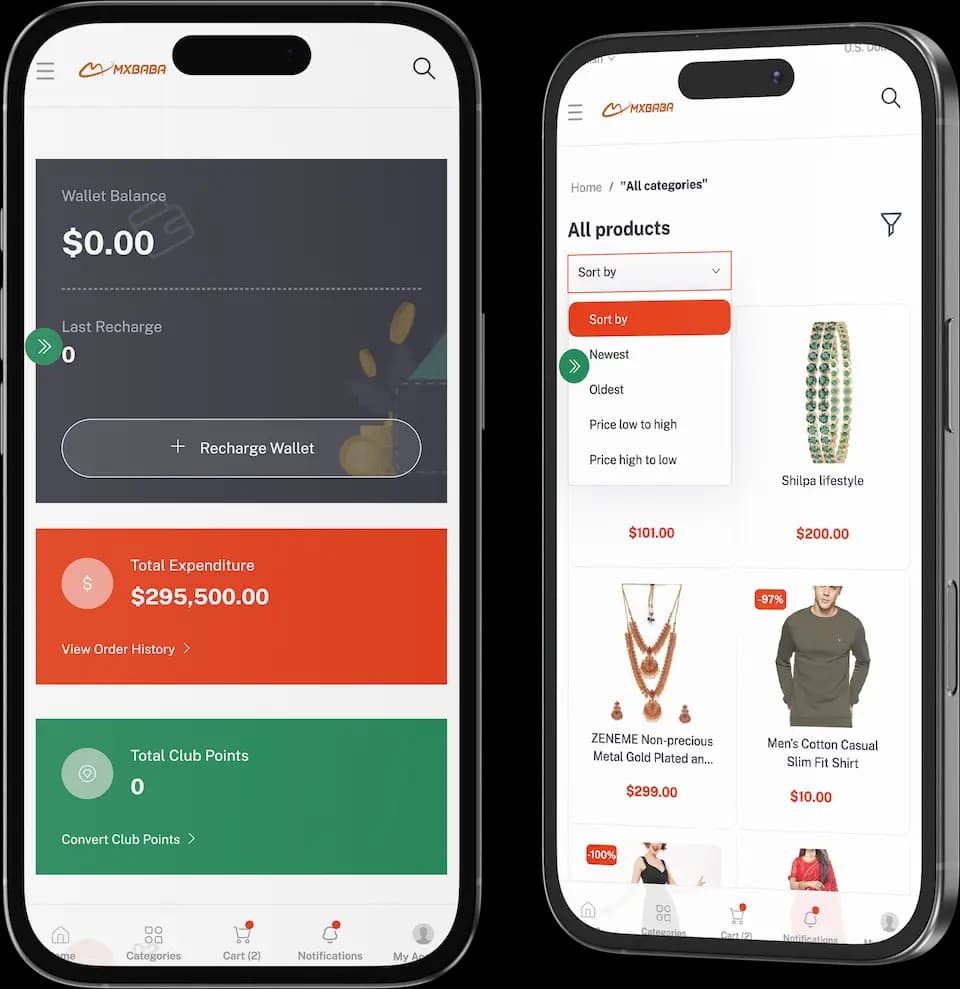
Synced panels
Almost-ready AI launch
Custom build
Source-code ownership
Trusted by the brands we build for



Wholesale trade demands different mechanics than retail carts.
overview
A B2B trade marketplace, in the style of Alibaba, is a wholesale platform where verified manufacturers and suppliers publish catalogs with minimum order quantities and tiered bulk pricing, and procurement teams discover them, request quotations, negotiate, and place large orders with milestone-based shipment tracking. The unit of work is the RFQ, the request for quotation, not the shopping cart.
The purpose is to bring trust and structure to cross-border wholesale trade. Buyers need to know a supplier is real before wiring money; suppliers need qualified inquiries instead of noise. A platform that verifies companies, structures negotiations, and keeps the full audit trail of every quote and shipment turns a relationship business into a scalable one, and charges for that trust at every tier.
The platform includes a buyer app built for procurement (RFQ tracking, supplier comparison, sample orders), a supplier panel with quote builders and certification profiles, and an admin panel operating verification ladders, membership billing, dispute resolution, and trade-assurance rules.
Global B2B e-commerce consistently outpaces consumer e-commerce in total transaction value according to widely published industry analyses, yet most national and vertical wholesale markets still run on trade fairs and WhatsApp. A regional or vertical B2B platform captures that digitization, and the operator earns from memberships, commissions, and the data layer underneath.
The platform-level summary above the role panels.
Buyers post requirements with quantity and specs, suppliers quote through a structured builder, and accepted quotes convert to orders with full audit trails.
Products carry minimum order quantities and volume-based price tiers that adjust automatically as buyers change quantities.
Company documents, certifications, and performance history feed verified and gold badges that display across profiles and listings.
Buyers order samples before committing to container volumes, with the sample history attached to the trade record.
Every message, counter-offer, and document attaches to the RFQ thread, so a disputed shipment has a replayable history.
Production, inspection, and shipping milestones update against the order with versioned documents for customs and compliance.
Subscription tiers, RFQ credits, and commission rules bill through the ledger and report separately.
Region-aware pricing and tax keep cross-border orders and invoices consistent.
What these buyers share: supplier relationships or trade corridors they already understand, and the intent to monetize the trust layer between both sides.
They hold the supplier base and want a digital front door for foreign buyers, with verification badges doing the selling.
Moving their relationship network online, because the platform formalizes what their sales teams already coordinate by phone.
Digitizing import-export corridors with verified company profiles and auditable trade histories.
From textiles to industrial parts, out-curating generalist platforms with depth and certification standards.
Deploying trade platforms for regional clients, white-label with verification ladders configured per market.
Wholesale buyers negotiate, request quotes, and order in container loads. The panels reflect that. All synced to one backend.
Built for procurement teams comparing suppliers, not casual shoppers.
Where manufacturers publish catalogs and win RFQs.
Trust is the product in B2B trade. This is where it is operated.
Four consoles, one view of the platform's supply, trust, and revenue position.
The supplier verification ladder operated end to end: document and certification review, KYC approvals, gold-tier billing, trade-assurance rule administration, and dispute resolution with the full negotiation history attached.
RFQ moderation keeping inquiries genuine, category tree and attribute governance, MOQ and tier-pricing rule administration, and RFQ credit accounting, so the demand side stays worth the supply side's attention.
Membership tier definitions and billing cycles, commission rates per category and tier, RFQ credit pricing, featured-slot rates, and revenue reporting split by every monetization line.
RFQ-to-order conversion by category and corridor, quote-response times and close rates per supplier tier, shipment milestone health, and cross-border settlement reconciliation, generated on schedule.
The product journey, end to end.
Manufacturers submit company documents and certifications, pass admin verification, and publish catalogs with MOQs and tiered bulk pricing.
A procurement team posts requirements with quantity, specs, and target terms, or browses and compares suppliers side by side on trade-history badges.
Suppliers respond through the quote builder; buyers negotiate in chat, order samples, and convert an accepted quote into an order with a full audit trail.
The order locks tier pricing, lead times, and milestone schedules, with multi-currency invoicing computed by the regional tax engine.
Production, inspection, and shipment milestones update against the order, and documents attach with versioning for customs and compliance.
Commissions and membership billing post through the ledger, and performance scorecards update so the next buyer negotiates with real history in view.
Five model-driven systems working the same trade stream. Each ships pre-tuned for B2B commerce and sharpens as your data compounds.
Routes each RFQ to the suppliers whose certifications, capacity, and history fit the requirement, so qualified inquiries crowd out noise.
RFQ specs, supplier capabilities, trade history
Higher quote rates and better supplier retention
Scores company documents, certifications, and performance signals into the verified and gold ladder your buyers filter by.
Registration data, certifications, dispute history
A trust ladder buyers pay to trust
Suggests quote ranges from your own closed trades, so both sides negotiate around a market reference instead of guesswork.
Closed-trade prices, volumes, categories, seasonality
Faster negotiations and cleaner margins
Projects category and regional demand so the platform recruits supply ahead of buyer seasons.
RFQ volume, category trends, regional patterns
Supply recruited before demand arrives
Ranks supplier profiles and listings by relevance, verification tier, and performance, steering buyers toward proven suppliers.
Search queries, conversion rates, verification tiers
A catalog that converts procurement teams
Four groups, each mapped to the part of the trade promise it protects.
The RFQ as the atomic trade unit: structured quote builders, counter-offers in chat with every message and document attached to the thread, and quote-to-order conversion with a complete audit trail, so a cross-border dispute has a replayable history.
MOQ enforcement per product, volume-tiered pricing that adjusts as quantities change, sample orders attached to the trade record, and single-plus-bulk hybrid catalogs serving both procurement teams and smaller buyers.
The verification ladder from company documents and certifications to verified and gold badges, trade-assurance rules governing order types, escrow-style payment protection, and performance scorecards from closed trades.
Production, inspection, and shipment milestones tracked against the order with versioned customs documents, multi-currency invoicing with region-aware tax, and membership plus commission billing through the ledger.
platform concepts
The RFQ is the atomic unit, not the cart, and it is a state machine. Posted, quoted, negotiated, accepted, ordered, shipped: every message, counter, and document attaches to that thread. When a shipment argument starts months later, the platform replays the complete negotiation history, which is what makes cross-border trade auditable.
Market economics run on tiers and milestones. Membership subscriptions bill monthly or annually, commissions apply per completed trade order, and RFQ credits plus featured quote placement monetize the demand side. Multi-currency pricing and region-aware tax keep cross-border invoicing sane.
The supplier catalog is a tiered trust ladder. KYC checks company registration and certifications, verified and gold badges display on profiles and listings, and trade-assurance rules govern which suppliers can take certain order types. Moderation keeps RFQs genuine, because a board full of phantom inquiries kills supplier retention faster than fees ever will.
insight
Global B2B e-commerce consistently outpaces consumer e-commerce in total transaction value according to widely published industry analyses, yet the majority of wholesale trade still moves through trade fairs, brokers, and messaging apps, where pricing is opaque and verification is a phone call. Digitizing that flow is the entire opportunity, and the platform that owns the RFQ thread owns the trade record underneath it.
The wedge for a regional or vertical operator is the trust layer: buyers wire large sums to strangers across borders, and a platform that verifies companies, structures negotiation, and escrows the transaction earns at every tier, memberships on the supply side and commissions plus credits on the demand side. The revenue table below quantifies the lines.
Supplier membership tiers (verified, featured, gold) billed monthly or annually.
Commission on completed trade orders, configurable per category.
RFQ response credits and featured quote placement.
Advertising inventory for logistics providers, inspectors, and trade insurers.
All of it is admin-configurable, so you can adjust membership pricing and commission rates as your supplier base matures.
Six monetization lines across the trade platform, quantified against published industry benchmarks. Every rate is admin-configurable; the figures here are modelling inputs, not projections of your platform's earnings.
| Criteria | Revenue line | How it is charged | Typical range | What sets the ceiling |
|---|---|---|---|---|
| Supplier memberships | Monthly or annual tiers (verified, featured, gold) with visibility and tooling perks | B2B SaaS tiers commonly run $50 to $500+ per month by tier | Trust economics. Tiers sell when the badge demonstrably raises close rates | |
| Trade commissions | A percentage or flat fee per completed trade order, configurable per category | B2B commissions commonly run 1% to 10% of order value, thinner than retail | Order value. B2B tickets are large, so a small percentage still compounds fast | |
| RFQ credits | Prepaid credits for responding to RFQs or posting featured requirements | Credit packs priced per market | Inquiry quality. Moderation keeps RFQs genuine, which is what makes the credits worth buying | |
| Featured placement | Promoted listings and featured quote slots | Priced per slot or bundled in tiers | Search integrity. Placement works when ranking stays relevant to procurement filters | |
| Trade services | Fees on inspection, logistics, and trade-insurance referrals through the platform | Referral or per-service pricing | Corridor depth. The more of the shipment journey runs on-platform, the more the services attach | |
| Advertising | Sponsored inventory for logistics providers, inspectors, and trade insurers | Media-rate dependent; sold per impression or campaign | Audience quality. Verified supplier and buyer attention is exactly what those brands pay to reach |
Standard inclusions on every engagement, almost-ready or custom. Nine things you never have to ask for.
The complete unencrypted codebase transfers to you, with documentation and deployment scripts. No per-order licensing, no vendor lock-in.
Your logo, colors, typography, and store accounts applied across every panel, plus branded customer communications.
App store and Play Console submissions handled end to end, with production monitoring switched on at go live.
Stripe, PayPal, and regional gateways configured, with automated split payouts across platform, sellers, and partners.
RFQ matching, verification scoring, and pricing signals arrive configured for B2B trade, not as raw APIs.
Languages, currencies, and tax display configured for your markets during the launch window.
Containerized services on AWS or Azure with autoscaling and queue-backed checkout for peak-hour traffic.
Sales dashboards, finance reconciliation views, and CSV exports so your operations team starts informed on day one.
Included support window plus product updates covering bug fixes, OS compatibility, and version upgrades.
B2B trade runs on negotiation workflows and audit trails.
Cross-platform buyer and supplier apps from one codebase, with role-based UI per account type.
Quote and order state machines with full audit trails, so a disputed RFQ has a complete history you can export.
Faceted wholesale search across millions of SKUs with MOQ and lead-time filters buyers actually use.
Region-aware pricing, tax rules, and invoicing for cross-border trade.
AWS or Azure with autoscaling and queue-backed document processing, so peak trade seasons stay responsive.
Logistics providers, inspection services, accounting exports, and translation or communication tools ship as configured integrations, so the platform plugs into the tools your trade corridor already runs on.
Role-based access, append-only audit logs, encrypted traffic and secrets, and rate-limited endpoints come standard, so compliance questions have answers before they are asked.
The almost-ready build, day by day. Store review can add a short buffer outside our control; custom builds run 3 to 4 weeks.
Categories, membership tiers, verification requirements, and commission model locked with a written scope, and your identity applied across buyer, supplier, and admin surfaces.
Payment gateways, chat, multi-currency rules, and verification checklists configured and tested against your live accounts.
Suppliers and catalogs onboarded with verification ladders armed, then a full pilot trade runs end to end: RFQ, quote, negotiation, order, milestones, and settlement.
App store and Play Console submissions with review buffers accounted for, production monitoring switched on, and full launch with post-launch support and product updates included.
Both tracks ship the same RFQ and verification core. The difference is time, price structure, and how much you want to change.
| Criteria | Almost-Ready AI Launch | Custom Build |
|---|---|---|
| Time to live | 6 working days from branding handoff | 3 to 4 weeks, scoped before work starts |
| Pricing | Fixed written quote after a short scoping call, no hourly meter | Estimated per module after the discovery call |
| Source code and IP | 100% ownership on delivery | 100% ownership on delivery |
| AI layer | Recommendations, ranking, and personalization pre-tuned for marketplace commerce | AI services designed around your workflows and data |
| Trust ladder | Verification tiers and trade assurance pre-configured | Any verification or financing workflow engineered to spec |
| Branding | White-label: your name, colors, and store accounts | Built to your product spec end to end |
| After launch | Post-launch support and product updates included | Post-launch support and product updates included |
$ moxace launch --nowBook a walkthrough and we will demo RFQ matching, verification, and the admin console on a live build, then send the written scope.
Share your idea
a quick call, no deck required
See the live demo
every screen, admin to user
Launch with source
full code, your brand, your servers
No two launches price the same. These are the factors that shape the written quote you receive after scoping.
The almost-ready AI build covers the proven feature set. Trade-financing integrations, custom verification ladders, or hybrid B2B and B2C models add scoped estimate work.
Membership tiers, commission rates, and language packs are configured per market. Adding categories or regions means more configuration, never a rebuild.
Payment gateways, logistics providers, and inspection services are wired during the build, and each integration is estimated individually.
Out of the box, matching, verification scoring, and pricing signals are pre-tuned for B2B trade. Training models on your historical trade data is an optional, separately scoped workstream.
Each ships as an optional module on the same trade core, scoped separately.
A bot that assists real-time price negotiation between buyer and supplier, anchored to the pricing signals from your closed trades, turning haggling into a structured product.
Interactive 3D booths where suppliers exhibit and buyers walk the floor digitally, with RFQs routing straight out of the stand into the platform's trade engine.
The single-plus-bulk hybrid: consumer checkout riding the same supplier catalogs, so surplus capacity sells retail while wholesale runs in tiers.
Timed auctions, flash deals, and clearance mechanics on wholesale lots, giving suppliers a second price-discovery channel beyond the RFQ.
Natural-language voice search across bulk catalogs, plus cryptocurrency payment support for corridors where traditional rails are slow or expensive.
B2B trade runs on trust. This build engineers it rather than promising it.
KYC ladders, certification fields, and audit trails are core product logic, because trust is what both sides pay for.
Quote builders, negotiation threads, and milestone tracking are designed for wholesale, not squeezed from retail carts.
One hundred percent of the source code transfers to you. No per-trade royalties, no black-box dependencies.
Wholesale digitization is a proven model. Teams often pair this with our marketplace app development and retail software development tracks for hybrid models.
Named deployments from our own portfolio, with metrics reported from production, not projections.
A high-volume ordering platform from the same engineering system, with recommendation and settlement engines running at consumer scale.
A streaming platform our team ships and operates, engineered so premiere-night surges never dent the viewing experience.
A global brand-content platform our team ships and operates, carrying campaign video to worldwide audiences at broadcast scale.
B2B trust is a paper trail before it is a promise. These controls keep the paper real.
Every message, counter-offer, and attached document writes to the trade record with versioning, so a disputed shipment replays the complete negotiation instead of reconstructing it from memory.
Badges compute from company documents, certifications, and closed-trade performance, not from what a supplier claims, and the scoring model updates the ladder as history accumulates.
Trade-assurance eligibility and milestone releases enforce in the backend, so payment protection is a platform guarantee rather than a promise in chat.
Production, inspection, and shipping milestones attach customs and compliance documents with versioning, so audits find answers before they ask.
RFQ moderation keeps the demand board genuine, because supplier retention dies faster from noise than from fees, and the audit trail behind every moderation action stays accountable.
the process
You start with a discovery call that locks categories, membership tiers, verification requirements, and commission model, and receive a written quote with a dated plan. On the almost-ready path your branding is applied across buyer, supplier, and admin surfaces, chat and payments are connected, and the platform launches inside the 6 to 9 day window. Custom work, such as trade-financing integrations, is scoped per sprint.
After launch, included support and product updates cover the early period. The first 90 days are a two-sided liquidity project: recruiting verified suppliers during weeks one to four, seeding qualified buyer demand and tuning membership and RFQ pricing in weeks five to eight, and by week twelve your first closed trades start feeding the performance scorecards that make verification worth paying for.
Open the web app, sign in with the printed demo credentials, or install the Android build — no signup, no sales call. What you see is what you launch.
Login: [email protected] | User_321 or [email protected] | Seller_321
$ moxace launch --nowBook a free scoping call: written plan, fixed quote, and a launch date inside the 6 to 9 day window.
Share your idea
a quick call, no deck required
See the live demo
every screen, admin to user
Launch with source
full code, your brand, your servers
Moxace is an independent software development company. We are not affiliated with, sponsored by, or endorsed by Alibaba.
The phrase “Alibaba clone” is used descriptively. It is how the software industry refers to building a platform with similar functionality, and how buyers search for one.
The design and codebase are built entirely by our in-house team. Nothing is taken from the Alibaba website, applications, or brand assets.
Alibaba and all third-party names and marks remain the property of their respective owners, referenced here only to describe the category of software we build.
Read the full legal notice on our disclaimer page.